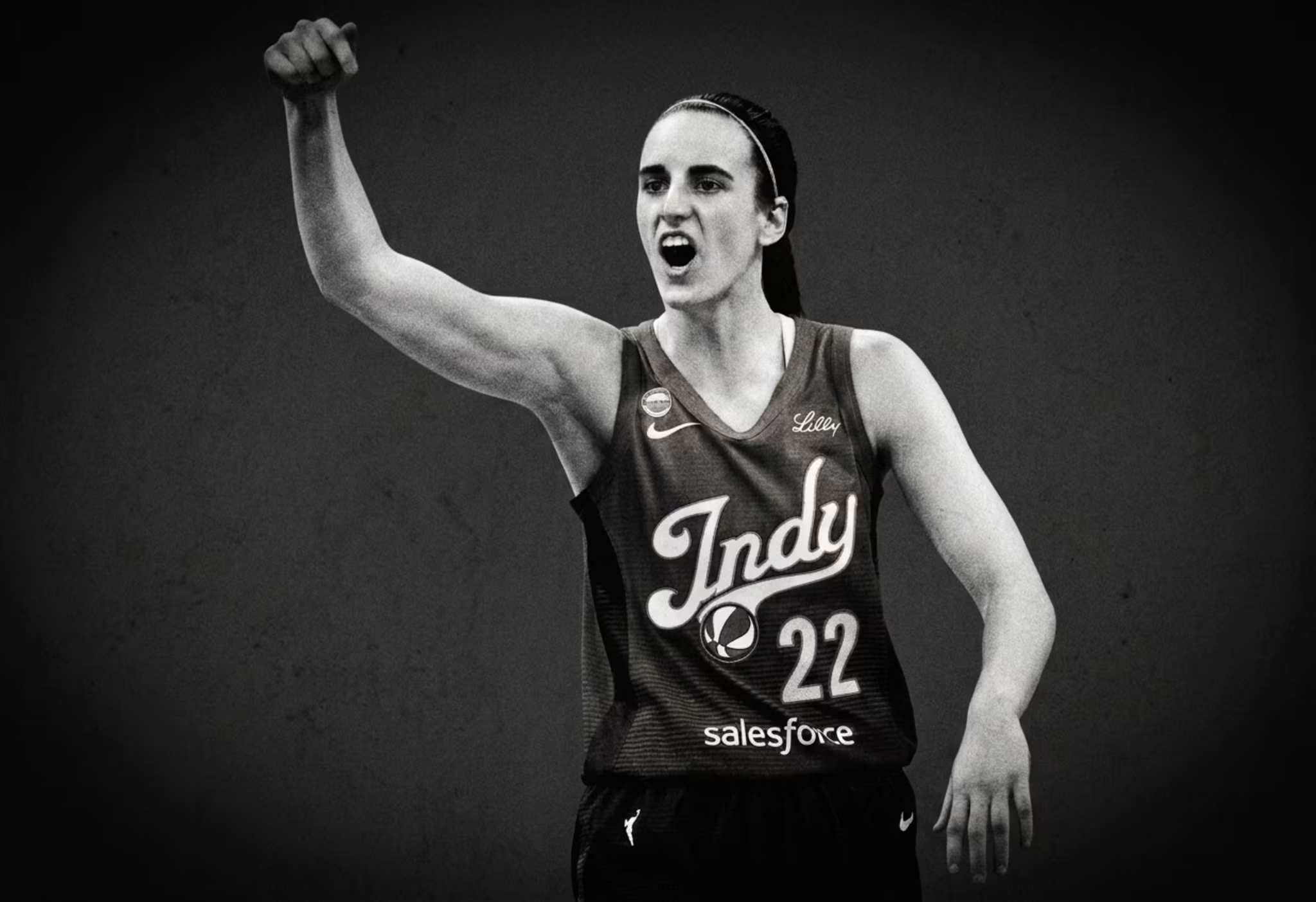
In our attention economy, is there such a thing as the wrong kind of new audience?
Since Caitlin Clark joined the WNBA in 2024, following a college career that made her a pop culture phenomenon, the league has exploded in popularity. Ratings are up, ticket sales are up, merch sales are up. But so are death threats, racist harassment and even sex toy-throwing.
Shop the Basketball collection on Complex
Clark’s arrival in the league has driven a huge spike in male fans: from 2023 to 2024, the percentage of men who said they followed the WNBA “somewhat closely” jumped 10 percentage points. And while male WNBA fans are overwhelmingly Democratic (56% to 27% Republican, the biggest split in pro sports), some of the loudest new fans are on the “My pronouns are ‘kiss my ass’” side of the political spectrum. Take Barstool Sports’ Dave Portnoy, whose WNBA commentary includes calling a recent foul on Clark “ASSAULT.”
While new eyeballs are always welcome, Portnoy, and some of these new WNBA fans seem to be unfamiliar with the WNBA. They are surprised by the league’s physical style of play, or can’t grasp basic basketball strategy, for that matter. So when Clark debuted and became the focus of physical defense, her fans hatched a narrative that WNBA players were jealous of Clark and targeting her with hard fouls. The fact that Clark is white and the majority of the WNBA is not adds another dimension to the story.
Clark’s perceived ill treatment by her fellow WNBA players was a topic that bubbled up occasionally during her first two seasons in the league. But it dominated the conversation heading into the All Star break.
The inciting incident occurred during the Fever’s June 24 game against the Phoenix Mercury. With 6:52 left in the second quarter, Clark and the Mercury’s Alyssa Thomas got tangled up going for a loose ball, and Thomas’ closed fist hit Clark’s neck. Thomas, somehow, wasn’t called for a common foul during the game, but was subsequently given a Flagrant 2 and one-game suspension. Thomas was then the target of death threats and, bizarrely, protests from her own fan base. Then, 11 congressional Republicans sent a letter to WNBA commissioner Cathy Engelbert, demanding the league take “accountability” for the “hostile work environment” surrounding Clark. (No, really.)
There’s a growing backlash to the hysterical defense of Clark as well. In early July, Clark was a trending topic again, this time for her vitriolic treatment of ref Gerda Gatling, and Clark’s recounting of the play in question, which seemed to contradict video of the sequence itself.
It’s all very messy, very heated, and very complicated. And most of it isn’t about basketball. Is the increasingly toxic and non-basketball-related nature of the Caitlin Clark culture wars worth it for the WNBA? Here’s an investigation.
Caitlin Clark Arrival Has Boosted the WNBA Overall
There’s no denying that Clark’s presence has increased the audience for the league. In 2023, the year before Clark joined the WNBA, average per game attendance was 6,615; that number jumped to 9,807 in 2024. There were 154 sellouts in 2024, up from 45 in 2023, and merch sales at WNBAStore.com and the league’s flagship store in NYC were up 601% that year.
The league’s media rights deals have grown exponentially since Clark’s collegiate run at Iowa made her one of the most famous athletes in America. In July 2024, the league signed an 11-year, $2.2 billion media rights deal that started this season, roughly four times the previous deal (it’s since grown with new partners and now averages more than $280 million a year—6.5 times the previous deal).
But She’s Not the Only Reason for Its Recent Success
Clark’s fans often refer to her as “the face of the league” (that’s the phrase congressional Republicans used in their letter as well). But the WNBA’s growing popularity clearly transcends Clark. Yes, viewership for the 2024 WNBA Finals was more than twice that of the ‘23 Finals, but Clark didn’t play in those Finals, the Fever having been swept in the first round. In 2025, the expansion Golden State Valkyries (a team Clark doesn’t play for) sold out all 22 of their home games (Clark played in exactly one of them).
It’s also worth noting that in its early years, the WNBA was extremely popular. In 2002, the league averaged 9,344 fans a game, a number that stood until it was broken in 2025. And the winner-take-all Game 3 of the ‘99 Finals between the Liberty and Comets drew 3.25M viewers, more than twice the average of the ‘24 and ‘25 Finals. The league’s dip in popularity after 2002 coincided with the end of its contract with NBC and move to ESPN and the smaller audience for cable television.
Clark Was Undoubtedly Helpful in the Negotiations for the Players’ New CBA—But the Scope of the Contract Reflects the League’s Overall Health
In March 2026 the league and the players’ union signed a new collective bargaining agreement that included 600% pay increases for some players and a revenue-sharing structure worth close to 20%. The negotiations had dragged on for 17 months, beginning when the WNBPA opted out of the old CBA in October 2024, at the end of Clark’s rookie season.
Clark wasn’t a team rep or on the WNBPA’s executive committee, but she attended in-person negotiations and was a vocal public presence for the union. Her presence at the height of her popularity undoubtedly helped the players’ association leverage, but ultimately the deal was about the overall long-term growth of the league.
The WNBA Has Become an Increasingly Physical League
For evidence that it’s not just Clark who’s involved in physical play, look no further than her now famous teammate Sophie Cunningham. Cunningham has never been more than a role player in the league, yet here she is getting horsecollared by the Chicago Sky’s Kahleah Copper in the 2021 WNBA Finals (called a common foul) and picking up a flagrant for tripping Copper the following year. Cunningham delivered her own hard foul, drawing blood on the Dallas Wings’ Satou Sabally in 2023, took a shoulder to the jaw from Emma Cannon that same year, and went toe-to-toe with current Fever teammate Myisha Hines-Allen in 2024.
The WNBA Has an Officiating Problem, Not a Targeting Caitlin Clark Problem
If the WNBA’s new fans aren’t familiar with the league’s physical style of play and think officiating in the league is inconsistent, they’re not alone. Lots of athletes complain about officiating, but it's endemic in the WNBA. Minnesota coach Cheryl Reeve has been a frequent critic, and earned a one-game suspension for calling the officiating crew’s assignment “malpractice” after a 2025 playoff game. At the 2025 All-Star Game Kelsey Plum criticized the lack of consistency in calls, and Napheesa Collier reached out to commissioner Cathy Engelbert for a private conversation on the state of officiating in the league. Anonymous reports from The Athletic noted that some players and coaches in the league wondered if the league had issued a directive to allow more physical play. And prior to this season the league itself put together a task force of coaches and executives to address the physicality and officiating consistency in the league.
Even if Other WNBA Players Are “Targeting” Clark, That’s Exactly What They’re Supposed to Do
From the moment Clark joined the league, she’s been singled out for physical defensive attention, not because she’s popular (or white) but because she’s slight compared to her backcourt counterparts, and she’s clearly uncomfortable with the attention. It’s something that’s been in her scouting report since Day 1. Before she was drafted, Hall of Fame UConn coach Geno Auriemma noted Clark is “just not built for the physicality of the league,” and her own coach admitted prior to the ‘25 season that “The level of physicality in the W is totally different. That’s the way teams have to try to keep her off balance.”
And It’s a Tactic That Was Used on Michael Jordan
Michael Jordan’s early NBA years share many similarities with Clark’s arrival in the WNBA: a player hugely popular before they became a pro, joining a league enjoying exponential gains in popularity. And Jordan was, famously, subjected to similar defensive tactics that Clark has seen.
Here’s Jordan getting mugged by three Milwaukee Bucks in a 1990 playoff game; here’s Jordan fouled hard repeatedly by the Detroit Pistons over the years. Jordan was able to withstand the rough star treatment. It remains to be seen whether Clark can do the same.
The Online Harassment of the WNBA’s Players—Specifically Its Black Players—Has Gotten Increasingly Ugly
In the wake of her suspension after her foul on Clark, Alyssa Thomas received death threats and was the subject of online racial slurs. Her teammate and partner DeWanna Bonner (the player on the receiving end of Sophie Cunningham’s viral point) was also inundated with violent and racist messages, including messages that featured her family’s home address. Bonner was a former teammate of Clark’s with the Fever, and says the harassment escalated after her less than amicable departure from Indiana. Thomas and other Black players were the targets of racist and homophobic online harassment in 2024 as well, when her then-team the Connecticut Sun defeated the Fever in the playoffs, leading Thomas to call out the Fever fan base by name. Clark has vocally denounced the harassment against Thomas
So Would the W Be Better Off Without Clark?
Probably not. But it wouldn’t shrivel and die without her either. It’s complicated.
The league is enjoying an unprecedented renaissance, fueled—in part—by Clark, but also established stars like A’ja Wilson, Breanna Stewart, and Alyssa Thomas, and young stars like Angel Reese and Paige Bueckers and rookies Olivia Miles and Azzi Fudd. The Fever are enjoying their best season since Clark joined—and she’s third on the team with 2.6 Win Shares, behind Kelsey Mitchell (4.2) and Aaliyah Boston (3.6). And the Fever are drawing a robust 15,575 fans a game—good for third in the W behind the Valkyries (18,064) and Liberty (16,224).
The WNBA just wrapped up arguably its greatest All-Star weekend yet. The game itself set an attendance record, filling the United Center. Fudd won the 3-point contest, Marina Mabrey dropped five 3s in one quarter, and Seattle Storm second-year player Dominique Malonga had a double-double and a dunk. And, yes, Clark hit a few logo 3s and even got a pep talk from President Obama. Good vibes all around (with the exception of DiJonai Carrington’s mentions.) There’s a world in which Caitlin Clark can be the very good player she is, and the league continues its skyrocketing trajectory. Let’s hope we get to that world soon.






