The NBA Playoffs are where ‘amazing happens’ often, yet sneaker surprises are scarce.
Blame it on ring culture or even orthotics. No matter how you slice it, high pressure, bright lights, and intense play are enough to make even the most brazen ballers keep it conservative on foot, sticking to the shoes they wore all season.
But what about the renegades? The alpha dogs looking to pop on television, gain favor with a footwear company, and sell sneakers all summer? Those who are truly willing to get fly or die trying?
Those are our guys. The GOATs, All-Stars, and instigators who defied familiarity to unveil new models, materials, and marketing campaigns in conjunction with chasing a championship.
Ahead of the 2026 postseason, here are the 15 Best NBA Playoff Sneaker Debuts of all time.
Nike Total Air Foamposite Max
Playoff Debut: First Round of the 1998 Western Conference Playoffs
Tim Duncan’s rookie arrival reads like fan fiction when recounted. Averaging 21 and 11 while wearing a barbell tongue-ring, a barely legal TD battled Bulls-era MJ for MVP votes and beat out a prime-health Grant Hill for All-NBA First Team honors immediately at onset.
Nike, knowing the Force camp's future resided in San Antonio, adjusted accordingly. Duncan’s NBA Playoff induction unveiled the Nike Total Air Foamposite Max: an $170 spaceship of a sneaker that upped the ante on Penny’s flagship Foams.
Timmy trounced Phoenix’s frontcourt of Antonio McDyess and Cliff Robinson in his massive moon boots, dropping 32 and 10 in the Total Air Foamposites. Matching mentor and Force forefather David Robinson in the David Stern-approved White/Black PEs, fans would have to wait until August to cop the metallic-silver retail rendition.
Adidas AE1 Low
Playoff Debut: First Round of the 2024 Western Conference Playoffs
Anthony Edwards brought out the Adidas AE1 Low—and the brooms—for his third-ever NBA Playoffs series. Facing off against childhood hero Kevin Durant and the Phoenix Suns, Ant’s alpha ascent hit full steam as his peach-toned marketing aura was backed by belt-to-ass postseason play.
Dropping a game-high 33 points in his new low tops, Edwards not only dogged the Suns in the drop-top take on his heralded high tops, but he also added a whole new range for his signature franchise.
Stat sheets and shopping carts both filled up as “Acid Orange” and “Lucid Lime” Lows caught fire all the way into the Western Conference Finals, the AAU’s hot summer circuit, and back-to-school fit pics.
Nike Hyperfuse
Playoff Debut: First Round of the 2010 Eastern Conference Playoffs
“Playoff Rondo” cut his teeth as both the steering wheel and fourth option for the Big 3 Boston Celtics in 2008 and 2009. By 2010, the Reebok rotator-turned-Elite Ekin was alternating retro Jordans and modern Foamposites in Beantown despite being one of the fastest end-to-end point guards in the league.
Approach and aesthetic aligned in 2010 by way of Rondo rolling out the Nike Hyperfuse: a featherweight flagship model drawing on the Hyperdunk’s dominance. PE pairs of the green, black, and white variety outfitted the head of the Celtics snake, who dissected defenses by averaging a double-double in the first two rounds of the 2010 NBA Playoffs.
While the Los Angeles Lakers would defeat the Celtics in seven games in the 2010 NBA Finals, Rondo remained synonymous with the Hyperfuse, as it soon saw use across FIBA action and NCAA play in the season that followed.
Converse AS 91
Playoff Debut: First Round of the 1997 Eastern Conference Playoffs
Dennis Rodman may have worn a white dress to his August 1996 book signing, but trust, The Worm was no playoff virgin. On the contrary, the reborn Rodman had balled out in the postseason in nine of his first ten years in the league, going deep in Detroit, San Antonio, and Chicago alike.
The bankable longevity and outsized personality made Rodman the perfect, pierced pitchman for Converse, headed into the 1997 NBA postseason. Years removed from Larry Bird, Magic Johnson, hell, even Larry Johnson, Rodman was a radical rebrand for the heritage hoops company.
It worked. Seizing the moment, Converse bet big on the Bulls’ success and Rodman’s tabloid virality to debut his signature AS 91 in the 1997 NBA Playoffs. Sporting sunglasses on the sideline and wreaking havoc on the court, Rodman won his fourth NBA Championship in his first of three signature shoes from Converse.
Nike LeBron 9 PS Elite
Playoff Debut: First Round of the 2012 Eastern Conference Playoffs
Michael Jordan may have invented the ‘playoff’ colorway at retail, but LeBron James could be credited for conceiving the playoff shoe across the industry. Rather than introduce a black-based variation of his regular-season silo for the postseason, Bron used the elevated stage to stretch the power of his brand.
Early on, Zoom 20-5-5 and Zoom Soldier sneakers positioned james as the unselfish star, content to shelve his flagship signature for his self-branded team shoe when the lights got brightest. Weird flex for sure, but a savvy business move for a guy with AAU and NCAA scale.
By the time of the LeBron 7 and LeBron 8, PS and V2 variations of those shoes shifted the strategy, rolling out for the playoffs and characterized by lighter tech construction. The concept hit its peak in Miami through the PS Elite series: a line that soon expanded to include Kobe, KD, and Hyperdunk drops.
Teflon takes—quite literally—on the LeBron 9 and later models introduced tougher, more angular iterations of the inline, properly backed by metallic accents and heightened prices. At retail and on court, the Nike LeBron 9 PS Elite immortalizes the King’s first championship in South Beach and an era when top-dollar basketball shoes, distressed denim, and deep-fried filters all existed in harmony.
Nike Hyperflight
Playoff Debut: First Round of the 2001 Western Conference Playoffs
Entering the 2001 NBA Playoffs, Allen Iverson was excelling at Reebok in wave caps while Michael Jordan was running the Wizards in suits. Nike Basketball’s signature roster was reduced to Scottie Pippen, Jason Kidd, and Gary Payton—all All-Stars ascending in age and sharing Morph Skin models.
Enter Jason Williams: a high-dribbling highlight machine who surpassed Sacramento’s small-market stature to become a league leader in jersey sales. While a proper signature shoe evaded White Chocolate with the Kings, Nike’s patent-leather dipped Hyperflight was effectively his.
Blasted by Bill Walton and adored by the youth, the shiny shoes jumped off the TV upon their 2001 NBA Playoffs arrival. Williams wore black and purple PEs in rounds one and two, taking down J Kidd’s Suns before being swept by the Shaq and Kobe Lakers.
Jordan Luka 1
Playoff Debut: First Round of the 2022 Western Conference Playoffs
It took Luka Dončić only two seasons to become an All-Star and roughly twice that time to become a signature athlete. Arriving at Jordan Brand after a Nike debut and flirtation with Under Armour, Luka led the Air Jordan flagship line and the slept-on Zoom Separate before landing his own shoe.
The timing worked out for all parties when the Jordan Luka 1 debuted during Round 1 of the 2022 Western Conference Finals. After missing the first three games of the opening round due to a strained left calf, Luka led the Mavs all the way to the Western Conference Final in his inaugural signature shoe. To this day, the Jordan Luka 1 is beloved by ballers of all levels and Dončić himself.
Under Armour Curry 4
Playoff Debut: 2017 NBA Finals
Under Armour knew they had an All-Star in Stephen Curry, but did anyone expect a unanimous MVP with a full-time residency in the NBA Finals? If so, speak now.
The late-stage-signature arrival of Steph and the assumed occupancy of the sport’s biggest stage led UA to double down on their pace. A signature shoe each season? Nah, more like two in a year, aiming to create a back catalog in real time and feverishly feed an ADHD market.
Such was seen on the Under Armour Curry 4: a sleek signature unveiled in Game 1 of the 2017 NBA Finals. Far fresher than the Curry 3 and 3.5 before it, the Curry 4 carried Steph in the gentlemen’s sweep of LeBron and company. Averaging a near triple-double in his fourth signature, the big stage debut revived the flatlining line while the world watched.
Nike Zoom Soldier 1
Playoff Debut: First Round of the 2007 Eastern Conference Playoffs
A $90 million Nike deal was never meant to move strictly $140 signature shoes and $25 Witness tees. A LeBron Brand built to scale would see sponsored schools, team shoes, baller bands, and diffusion lines made for the masses. It would happen like Mike, just sooner and wider.
This proved true in 2007 when a 22-year-old LeBron led the Cleveland Cavaliers all the way to the NBA Finals. In only his fourth season and second postseason, King James was dismantling Detroit and taking on a San Antonio dynasty for a chance at his first Larry O’Brien trophy.
As alluded to before, he wouldn’t do it in conventional LeBrons. The Nike Zoom Soldier introduced a battle-tested team concept that would be synonymous with playoff arrivals and school scaling. The strapped original debuted in Game 1 of the 2007 Eastern Conference Playoffs and appeared in every round after, immortalized by the 25-straight-point pounding of the Pistons.
Adidas Crazy Light
Playoff Debut: First Round of the 2011 Eastern Conference Playoffs
When carrying the weight of a starved city on your heart and a $17.5 billion brand on your back, your shoes better be light. Maybe even Crazy Light.
Such was the case for Derrick Rose, who entered the 2011 NBA Playoffs as the homegrown hero leading the Chicago Bulls while moonlighting as the breadwinner for Adidas Basketball. Despite having his own signature shoe—and its 1.5 iteration—smoking at retail, the face of the Three Stripes showed his Herzog team spirit by debuting the Adidas Crazy Light.
Coming in at a slight 9.8 oz, the Crazy Light was a watershed moment for Adidas, backed by the youngest MVP in NBA history. Derrick didn’t disappoint with the weight of debut duties, demolishing the Pacers 4-1 before returning to the Rose 1.5 against Atlanta and Miami.
Nike Air More Uptempo
Playoff Debut: First Round of the 1996 Eastern Conference Playoffs
The Nike Air Barrage might not be on your Mount Rushmore of Golden Era Swoosh sneakers, but it sure was on the mood boards of Foot Locker execs. As former Nike Footwear Product Director David “Boot” Bond recalled on The Designasty Podcast, the Marshall Faulk-favored trainer was retail gold simply because of its “A-I-R” midsole tagging.
As an on-the-nose parody of the sales-hungry suits, Bond and Nike designer Wilson Smith sketched the Nike Air More Uptempo: an intentionally shameless send-up of the Barrage branding, engineered to take over basketball courts and sales registers.
All good jokes contain truth, as the More Uptempo absolutely smoked, speaking to the souls of hoop-obsessed kids craving big branding and visible tech. Per usual, Nike’s marketing was right on time, debuting the More Uptempo on the fast feet of Scottie Pippen in the 1996 NBA Playoffs.
Pippen played the entirety of the 1996 postseason in the all-new More Uptempos, capping off a historic 72-10 season in black nubuck billboards. By the time he hoisted his fourth championship trophy, the More Uptempos were ringing off at Foot Lockers and appearing in the Olympics. Marketing gold, indeed.
Puma Hali 1
Playoff Debut: 2025 NBA Finals
Half meme, half amazing, Tyrese Haliburton capped off a rollercoaster ride of USA Basketball bench splinters, shaky season start, and unbelievable buzzer-beater after unbelievable buzzer-beater in the 2025 NBA Playoffs to what appeared to be the only obvious outcome of such a theatric path: a signature shoe debut in the NBA Finals stamped by, you guessed it, another unbelievable buzzer-beater.
The spiritual successor to Reggie Miller took his NYC villain antics to OKC in late June, downing the Thunder in his first wear of the Salehe Bembury-designed PUMA Hali 1. The hibiscus-hued sneakers blossomed into one of the best and most unexpected stories the NBA Finals have ever seen, sadly ending in an Achilles’ rupture for Haliburton early into the deciding Game 7.
Nike Zoom Soldier 10
Playoff Debut: 2016 NBA Finals
Perhaps the biggest critique of LeBron James’ career is his implied intent to control the narrative. Being incredibly bright and calculated in both basketball and business has led to fewer surprises or risks than those of his predecessors, creating many “wow” moments but fewer “did that just happen?” moments.
The defining moment of his storybook career—thus far—is not The Decision but rather the 3-1 comeback against the 73-9 Golden State Warriors. Looking for revenge, King James clawed his way back to what was considered an insurmountable deficit against the defending champs, who beat him in the Finals just one year prior.
The element of surprise came not just from the unprecedented outcome, but also from an unexpected risk. In Game 3 of the NBA Finals, James jumped ship from his signature Nike LeBron 13 Elite to debut the never-before-seen Nike Zoom Soldier 10. Unveiled in triple-black wear-test form and later with static straps and gold accents, the brazen switch shocked footwear fans and eventually the Warriors. The bold bet played off, seeing LeBron at his most vulnerable and most victorious on the sport’s grandest stage.
Air Jordan 14
Playoff Debut: 1998 NBA Finals
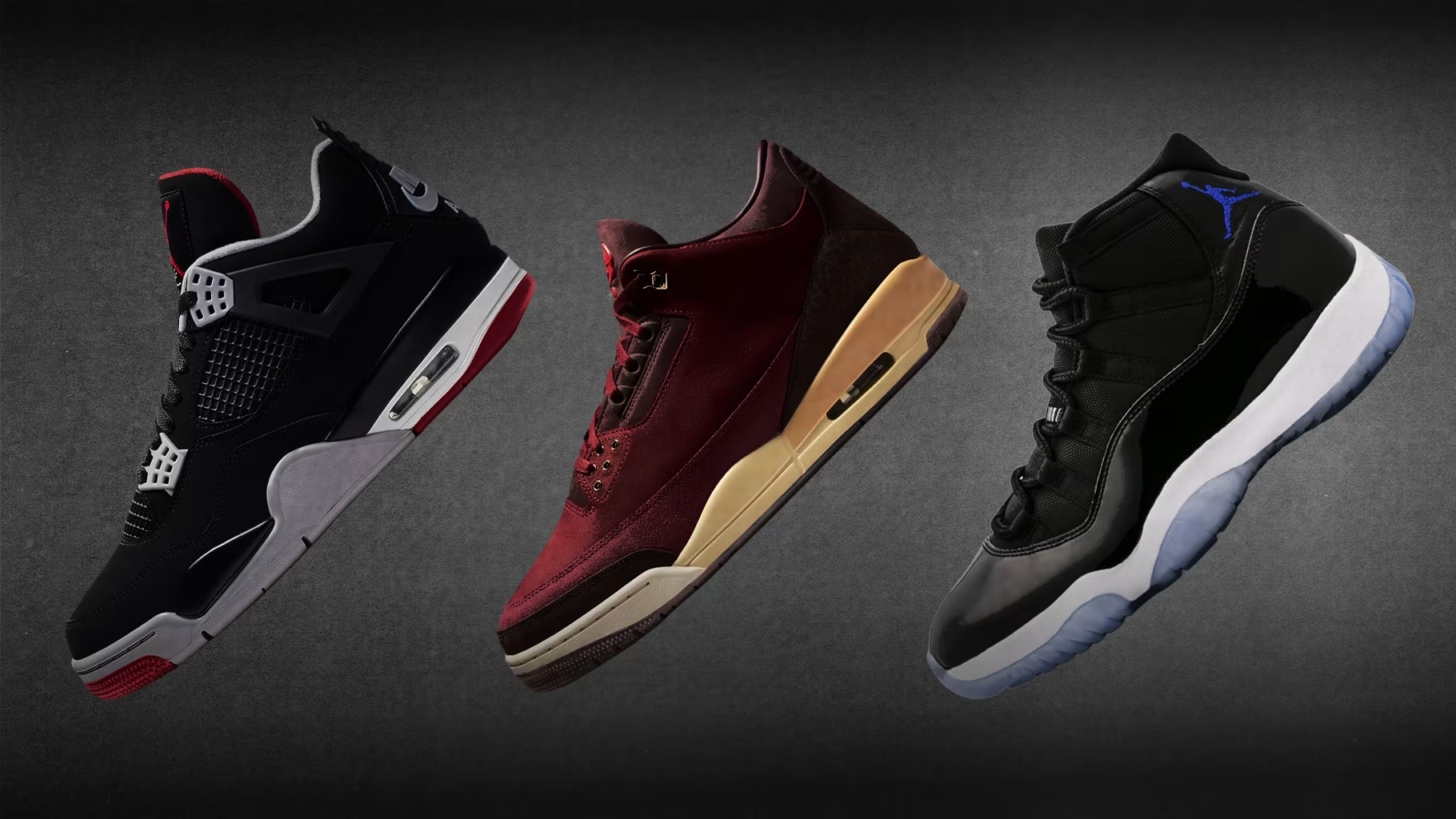
Over 29 million nightly viewers—a record that still stands today—tuned in each night of the 1998 NBA Finals. Naturally, Michael Jordan, the newly-named leader of his namesake Nike subsidiary, used the grand stage, and backstage, to debut the shoes that would immortalize his legacy and provide his pension in retirement.
The Air Jordan 14 arrived at the most-watched NBA Finals ever, but not on court. MJ wore test pairs of “Black Toe” and “Candy Cane” colors in the tunnels of the Delta Center before breaking out the Black/Red rendition that would be mythologized in real time.
Introduced at home in Game 3 of the NBA Finals and brought back out for Game 4 and Game 6, the Ferrari-inspired shoes steered the step-back footwork on what’s now known as “The Last Shot,” providing a storybook ending for MJ the Bull and laying the tracks for his billionaire ascent.
Air Jordan 11
Playoff Debut: Second Round of the 1995 Eastern Conference Playoffs
The great Rosie Perez once articulated that “winning or losing is all one organic mechanism, from which one extracts what one needs.” Thus, not only are there wins in losses, or even lessons in ties, but success is not necessarily binary nor linear.
We’re not sure if Michael Jordan ever watched White Men Can’t Jump, but we’re pretty positive he was mad as hell when the Orlando Magic were partying on his comeback campaign. Ridiculed for his new number and rusty touch, the GOAT did what any rational hooper would do during an identity crisis or shooting slump: he got new shoes.
The Air Jordan 11—crafted in secret by Tinker Hatfield, poo-poo’d on by Nike execs, and even questioned by consumer focus groups—was never meant to happen, let alone be worn by MJ months before its eventual release. Never fond of fitting in, Jordan used Round 2 of the 1995 Eastern Conference Playoffs to show up Shaquille O’Neal and Penny Hardaway’s upstart squad and attempt to get his mojo back.
He lost. Orlando defeated Chicago 4-2, and the NBA fined MJ for wearing the “Concord” colorway that disobeyed David Stern’s postseason dress code. As we all know, the big bet on both himself and his brand paid off as MJ spent the summer sharpening his tools against pros, all while filming a $250 million blockbuster.
By October, the Air Jordan 11 was evaporating at retail, and the Bulls began running off a historic 72-10 season that started their second three-peat. The Air Jordan 11 is an institution on court, in culture, and in stores to this day, proving that success isn’t always instant or linear, and that the biggest wins can come from loss, just as Rosie revealed.