Key Takeaways
- On May 1, 2026, NIGO unveiled “NIGO: From Japan with Love,” a new exhibition at the Design Museum in London that documents his 30-year career. The opening was marked with the release of his first Nike Air Force 1 collab inspired by “Last Orgy 2,” the massively influential Japanese editorial series founded by NIGO and Jun Takahashi in the ‘90s.
- This feature traces NIGO’s legendary career in streetwear from a magazine-obsessed kid in Maebashi to a culture-shaping designer. It explores highlight from his co-founding of NOWHERE to founding of BAPE to Human Made’s rise to his appointment at Kenzo.
- Along the way, NIGO has collaborated with other cultural icons like Pharrell, Marc Jacobs, and Virgil Abloh. He has also worked with a wide range of notable brands, from Pepsi to Nike to Louis Vuitton.
On May 1, NIGO unveiled “NIGO: From Japan with Love,” a new exhibition at the Design Museum in London that documents his illustrious career in streetwear.
The legendary Japanese designer has been cultivating his own version of luxury for decades. From his era-defining tenure at BAPE to his more recent collaborations with Virgil Abloh for Louis Vuitton, NIGO has long been at the forefront of making streetwear feel like a coveted commodity, a new form of luxury that only in recent years has been adopted by purists in the luxury word.
Perhaps Pharrell said it best, speaking to Complex back in 2013, “NIGO is a sage, an unstoppable force that will always continue to inspire.”
From growing BAPE into a cultural force in the 2000s to his first official Nike Air Force 1 collaboration in 2026, here is A Timeline of NIGO's Career Highlights.
NIGO’s Upbringing
NIGO was born in 1970 as Tomoaki Nagao to a mother who was a nurse and a father who was a metal fabricator. Despite the impact he’s made within fashion, Nagao was not a formally trained fashion designer. Originally from the city of Maebashi in the Gunma Prefecture of Japan, Nagao said he first became interested in fashion by reading the influential Japanese men’s fashion magazine Popeye. In an interview with Pig, Nagao said he was first drawn to the ‘50s Americana fashion trend that took over Tokyo in the ’80s before admiring the style of rap artists such as Run DMC in his later teenage years.
Inspired by the many Japanese fashion magazines he grew up reading, Nagao moved to Tokyo when he was 18 to study editorial at the Bunka Fashion College, with aspirations of becoming a fashion journalist. One of the magazines he grew up reading was Takarajima, a street culture magazine which included a monthly column called “Last Orgy.” Written by Kan Takagi and Fragment Design founder Hiroshi Fujiwara, “Last Orgy” highlighted the eclectic interests of two influential Japanese tastemakers. Fujiwara was a prolific influencer who popularized Western streetwear brands like Stüssy and hip-hop culture within Japan. In interviews, Nagao said he was obsessed with Fujiwara’s column. While attending Bunka, Nagao befriended the Japanese fashion designer Jun Takahashi, who formally introduced Nagao to Fujiwara in the late ‘80s. Nagao became so close to Fujiwara that those in the influencer’s inner circle began noticing they looked alike. So, Nagao was nicknamed to be Fujiwara’s “NIGO,” which translates to “number two.”—Lei Takanashi
NIGO and Jun Takahashi Launch “Last Orgy 2”
NIGO made his first official entrance into fashion the same way he was introduced to it: a magazine. After linking up with Fujiwara, NIGO got down with Popeye to work as a stylist and writer. Alongside Takahashi, NIGO wrote a column dubbed “Last Orgy 2,” which carried on the spirit of Fujiwara’s and Takagi’s columns. NIGO’s experience in magazines served as a catalyst to his work as a fashion designer. “It was a great experience in that I was able to learn and experience editing, photography, writing/composition, editorial, etc. I actually have never studied fashion at university or otherwise,” said NIGO in an interview. “It was through editorial and that experience that I started to make clothing, and all of this has led to now. Things like street culture were born out of these experiences. I don’t draw or sketch designs either.”—Lei Takanashi
NIGO Opens NOWHERE and Founds BAPE
After spending time writing about fashion and other cultural happenings for various magazines with Takahashi, the duo soon decided to open their first business venture. In 1993, NIGO and Takahashi opened the NOWHERE store in “Urahara” or “the hidden Harajuku.” One half of the shop served as a retailer for Takahashi’s punk-inspired label Undercover, while the other half of the shop sold a selection of curated goods by NIGO such as Adidas Superstars. Although Takahashi’s Undercover garments were moving, NIGO’s curated wares were not selling as well. So after being inspired by some Planet of the Apes films, NIGO conceived A Bathing Ape (BAPE) along with the graphic designer Sk8thing in 1993. During the first two years, NIGO produced T-shirts in small batches of 30 and only sold half of them so he could give the other half to friends. According to an article by Ametora author W. David Marx, “half the kids in Harajuku had an Ape head on their back, and the other half were waiting in enormous lines outside of NOWHERE to get their own.” By the end of the ‘90s, BAPE had collaborated with major brands like Pepsi, revered artists like Futura, opened six stores in Japan, and was pulling in 2 billion Yen annually. —Lei Takanashi
NIGO Introduces The Bape Sta
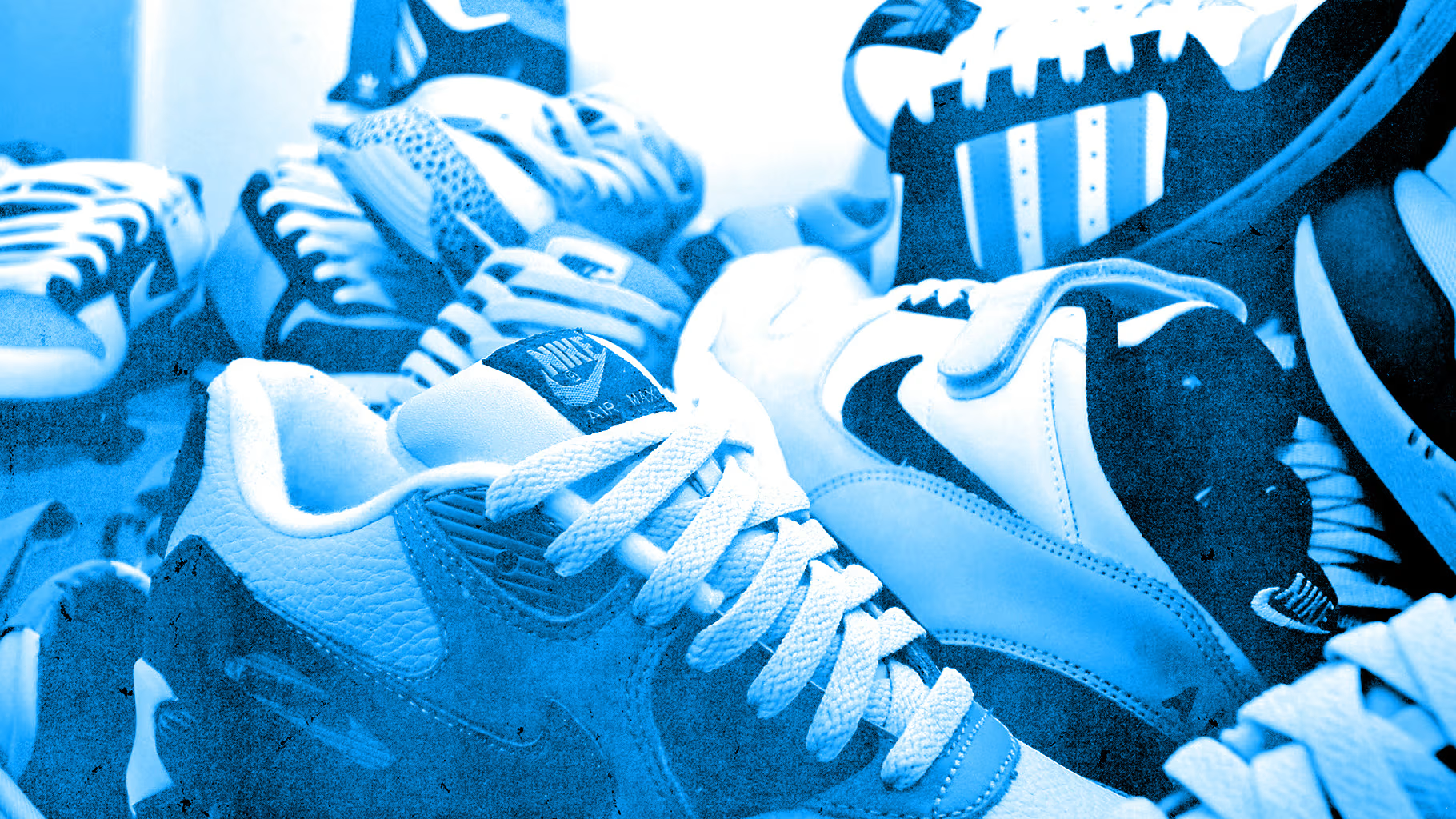
NIGO released the Bape Sta sneaker, which was a riff on Nike’s classic Air Force 1, in 2002. He updated the silhouette with a star and lightning zap, which replaced the Nike swoosh. APE and BAPE on the sole replaced the AIR text. When NIGO released the sneaker, Air Force 1s were a staple, but they weren’t exactly a canvas for creativity. Dapper Dan was known for customizing them with designer logo fabric in the 1980s, but outside of that they were relatively basic unless they were customized. NIGO changed that with the Bape Sta, releasing the sneaker in new fabrications like patent leather, and interesting color combinations. He also turned them into collectors’ items by collaborating with artists including Kanye West in 2007, a couple of years before he would partner with Nike, and KAWS in 2005, a few years before he would work with Supreme and Nike on an AF1 design. Other notable collaborators included SpongeBob, N.E.R.D., DC Comics, and Marvel. NIGO helped elevate the sneaker into a collectible luxury item. —Aria Hughes
NIGO Opens First BAPE Store in the United States
When Bape arrived in SoHo in 2005, NIGO had already established an innovative retail footprint across Japan and Hong Kong with help from Masamichi Katayama, the founder of architecture firm Wonderwall. BAPE stores merchandised products as if they were art pieces in a museum and featured colorful Bape Sta sneakers encased in glass on a rotating conveyor belt.
“Working with Nigo opened my eyes to how conventions and preconceptions limit our ideas,” Katayama told Complex. “Creating Bape stores was not just about planning or design. It was about Nigo’s sensibility for the quality of the execution. Our work together was original and didn’t follow market trends or stereotypical retail formats.”
Having a store in Soho showed the competitive New York retail market that streetwear stores could still offer a high end experience, and for the first time consumers in America could buy BAPE pieces straight from the retailer.—Aria Hughes
NIGO Helps Launch Billionaire Boys Club/Ice Cream With Pharrell
With BAPE infiltrating the United States market, thanks in large part to the help of Pharrell, he and NIGO officially teamed up to launch a Billionaire Boys Club/Icecream in 2003. The streetwear label immediately made an impression, not only because of the two influential men behind it and clever product placement in the “Frontin’” video, but because of its attention-grabbing graphics. It quickly gained an audience with the help of its astronaut head logo, T-shirts with its now-iconic arc logo across the chest, colorful zip hoodies covered in diamonds and dollar signs, and slogan, “wealth is of the heart and mind, not the pocket.” The pieces were expensive in comparison to its streetwear counterparts at the time due to the line being 100 percent manufactured in Japan. Despite the steeper prices, it was incredibly successful and became a symbol of the era. In a way, it showed that streetwear items like colorful graphic T-shirts and all-over print hoodies could be viewed as a luxury commodity, an ideal that we see infiltrating the runways of luxury fashion houses time and time again today but wasn’t as accepted at the time. While BBC may not have the same cache it once did in the aughts, the brand is still going strong today. And it wouldn’t have been possible without NIGO. —Mike DeStefano
NIGO Collaborates With Marc Jacobs and Pharrell To Design Louis Vuitton’s Millionaire Sunglasses
Years before NIGO was being tapped by Virgil Abloh for collaborative capsules or appointed by Kenzo, his relationship with LVMH was already blooming. Back in 2004, he and Pharrell worked with then-creative director of Louis Vuitton, Marc Jacobs, to design a line of sunglasses. The most sought after pair is known as the Millionaire. The $1,200 Carrera-inspired frames came in an array of colors such as red, purple, and black, highlighted by gold hardware. With the help of the NIGO and Pharrell co-signs, the design became coveted among more than just the luxury consumer. It was so popular that more colorways would be released in 2007. A testament to how influential it was, Abloh also created his own take on the Millionaire shades, the 1.1 Millionaire, for his debut collection with LV in 2019. Nowadays, luxury items being adopted by the streetwear consumer is commonplace. But the Millionaires are yet another example of NIGO using his touch to introduce the luxury world to a bigger audience long before it was expected. —Mike DeStefano
NIGO Launches Human Made
After successfully launching and running BAPE, NIGO’s style was changing and he wanted to make clothes for himself, which is why he introduced Human Made in 2010. The brand’s name was inspired by the evolution of an ape to a human and offered more grown up designs that veered away from BAPE’s popular logos and bright colors. Instead, NIGO dove into workwear and craftsmanship by attempting to recreate special details that no longer existed in modern day garments. In 2012 he told Dazed: “The era of clothes that inspires me for Human Made represents lost technology: the machines don’t exist anymore to make some of the fabrics and stitching we admire in old clothes – so working around that problem to achieve a similar feel is an interesting process.” Since launching Human Made the brand has collaborated with artists like Lil Uzi Vert and American fast food chains like KFC. —Aria Hughes
NIGO Sells BAPE to IT Company in 2011 For $2.8 million
By 2010, Bape lost some of its luster as it became less and less exclusive. It was also no longer profitable and therefore in extreme debt. Because of that, NIGO gave up a 90 percent stake in the company to I.T Ltd., a Hong Kong-based retailer that paid around $2.8 million to acquire the brand in 2011. NIGO stayed on for a couple of years, but eventually exited BAPE to focus on Human Made and other projects.—Aria Hughes
NIGO Is Hired as The Creative Director of Uniqlo’s UT Line
One of the biggest moves that NIGO made post-BAPE was becoming the first creative director of Uniqlo UT in 2014. The first Uniqlo UT T-shirts that NIGO dropped introduced a new T-shirt model dubbed “The New Model T” and included a range of collaborations with Star Wars, Line Friends, Peanuts, and more.
The biggest collaboration that NIGO brought to UT was with KAWS. It was a huge moment for streetwear enthusiasts because KAWS shirts were previously only available in limited quantities through his defunct clothing label OriginalFake or limited-edition collaborations with streetwear brands such as Supreme.
NIGO’s work at Uniqlo proved that his creative eye could resonate with a much wider audience that went beyond the cult streetwear fanbase. —Lei Takanashi
NIGO Releases a Collaboration With Virgil Abloh and Louis Vuitton
A watershed moment from Virgil Abloh’s time at Louis Vuitton was his collaborative work with NIGO. Announced in December 2019, the LV2 collection saw NIGO lend his creative lens to the fashion house. In doing so, it further pushed the traditional streetwear ethos into the luxury world by nodding to the 2000s. When speaking on the colllab, Abloh told i-D, “Being at Louis Vuitton, it was important to me to bring that full circle, to see through a NIGO project at one of the highest levels of Parisian fashion, and make that possible with my interpretation, as well.”
Across the two collections that would release, designed in tandem by Abloh and NIGO, the Japanese designer made his presence felt through the use of motifs like ducks, hearts, and tigers that are commonly featured across his Human Made offerings, while nodding to UK’s Savile Row and mod era in the process. Other twists included new takes on LV’s iconic Damier and monogram prints through the use of dripping paneling featured across denim pieces and leather goods. The whimsical approach made the capsules feel uniquely NIGO, while still maintaining more traditional offerings to balance it out–perfectly tailored chinos, knit cardigans, and minimally-branded kimono coats among them. It proved that when given the keys, NIGO’s playful approach could translate to desirable items in the luxury realm without fully abandoning the brand’s DNA. While speaking on the project, Abloh stated, “For me, there is no one like NIGO. He helped us understand how luxury can relate to a new generation.” —Mike DeStefano
NIGO Is Named Creative Director of Kenzo
After decades of shaping modern luxury as we know it through his ventures like BAPE, BBC ICECREAM, and Human Made, NIGO was announced as French luxury fashion house Kenzo’s new artistic director on Sept. 20, 2021.
“Kenzo san’s approach to creating originality was through his understanding of many different cultures. It is also the essence of my own philosophy of creativity,” Nigo wrote on Instagram to announce his new role. “Inheriting the spirit of Kenzo san’s craftsmanship to create a new KENZO is the greatest challenge of my 30-year career, but, together with the team, I intend to devote myself to it.”
On Jan. 23, 2021, NIGO presented his first collection for Kenzo at Galerie Vivienne in Paris, the same place that Kenzo Takada held his first fashion show in 1970. The show was met with excitement and attended by longtime friends and collaborators like Pharrell, Ye, Pusha T, and Tyler, the Creator. Since taking over the role, NIGO has found a way to balance archival references to Takada’s original collection with contemporary twists, like a collaboration with Verdy. —Mike DeStefano
NIGO Releases I Know Nigo Album
Since the beginning, NIGO’s career has always been deeply intertwined with music. In 2022, he cemented the relationship even further with the release of I Know NIGO!, his first album in two decades. The list of rappers that contributed to the project was a who’s who of hip-hop: Kid Cudi, Clipse, Gunna, Pharrell, Pop Smoke, Tyler, the Creator, ASAP Rocky, and Lil Uzi Vert. The project also blessed us with the incredible video for “Heavy,” which featured NIGO, Uzi, Rocky flexing some of their finest jewelry in Jacob and Co.’s New York City store.
NIGO Releases a Collaboration With Pharrell and Louis Vuitton
It was only a matter of time before Pharrell linked up with NIGO at Louis Vuitton. For Louis Vuitton Men’s Fall/Winter 2025, the duo collaborated on a collection to celebrate their 20-plus-year partnership. The most straightforward designs saw side profile drawings of Pharrell and NIGO stamped on everything from leather goods to knits. Highlights experimented with frayed denim patchwork and mixed brown monogram and Damier prints across puddle-shaped panels on bags.
Leaning fully into their history, the runway presentation in Paris where the collection debuted concluded with the reveal of multiple display cases housing callbacks to their memorable work, from rare sneakers to instruments.
NIGO Releases His First Nike Collaboration
It was a long time coming, but NIGO finally released his first official Nike collaboration in 2024. The capsule collection consisted of apparel like varsity jackets and crewnecks bearing a remixed Nike logo that read “NIGO.” It was all centered around a multicolored Air Force 3. We spoke to NIGO about it here.
In the three years since, we have seen various NIGO x Nike Air Force 3s hit the market, from brown Planet of the Apes-inspired pairs to denim variations in collaboration with Levi’s.
NIGO’s Human Made Goes Public in Japan
In November 2025, Human Made made history when it became the first streetwear brand in history to launch an IPO on the Tokyo Stock Exchange, raising approximately $115 million. It closed its first day as a public company up 13 percent.
The brand looks to continue its rapid expansion beyond Asia. In March 2026, it was announced that Human Made has launched a U.S. subsidiary to continue its global growth.
NIGO Unveils the “NIGO: From Japan with Love” at London’s Design Museum
On May 1, 2026, “NIGO: From Japan with Love” opened to the public at the Design Museum in London.
The first-of-its-kind exhibition looks back on the designer’s 30-year career. Guests can expect to see hundreds of rare objects that range from unreleased sneakers to pieces from his personal archive. The exhibit even features a to-scale recreation of his teenage bedroom.
To help mark the opening, NIGO also collaborated with Nike on his first Air Force 1, which acts as a tribute to “Last Orgy 2.”
Anyone traveling to London soon, book your tickets now. The exhibition is running until Oct. 4, 2026.