
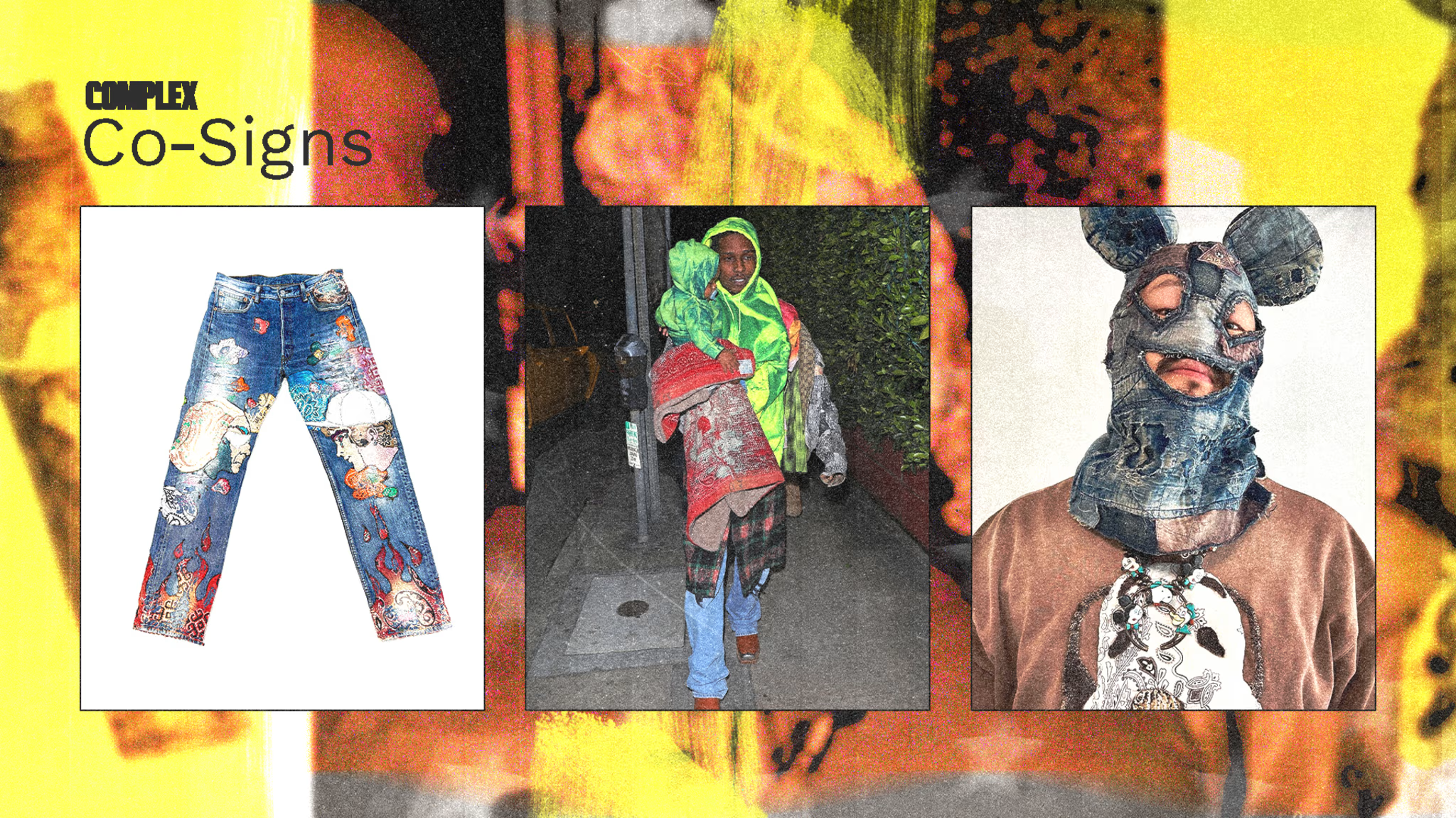
‘Complex Co-Signs’ is a monthly feature that will highlight up-and-coming or under-the-radar creators within the style space that we are personally fans of but may fall outside the realm of our regular news cycle. Hopefully, it will help you discover a new brand or learn more about someone that you’ve already taken a liking to. Whether you are familiar with them yet or not, these individuals are surely worth keeping up with.
While many Japanese brands and designers have re-popularized “Boro” (the Japanese fashion practice of upcycling garments made from vintage textiles), none have captured as much attention recently as Proleta Re Art, a Japanese label crafting some of the most eye-catching distressed garments today. Secret chemical dyes, painstaking embroidery, and hours of sewing are what give Proleta Re Art’s garments a distinct patina that has been coveted by celebrities like ASAP Rocky, Travis Scott, Lil Baby, 21 Savage, and more.
“By ‘hacking’ materials such as used clothing and fabrics through repairing, customizing, and vintage processing, we reincarnate them as art and breathe new life into them,” says Prot, the pseudonym of the mysterious 35-year-old designer behind Proleta Re Art. “When it breaks, we fix it again. But we don't just fix it; we repair it by adding a design. I wanted to make clothes that not only change over time, but also have taste.”
If you’ve followed what any fashionable rapper is wearing right now, you’re already familiar with Proleta Re Art’s work. A pair of Proleta Re Art’s jeans were recently worn by Kendrick Lamar in the music video for “The Hillbillies.” Lil Baby donned his bespoke “Meme” denim that feature chain stitch embroideries of demented cartoon characters stitched by his partner “E.” This year, Prot officially collaborated with Gucci by reworking a monogram-clad two-piece denim set for the Italian luxury house’s Gucci Vault program. What Prot produced was a Canadian tuxedo that created the illusion of denim crafted out of a disintegrating Persian rug. That look was true to Prot’s “Uroboros” line, which has also been spotlighted in a collaboration with Yohji Yamamoto last year and a commissioned pair of jeans for Travis Scott.
Prot’s not one to gloat over his relationships with celebrity clients or revered fashion labels.“I learned a lot from designing clothes for these great brands, but the most important thing I learned was to reexamine the history and concepts of these brands,” Prot plainly states, when asked about his collaboration with Gucci and Yamamoto. He vaguely alludes that he’s particularly close with ASAP Rocky, hinting that he was involved in the design process for his collaboration with Gucci. Rocky has been photographed in many Proleta Re Art pieces and even commissioned the label to craft a baby blanket for his son, RZA.
“I like the RZA blanket I made for Rocky and Rihanna the best,” says Prot, when asked what his favorite celebrity commission has been. “I am very happy to hear that he loves this blanket on a daily basis. I was even happier to see that the blanket’s tattered design had become even more tattered. I will have to do some more repairs!”
While it may seem odd to hear a designer react positively to his garments falling apart, Proleta Re Art is far from a traditional clothing label. Prot’s garments are not mass-produced. Some stores like Mr Porter have been lucky enough to sell a handful of Prot’s 1 of 1 pieces, but his label is not focused on scaling the business. Instead, each of his garments is individually numbered like artwork, upcycled from salvaged vintage materials, and distressed by hand, and undergoes other special vintage treatment processes to create his trademark aesthetic. His popular denim jeans cost up to $3,000, and his entire label has only produced, in total, less than 500 garments to date. But Proleta Re Art isn’t an upcycling fashion designer trying to reinvent our notion of traditional couture. Instead, Prot’s disinterest in scaling upward comes from his awareness of how we really don’t need more clothes out there.
“I believe that the cycle of mass production and consumption in today's capitalist society is finally reaching its limits,” Prot writes, when explaining why his label’s name is inspired by the working-class proletariat. “Clothes are produced with a large amount of material loss; technical interns are underpaid; clothes are made in countries with low wages, sold at very low prices, and then immediately thrown away by the consumer. Rather than sell you some superficial sustainable production background, I think it’s more sustainable to create clothing you would never want to part with.”
That feeling of never wanting to part with a piece of clothing came at an early age for the designer. Prot remembers that his earliest memories of saving used garments was in elementary school, when he begged his father for his distressed leather wallet. He remembers being drawn to the wallet’s shiny black sheen, left from from the grease of his working-class father’s hands. The wallet’s once shiny brass buttons and zippers oxidized into a green-blue rust. While his father just saw a torn-up wallet repaired with duct tape as trash, Prot only saw irreplaceable beauty.
“When an item is used that way, customized and repaired, then used for many years, it takes on this aura that reflects the owner's humanity,” says Prot. “That’s why I upcycle old clothing, because the clothes will change as they age and renew their coolness.”
Used clothing eventually became an obsession for a young Prot. After learning about fashion through magazines from his older brother, he began going through the racks of vintage streetwear shops in Harajuku to find pieces from A Bathing Ape, Swagger, and Stüssy during the early 2000s—an era of Japanese street style that has been canonized by Shoichi Aoki and FRUiTS magazine. “Since I was in junior high school, I didn't have a lot of money, so I would buy used clothes from these stores with the little allowance I had,” Prot shares. Eventually, he started customizing his vintage streetwear finds by painting on them, putting in studs, or just using a knife to distress them.
Prot prefers to remain secretive about the specifics of his professional fashion background that eventually led to launching Proleta Re Art. What he chooses to reveal is that he’s a formally trained designer who studied at Musashino Art University in Tokyo. There, he took a four-year program that taught him about fashion, stage design, lighting, and even interior design. Post-graduation, he worked for a decade at a label he declined to specify that specializes in crafting distressed denim in Okayama, Japan. Prot says he was the chief designer for a line that focused on reviving worn garments and custom vintage processing.
“The team I was on not only designed but made samples with their own hands. They sometimes worked on one-of-a-kind items themselves, so I often completed all the design, sewing, and vintage processing myself,” says Prot. “I often worked with materials other than denim, and I acquired specialized skills by working for that brand.”
But then, tragedy struck Prot. He became sick and his health deteriorated so much that his doctor told him he should not work until he recovered. Prot declines to specify the illness he had but says a “combination of factors led to my mental illness and insomnia.” That led to him resigning from the label he worked for. While he was sick, “E,” his partner in Proleta Re Art, urged him to consider making a brand of his own. Prot gave it a shot and began releasing garments in 2020. Originally, he sold his bespoke pieces for a low price (as little as $580) by selling them on Yahoo! Japan auctions. His original listings were vaguely titled — something like “Bandana Boro on a vintage ‘70s Levi’s Denim Jacket.” But soon, he noticed his listings were being sold to buyers overseas. In March of 2021 he saw that one of his Boro garments floated up on the Instagram page of fashion archivist @noausterity. The collector captioned the jacket with the exact title on his auction listing. When Prot noticed several comments asking how they could buy it, along with others lamenting how they should have bid higher, he left comments on posts saying he made the jackets. Orders started to flood his DM.
“I honestly never imagined that my very niche work would gain such worldwide recognition and demand,” says Prot, who says he prefers to grow slowly despite his label’s overwhelming popularity. “I am convinced that if I expand the scale of my work, I will inevitably not be able to personally work on all of it, so I have no plans to expand the size of my brand at this time.”
Prot also says it’s difficult to scale Proleta Re Art because the manufacturing process behind his garments is “impossible” to mass-produce while maintaining the label’s quality. While he says individuals could produce similar garments without specialized equipment and materials, the results he’s seen so far have looked lackluster. “You can immediately tell that they are fakes,” says Prot, who also emphasizes that his garments are impossible to replicate because a bootlegger would also need to understand the intricacies of upcycling vintage goods.
“I don't think it is possible to create a high-quality vintage piece without being able to distinguish between authentic vintage jeans that have faded heavily and replica jeans that have undergone a vintage treatment instantly,” declares Prot. “I am thorough in combining authentic vintage materials with the vintage processing techniques I have studied for years to create a design and quality that confuses consumers of my work in a good way. They can never tell where the real fading or damage begins and where my handiwork comes in. That’s because all my pieces are designed and produced entirely within my studio by myself and my partner [E] alone.”
Prot is naturally very secretive about his process. But what he does reveal to Complex explains his high price tag and long turnaround times — a single piece can take over 24 hours of labor to produce. It starts with sourcing vintage clothing from flea markets, thrifts, antique stores, or sellers online. For certain commissions, he lets customers send in their own personal belongings. He then builds around the unique qualities of each piece. If he finds a pair of jeans stained with paint, he’ll select patchwork fabrics that match the stain. If one jean’s knee is ripped, he would leave it as is but distress the other knee to match.
Proleta Re Art’s garments then fall into one of two separate lines. One is “Uroboros,” a name directly pulled from the centuries-old symbol of a serpent eating its own tail. “Uroboros represent cyclicity, permanence, and infinity,” explains Prot. For this line, Prot washes heavily damaged jeans and denim at high temperatures, dismantles them, and then repairs them with other vintage materials such as old bandanas or indigo-dyed Japanese cloth that is over 100 years old. He then uses traditional sashiko stitching to sew everything back together before adding in his secret vintage processing techniques.
Prot’s other line, “Meme,” also requires painstaking labor and boasts elements of Boro but is distinguished by his love for poorly drawn popular cartoon characters. These pieces are defined by chenille embroideries featuring twisted interpretations of cartoon characters. The embroidery work is done by “E,” who Prot met through the company he previously worked for. “I think she is as obsessed with embroidery as I am with vintage processes,” Prot professes. “She is very good at very detailed and intricate handwork, with a precision of less than 1 millimeter in detail. She is also very patient.” Prot traces his love for amateur interpretations of popular cartoon characters to his young interests in ROM-Hacked video games and doujinshi (fan-created manga) that he found to be better than the originals. But he particularly cites the influence behind his Meme garments to his travels in South Asian countries as an art student, where he would see tastefully distorted drawings of Mickey Mouse and other characters that everyone knows on the signs of private stores and food stalls.
“They were exposed to the wind and rain, weathered, and clothed in melancholy, blending into the landscape of their lives and taking on this unique flavor that burned into my mind. For me, more than masterpieces by any famous artist, I love above all these poorly drawn works of art created by amateurs or children.”
Prot says he doesn’t have any specific goals when it comes down to the future of his label. What he currently aspires to do is build upon his work better by developing new customization tools and ideating vintage processing techniques to stay ahead of the curve. While he’s interested in collaborations, he’s not vying to work with any specific name brand. Instead, he’s more interested in working with creators who can help him create something within a field he’s unfamiliar with. If anything, what comes first for Prot is not profit but maintaining the integrity of his label and those behind it.
“I have endless ideas of what I would like to create, so I would like to create an environment that allows me to realize these ideas,” says Prot. “I would like to take better care of myself and do my best to make my colleagues and those with whom I have formed partnerships happy. I believe that as long as we continue to focus thoroughly on the work in front of us, the product will take us to a better future.”




