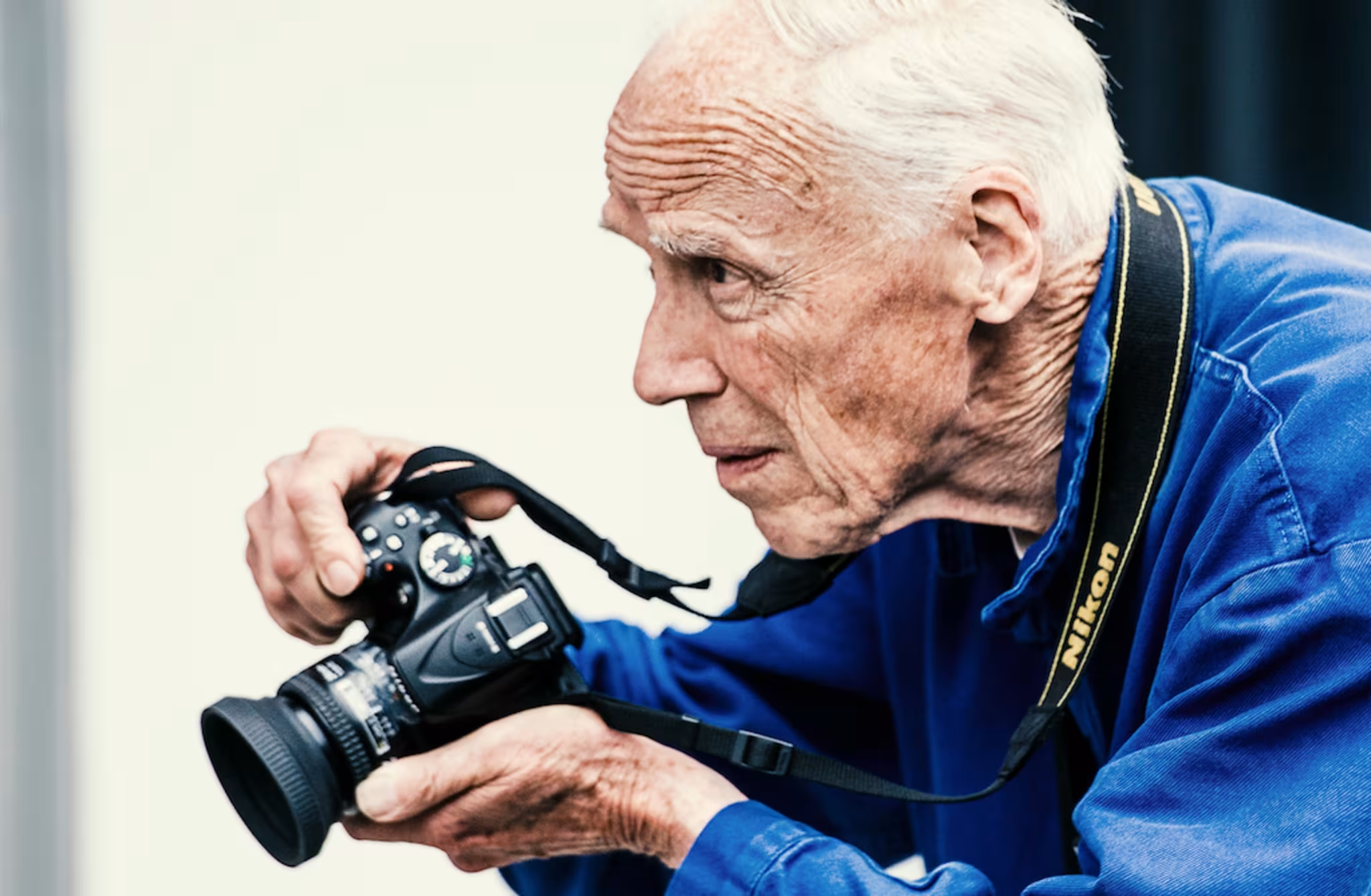
Image via Getty/Noam Galai
The essential attribute of street photography is chance — and that’s likely why we’re so drawn to it. Unlike documentary photographers, who wish to tell an overarching story of the subjects and places they capture, often for news publications, street photographers take photographs of fleeting moments that may exist outside of a greater narrative. Often, they are only meaningful for the single moment they capture.
The street photographers of the world might envy photographers who take portraits or stage photo shoots. The latter group gets to control and create an image before taking it, which seems a hell of a lot easier than being able to get the perfect moment on camera as it occurs spontaneously. The street photographer has to wait for just the right moment to capture something worth shooting.
The whole point of street photography is to capture happenstance — unplanned moments in public space. Often this involves humans (sometimes doing funny things, like tripping or making strange expressions), but sometimes street photography just captures the photographer’s surroundings. Although it can be similar to architectural photography, it doesn’t have to focus on the structures in front of a lens. Instead, the focus of a street photograph is the composition of random objects coming together in a photographer’s frame. The talented street photographer captures these chance happenings in a meaningful and engaging way.
We’ve compiled a list of these kinds of photographers — the ones who have turned their cameras to the streets and come away with images worth hanging in the most prestigious galleries — from the forefathers of the photographic genre to contemporary artists. And there are still many young street photographers who are just developing (non pun intended) their skills. If street photography is something you aspire to personally, be sure to check out our list of expert tips to take your photo game to the next level.
Martha Cooper
Best known for her iconic photos in the ’70s of the New York graffiti scene, Martha Cooper is a legend among street and documentary photographers. Her photos of sprawling subway graffiti pieces were published in Subway Art in 1984, and have appeared in National Geographic and the Smithsonian magazine. She’s still shooting photographs on the street today, including a project in Baltimore’s Sowebo neighborhood.
William Klein
One of the most influential photographers of all time, a renowned filmmaker, and one of the “grandfathers of street photography,” Klein rose to fame in the ’50s capturing life on the street in various cities, especially Paris and New York. He is also known as a fashion photographer, and for his unique use of natural lighting, blurred effects, and wide-angle lenses. Today he continues to exhibit his work in galleries around the world.
Janette Beckman
Also known as a documentary and portrait photographer, Beckman is a master of street photography focusing on outsider groups, including British punk rockers, Los Angeles gang members, and Harlem dirt bikers. She hasn’t left this subject matter behind in her later years, telling Complex in an interview, “I’m still looking for rebel cultures.”
Daido Moriyama
Embedded with cultural significance, Japanese photographer Moriyama’s images frequently capture the destruction of traditional values in his home country. He’s trained his lens on Tokyo for the past 50 years to capture the dark underbelly of the city.
Eugene Atjet
In an effort to capture Paris before the city’s architecture and inhabitants were changed forever by the tides of Modernism, Atjet focused his lens on working-class Parisians going about their everyday lives. Atjet is considered one of the grandfathers of street photography, and the fact that he had to rely on a camera with bellows instead of a DSLR makes his work even more impressive.
Henri Cartier-Bresson
Not only is Cartier-Bresson, the man behind the infamous Magnum Photos, considered the originator of photojournalism, but he also outlined the idea of The Decisive Moment—an idea that street photography relies on. Using 35mm film, Cartier-Bresson captured cities all over Europe. In 1937, during the coronation of King George VI and Queen Elizabeth II, he famously refused to photograph the monarchs at all and instead captured the crowds on the streets.
Garry Winogrand
Born and bred in the Bronx, Winogrand is arguably New York’s most beloved street photographer. In his first photo book, The Animals, he captured people engaging with creatures at the Bronx Zoo and New York Aquarium. He went on to win numerous awards and exhibit at museums and galleries across the world.
Helen Levitt
Levitt struck out from her home of Bensonhurst, Brooklyn, to photograph the city around her. She began by photographing children’s chalk drawings on the sidewalk, which were compiled in a book called In the Street. She then went on to photograph residents of Spanish Harlem and the Lower East Side. Although she was not well known during her lifetime, Levitt has risen to fame as one of the most influential street photographers of all time.
Anna Delany
New Zealand/New York-based Anna Delany documents gritty street life and urban decay architecturally and in portraits. Anna may be one of the most successful street photographers in terms of her ability to capture facial emotion in a split second.
iO Tillett Wright
iO Tillett Wright's work is grounded in really excellent black and white street photography, whether of scenery or people, even if most people know her for editorial and fine art endeavors. Her most recent Self Evident Truths project brought her across America shooting candid portraits of hundreds of people who identify as LGBTQ, and brought attention to her scope of awesome street photo work.
Richard Sandler
Estevan Oriol
Estevan Oriol is a multi-faceted director and photographer, whose street photography throughout Los Angeles is visual storytelling at its best. Shot in black and white film and retaining a black frame, Estevan's photographs look at people, cars, and graffiti from an angle all his own.
Lee Jeffries
Lee Jeffries' work looks like it was shot in film a long time ago, but all of these portraits are from the last 3 years and were shot digitally. His street portraiture has a lot of character and brilliantly conveys the emotion of his various subjects using high contrast and ISO.
Steve McCurry
Steve McCurry is a staple of editorial and street photography. His photographs seem to carry an intensity throughout, whether in their saturation, facial expressions, contrast, or composition. When all is said and done, Steve McCurry is one of many who have made street photography the amazing genre that it is.
Eric Kim
Will Steacy
Brian Sparks
Cheryl Dunn
Cheryl Dunn's dedication to street photography is as impressive as her portfolio. In 2011, she successfully kickstarted a project to create a documentary about the historical figures within the genre, two of which made this list. She's published multiple books of her work, as well.
Matt Stuart
Martin Roemers
Jaime Martinez
Joel Meyerowitz
Joel Meyerowitz has been a leading figure in street photography for a while now, and he continues to publish books of his work. Whether documenting barely discernable people on the street or construction, he's paved the way for many and done a lot to establish the genre as worthy of the art world's recognition.
Jesse Wright
Sha Ribeiro
Boogie
Bill Cunningham
People initially think of Bill Cunningham as a street style photographer, but to us, his work transcends any genre of photography. His ability to see trends in fashion translates to patterns in culture, art, and design, and he really seems like the only living artist who's made these connections so seamlessly. His dedication to the craft for decades has made him an inspiration to all artists, and if there's anyone on the list who would be the street photographer, it's him.




