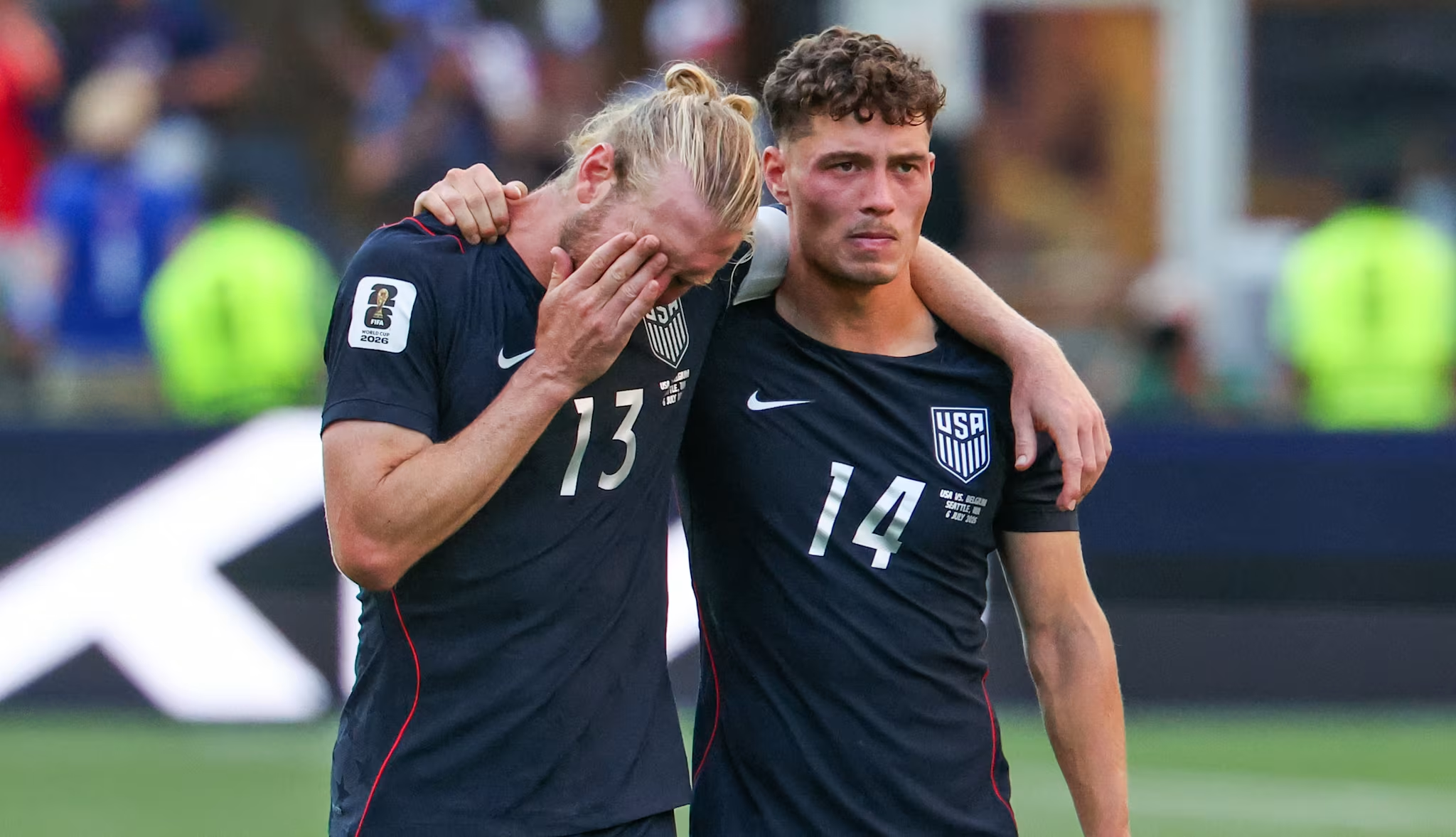
The United States' 4-1 loss to Belgium in the 2026 FIFA World Cup Round of 16 reignited one of American soccer's longest-running debates: Is the country's youth development system preventing the men's national team from reaching its full potential?
The discussion gained new momentum after former U.S. national team defender Alexi Lalas defended the pay-to-play youth soccer model on social media, prompting backlash from fans and renewing criticism from former stars Thierry Henry and Zlatan Ibrahimović.
Here's why the debate keeps resurfacing, and why the men's and women's national teams have historically produced very different results.
What Is America's Pay-to-Play Soccer System?
Unlike many of the world's top soccer nations, much of the United States' youth soccer structure relies on families paying for elite club participation. Expenses often include coaching, league registration, tournaments, travel, hotels, uniforms, and equipment, with costs sometimes reaching several thousand dollars per year.
In countries like France, Germany, Spain, and Brazil, professional clubs typically identify talented players at a young age and develop them through academy systems at little or no cost to their families. Critics argue that the American model places a financial barrier in front of talented players who cannot afford expensive club soccer.
Why Critics Say It Hurts the USMNT
Following the United States' latest World Cup exit, many fans again blamed the pay-to-play system, arguing that it limits access for lower-income players and shrinks the country's talent pool.
Former France star Thierry Henry has repeatedly pointed to his country's academy structure as an example, explaining that professional clubs invest in player development instead of requiring families to shoulder the costs.
Zlatan Ibrahimović has expressed similar concerns after his children played youth soccer in the United States.
"My children play in a good team, and I paid $3,500 per child," Ibrahimović previously said. "I don't like that because not everybody has the money, and sport should be for everyone because it unites people regardless of their origins."
Critics believe soccer talent exists across every community, but that financial barriers make it more difficult for many gifted players to reach elite development pathways.
Alexi Lalas Doesn't Believe Pay-to-Play Is the Main Problem
Lalas has consistently defended the current system.
After the USMNT's disappointing Copa América performance in 2024, he argued that "pay to play is not ruining youth soccer," comparing soccer to activities such as piano lessons that families voluntarily choose to pay for.
Following the World Cup loss to Belgium, Lalas again defended the model on X, writing that youth sports operate within a competitive marketplace and questioning who would fund free soccer if families no longer paid for it.
When one fan argued youth sports should not function as a business, Lalas responded by asking whether critics believed youth soccer should instead be funded by taxpayers or charitable organizations.
What Does the Research Say?
Research suggests cost can be a significant barrier.
A 2018 Sports & Fitness Industry Association study found that more than 70% of children participating in pay-to-play sports came from households earning over $50,000 annually, reinforcing concerns that lower-income families may be priced out of elite competition.
At the same time, the landscape has begun to change. Major League Soccer has steadily expanded its academy network over the past decade, and every MLS club now operates a youth academy. Many of those academies are free for elite prospects and provide a professional pathway that bypasses the traditional pay-to-play model.
Still, many of the country's youth players continue to develop through traditional club soccer, where costs can remain a significant hurdle.
Why Doesn't America Produce More Elite Players?
Another challenge is unique to the United States. Unlike Brazil or Argentina, soccer isn't the country's undisputed No. 1 sport.
Many of America's best young athletes choose football, basketball, baseball or track instead.
In Brazil, the country's most gifted athlete almost always grows up dreaming of playing soccer. In America, that same athlete might dream of reaching the NBA or NFL. The competition for athletic talent is unlike almost anywhere else in the world.
Soccer also occupies a different place in American sports culture than it does in many traditional soccer powers. While interest in the sport has grown dramatically over the past three decades, professional leagues in Europe and South America have spent generations building scouting networks, academy systems and deeply rooted soccer cultures.
Major League Soccer, by comparison, has only existed since 1996 and is still relatively young compared to many of the world's elite leagues.
Why Has the USWNT Been So Much More Successful?
The women's game developed under very different conditions.
One of the biggest reasons is Title IX, the landmark 1972 federal law requiring schools receiving federal funding to provide equal athletic opportunities for women.
The legislation dramatically expanded girls' participation in sports, particularly at the high school and collegiate levels. For decades, the United States possessed one of the strongest women's development pipelines in the world, fueled by school athletics, college scholarships, and NCAA competition.
At the same time, many of the world's traditional soccer powers invested relatively little in women's soccer. Several European federations didn't begin making significant investments in women's professional leagues and youth academies until the 2000s and 2010s, allowing the United States to build a substantial head start through its school and college systems.
That developmental advantage helped produce one of the most successful national teams in sports history, winning four FIFA Women's World Cup titles, five Olympic gold medals and consistently competing for major international trophies. It also helped produce generations of legendary stars, including Mia Hamm, Abby Wambach, Carli Lloyd, Megan Rapinoe and Alex Morgan.
Why the Rest of the World Has Caught Up
The USWNT no longer enjoys the overwhelming developmental advantage it once had. European clubs and federations, including Barcelona, Chelsea, Arsenal, Lyon and Paris Saint-Germain, have invested heavily in women's academies and professional teams over the past decade.
FIFA has also made expanding women's football a major strategic priority worldwide, helping accelerate development across Europe, South America and Asia.
Spain's 2023 Women's World Cup title and England's UEFA Women's Euro 2022 championship demonstrated just how much the global landscape has changed.
As a result, international competition has become significantly stronger, making Women's World Cups and Olympic tournaments far more competitive than they were two decades ago.
Can the USMNT Close the Gap and Win a World Cup?
There is no universal agreement on the solution.
In reality, most experts believe no single issue explains the United States' struggles. Instead, they point to a combination of player development, coaching, scouting, infrastructure, and the country's unique sporting landscape.
However, the encouraging news for American fans is that the player pool is stronger than ever. Christian Pulisic, Weston McKennie, Tyler Adams, Folarin Balogun, Gio Reyna and several rising prospects have all developed into players capable of competing at the highest level in Europe.
The debate over pay-to-play will almost certainly continue after every disappointing tournament. But whether the United States eventually wins its first men's World Cup will likely depend on more than just eliminating registration fees.






