Words by Steve Hopkinson
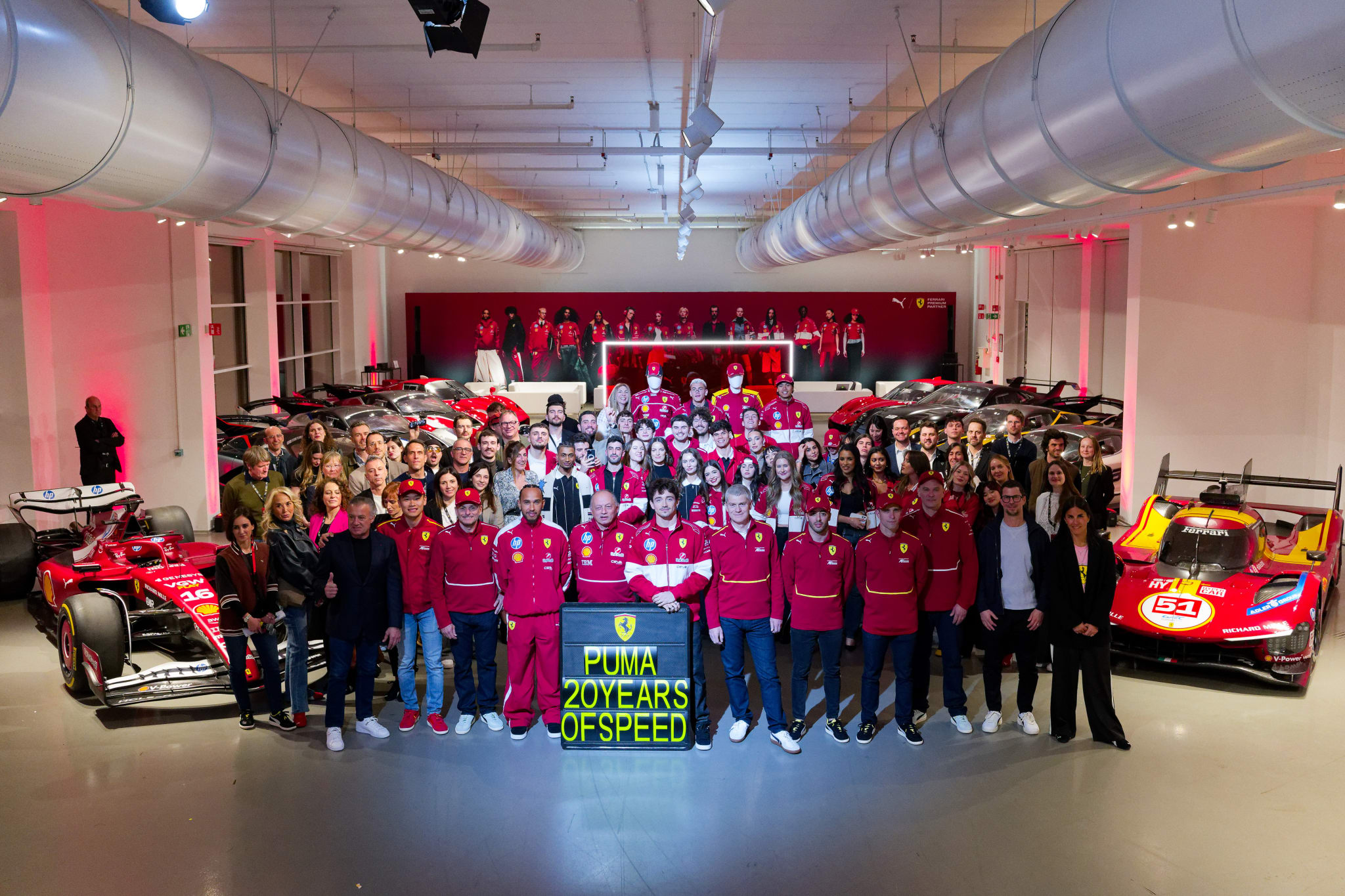
Since Enzo Ferrari established a permanent home for his racing team in 1943, Ferrari’s headquarters in northern Italy has been one of the most closely-guarded facilities in sports. Built in the days before sports teams were structured around lucrative sponsor deals and corporate hospitality, the ‘factory town’ of Maranello is a walled facility, strictly off-limits to anyone but staff and family. So when Formula 1’s most prestigious team invited a handful of media representatives to its headquarters last week for a gala dinner to celebrate the 20th anniversary of their partnership with sportswear brand PUMA, it wasn’t just corporate hospitality by numbers—it was an affirmation of how deeply the ties between these companies run.
At 20 Years Of Speed: Family Comes Together, stars from the Formula 1 team testified to PUMA’s significance in their success. Team principal Fred Vasseur was joined by Ferrari drivers past and present, including the team’s current all-star lineup of Lewis Hamilton and Charles Leclerc. Hamilton, who will make his racing debut for Ferrari at this week’s Australian Grand Prix, believes his partnership with Leclerc is “the strongest pairing F1 has probably ever had.”
‘Partnership’ can sometimes be used as a corporate euphemism, a fluff term to soften the transactional nature of corporate sponsorship, but in the case of Ferrari and PUMA, it rings true. The relationship with Ferrari is central to PUMA’s identity as a brand: their Speedcat trainers, with a silhouette inspired by driving shoes and design details echoing the racetrack, were PUMA’s hottest item in 2024, and helped drive the company to 10% sales growth in a challenging market. And for Ferrari, the unique demands that Formula 1 places on athletes make PUMA a critical factor in their success on track.
Ferrari’s Formula 1 team employs over 1,000 people, with the singular goal of achieving the best possible results on track. But the product of those efforts is two cars, and the team’s success depends on their two drivers being able to maximise the cars’ performance, lap after lap. To achieve that, drivers rely on thousands of subtle sensory cues felt through their gloves, boots and race suits. For Ferrari’s drivers, all of those are produced by Puma. And while some of the adjustments drivers require are fairly mundane, others are more esoteric.
For Leclerc, Ferrari’s work with PUMA has been critical to his success in a sport where titles can be decided by milliseconds on the stopwatch. “That partnership is so incredibly important, because it’s really what connects me with the car,” he says. “Everything that I feel of the car is with PUMA gear, whether it’s through the gloves that I have on the steering wheel, my shoes on the pedals, the suits—all these kinds of things help me to feel the very smallest details.”
Leclerc is especially proud of his collaboration with PUMA to develop his racing boots, a project that is still ongoing in his seventh year with the team as he chases ever more subtle feedback on the car’s behaviour through his feet. “With the shoes,” he says, “there’s been so much work in trying to have every kind of feeling so that I can extract the maximum from the car.” The results speak for themselves: in qualifying, where a driver’s only objective is to deliver the maximum possible performance over a single lap, Leclerc’s success rate puts him in the top ten drivers of all time.
For Fred Vasseur, who joined Ferrari as team principal in 2023, getting the team back to a place where it can challenge for titles has been a multi-year project. While some teams have struggled due to volatile relationships with sponsors, Ferrari’s partnership with PUMA has given Vasseur a stable platform to build on. With the 2025 season starting in earnest this week, Ferrari have been tipped by many as one of the favourites for the title, and questions have turned to how Vasseur will manage his drivers if they find themselves in an intra-team dogfight for the championship.
But Vasseur is unconcerned. “It’s not that hard to manage champions,” he says. “I think it’s even easier to manage them than guys at the back of the grid sometimes, and the fact that we have a long-term relationship... I’ve known Charles for 14 years, and for Lewis it’s even [longer]: 22 or 23. But the fact that before you started to work with them, they became world champions, I think it’s helping a lot with the relationship.”
Ferrari’s familial approach to working with PUMA has enabled both companies to reach new heights; will Vasseur take a similar approach with his drivers? “I’m not their father, at all,” he says. “It’s not this kind of relationship, but it's true that I started with them when they were kids. Honestly, I started my business when I was the age of my drivers. Now I’m at the age of their fathers, sometimes their grandfathers, it is much easier to manage them, knowing them for a long time.”
One of the biggest shifts in the sport since PUMA joined Ferrari has been the increased media attention on drivers. While in 2005 drivers could still live fairly private lives, hidden behind visors on the track and behind closed doors away from it, today’s drivers are brand ambassadors. For companies like PUMA, this exposure is invaluable, but it has also driven changes. While race suits of the past were purely pragmatic, today’s race suit is the face the brand presents to the world’s media. The appearance has become just as important as the performance.
For Leclerc, who spends as much time facing the media in his race suit as he does driving the car, PUMA’s focus on race suits as fashion items has been a huge positive. “It’s great to see that fashion is more and more part of it, that the team kit is not only a team kit anymore, but it's also a fashion statement,” says Leclerc. “It’s very cool to be part of this process, to see how it’s been developing in the last few years and to see the level it’s got to. That’s a really cool process to have witnessed since I joined the team. And yeah, I definitely feel cooler and more confident in the gear now.”
Jean Alesi, who won the 1995 Canadian Grand Prix for Ferrari, thinks the heightened media focus means today’s drivers have a more difficult job than those of his generation: “We had more freedom. We had more of a side where we were not on pictures or on camera. That was at the time where everybody had a chance to park their car in the centre of London without getting a ticket, because nobody saw the car. Now you have cameras everywhere. I think, for the drivers, it’s like that now: you can’t hide yourself. You can’t hide the mistakes. The engineers, with all the technologies they have, they see where you get it wrong nowadays. Before, it was possible to cover a mistake, but now it’s much more difficult for the young generation.”
Alesi competed in Formula 1 from 1989 to 2001, a period that saw him sharing the track with some of the biggest characters in the sport’s history—not least Ferrari’s own Alain Prost, whose rivalry with Ayrton Senna was the subject of a big-budget Netflix series last year. Asked if characters like that could survive in Formula 1 today, Alesi shakes his head: “Impossible, impossible. I was there before the race, when Senna drove into Alain Prost. He had said to the press before the start: ‘If Alain gets away before me, I will go directly into his gearbox.’ And that’s what he did. If today you imagine Max Verstappen saying, ‘Okay, if Lewis is ahead of me at turn one, I will go into his wing,’ he would lose his license forever.”
With Vasseur at the helm, two of the sport’s greatest drivers at the wheel, and a car that was consistently one of the fastest in pre-season testing, Ferrari seem better placed heading into the 2025 season than at any time in recent memory. Is Alesi feeling optimistic about the team’s chances? “I’m the wrong person to ask, because I’m a Ferrari fan!” Sebastian Vettel, who partnered Leclerc at Ferrari for two years, said that everyone is a Ferrari fan, even if they say they’re not. For a brand like PUMA, that recognition is as valuable as a world title.