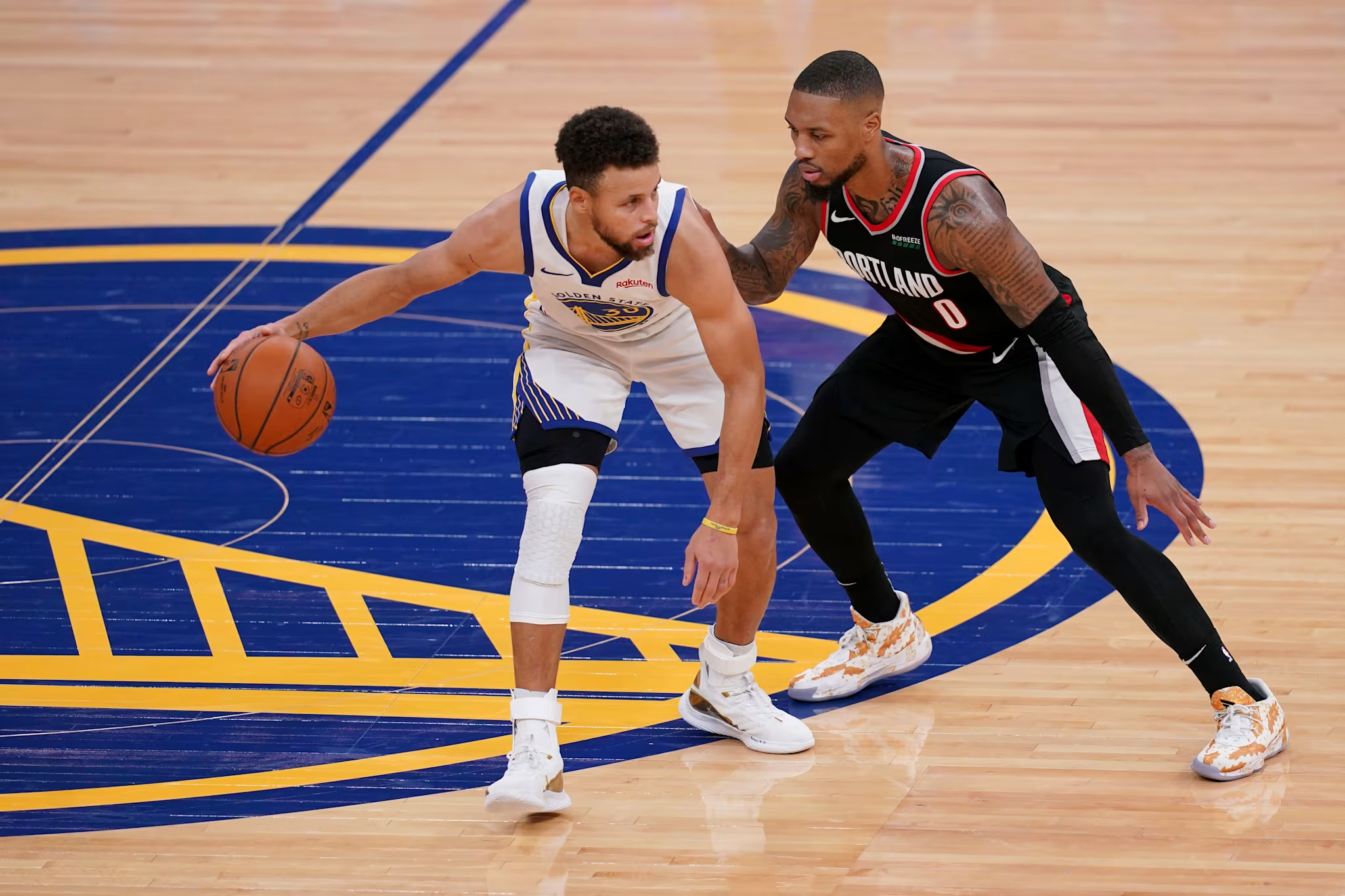
Jan 1, 2021; San Francisco, California, USA; Golden State Warriors guard Stephen Curry (30) dribbles the ball against Portland Trail Blazers guard Damian Lillard (0) in the third quarter at the Chase Center. Mandatory Credit: Cary Edmondson-USA TODAY Sports
Preferences in point guards are kind of like pizza toppings. Everyone has their favorite for very distinct reasons, but one continues to reign over the rest.
I guess that makes Steph Curry pepperoni—statistically America’s favorite topping and undoubtedly the GOAT of pizza additions—for our purposes here since we crowned the Golden State Warriors floor general the best point guard in the NBA yet again. As we began to debate our point guard rankings for the 2020-21 NBA season, Curry was an easy choice and I don’t think I spoiled anything by revealing he’s No. 1. His 2020-21 campaign was nothing short of brilliant and arguably worthy of him winning a third MVP. The real fun, of course, comes in deciding where the rest of today’s top point guards slot in behind him. And who, precisely, qualifies as a point guard in today’s increasingly position-less NBA.
We did this last year in August before the playoffs in the bubble began and a few days before the 2021 postseason tips off across the Association it was time for an update. You’ll undoubtedly agree with where we slotted some guys compared to others while vehemently disagreeing with others. Some fans may even absurdly think a worthy candidate was snubbed (like Kyrie Irving who we decided to classify as a shooting guard, as the Nets did upon acquiring James Harden, even though Irving played 93 percent of his minutes at point guard this season thanks to all the games Harden missed) or dropped from last year’s rankings because we low-key hate that player or the team he plays on. I promise you it ain’t that serious.
But before you dig into the rankings I encourage you to read this annual disclaimer: LeBron James is not on here. Despite the fact that I continue to advocate heavily for The King to officially be classified as a point guard for our purposes, my colleagues disagree. Why? While James unofficially officially morphed into a point guard upon joining the Lakers (he played 73 percent of his minutes there this season) and intermittently served as such in Miami and Cleveland, a segment of NBA fans will tell you he’s really a small forward, or a point-forward, or something entirely else. Sorry Lakers fans and LeBron stans.
De'Aaron Fox
2020-21 Stats: 25.2 PPG, 3.5 RPG, 7.2 APG, 20.7 PER
Last Year: NR
The progression of De’Aaron Fox into a top 10 point guard kind of gets lost since he plays for the Kings and they failed to make the playoffs for the billionth straight season. But the lightning-quick Fox, whose scoring average has impressively improved in each of his four seasons, definitely deserves more credit for being an excellent offensive point guard than he generally receives. There are holes in the 23-year-old’s game for sure (below average from three and the free throw line) and he’s definitely a notch or two below the truly elite point guards since a few of those qualify as living legends. But few guards in the league finish around the rim as efficiently as Fox (76.1 percent this past season from 0-3 feet) and if he’s this good this young just imagine how much of a problem he’s going to be when he hits his prime in 3-4 years.
Mike Conley Jr.
2020-21 Stats: 16.2 PPG, 3.5 RPG, 6.0 APG, 19.2 PER
Last Year: NR
The Jazz point guard finally got a well-deserved All-Star nod this season as he helped lead Utah to the NBA’s best record and enjoyed a career year offensively. His numbers may not jump out at you compared to guys like Russell Westbrook or Steph Curry, but when healthy Conley’s been ultra-steady over his 14 seasons in the league. This year he posted his best numbers from beyond the arc (41.2 percent), effective field goal percentage (.552), and offensive rating per 100 possessions (123). We’re all wowed by the flash of other point guards on this list, but please take a moment to respect someone that’s been running point, and doing it at a very high-level, for well over a decade now.
Ben Simmons
2020-21 Stats: 14.3 PPG, 7.2 RPG, 6.9 APG, 18.3 PER
Last Year: 7
Everybody knows Ben Simmons is a jump shot away from being a superstar, but until the 24-year-old Sixers point guard feels comfortable launching from beyond the paint (91 percent of his attempts this season came within 10 feet or less of the basket) let’s just appreciate all the other things that he does phenomenally well. Like play stifling defense (9th in defensive win shares), distribute at a high level (6.9 APG), and attacking the rim about as well as any guard on this list. For my money, Simmons should be Defensive Player of the Year since he’s so versatile and can basically guard every position. Rudy Gobert will almost assuredly to win DPOY honors again and the analytics will absolutely justify that selection by the media. But what Simmons does is special and a lot of fun to watch if you actually, you know, appreciate elite effort on the other end of the floor.
Trae Young
2020-21 Stats: 25.3 PPG, 3.9 RPG, 9.4 APG, 23.0 PER
Last Year: 8
Is Trae Young the exact opposite of Ben Simmons? He just might be since the pint-sized point guard can shoot from anywhere on the floor and plays zero defense. Despite his shortcomings, Young’s still a premier facilitator (second behind Russell Westbrook in APG at 9.4) and a dangerous scorer (25.3 PPG) who has no problem pulling up from the logo and knocking down 35-40 footers like it’s nothing. Only 22 years old, don’t lose sight of the fact that Young has averaged 24 and 9 over his first three seasons. If he keeps up that stat line up he’ll be earmarked for the Hall of Fame by age 30.
Russell Westbrook
2020-21 Stats: 22.2 PPG, 11.5 RPG, 11.7 APG, 19.5 PER
Last Year: 3
Since Russell Westbrook was No. 3 in our rankings last summer, some will think we’ve lost our god damn mind dropping him three spots after he turned it up a notch over the season’s final few months and became the NBA’s all-time leader in triple-doubles. Let me be clear here and say slotting him at No. 6 this season is absolutely no shade on Russ. The guys ahead of him have valid cases to be where they’re at. With that disclaimer out of the way, let’s start praising the hardest playing point guard in the NBA who lifted the Wizards from the basement of the Eastern Conference to the fringe of the playoffs. Westbrook’s flaws haven’t changed as he’s aged (he led the league in turnovers by a lot and those shooting percentages remain below league average) but his non-stop motor is forever his most enviable trait. Westbrook, obviously, fills up the stat sheet like few others in the game’s history and has an uncanny ability to will his squads to wins like few other players. His teammates (well, just about all of them) will sing his praises and if you appreciate someone who never takes a play off then Westbrook—who could very well find his way onto one of the All-NBA squads—deserves way more admiration than ire.
Luka Dončić
2020-21 Stats: 27.7 PPG, 8.0 RPG, 8.6 APG, 25.3 PER
Last Year: 5
Do I really have to hype up Luka Dončić? The Mavs’ third-year point guard didn’t have the MVP-caliber season everyone predicted back in December, but Dončić was still a certified stud while knocking down a higher percentage of his threes than ever before. That should earn him First-Team All-NBA honors (or Second Team All-NBA at the absolute worst, but he deserves First-Team) for the second straight season and he’s only 22 years old. He may whine like a baby after every blown whistle and athletically he’s a step or two behind just about everyone else on this list, but the only players with a higher VORP (value over replacement player) than Dončić this season were Nikola Jokić, Giannis Antetokounmpo, and Steph Curry. If you were hypothetically building a franchise for the next 10 years who are you picking ahead of him to run point? Nobody.
James Harden
2020-21 Stats: 24.6 PPG, 7.9 RPG, 10.8 APG, 24.5 PER
Last Year: NR
Yes, even though he technically spent 43 percent of his minutes on the court at shooting guard, James Harden is a point guard. Since Brooklyn acquired the Beard, Harden has served as the Nets’ main distributor and facilitator, pushing Kyrie Irving to the 2 and it’s obviously worked out beautifully for the No. 2 seed in the Eastern Conference. Harden averaged the second-highest assists per game total of his career this past season (10.8 cumulatively with the Rockets and Nets) and sacrificed some of his offense (his 24.6 PPG was his lowest average since the 2013-14 season) to form a juggernaut of an offensive squad in the County of Kings. That doesn’t mean Harden’s still not the same lethal scorer who can obliterate teams in the blink of an eye. Quite the contrary since he finished the season with his highest effective field goal percentage of his career (.548), the third-highest true shooting percentage of his career (.618), and a higher offensive box plus/minus rating than every other point guard in the league other than Steph Curry and Damian Lillard. Oh yeah, he’s also an underrated defender. If you’re salty over me having Harden at No. 4, only playing in 44 games this season (plus those desultory first few weeks with the Rockets) was a factor.
Damian Lillard
2020-21 Stats: 28.8 PPG, 4.2 RPG, 7.5 APG, 25.6 PER
Last Year: 2
About as clutch as they come, Damian Lillard remains a top 3 point guard in our book. The gritty and incredibly loyal Trail Blazers leader had another stellar season guiding Portland back to the playoffs, averaging 28.8 PPG and 7.5 APG which was good enough for him to earn the second-best offensive rating (125) of his career. Those numbers and Portland’s success despite injury issues should easily earn him his sixth All-NBA selection. Dame rarely misses games, or shots to win them, and if you need more evidence why Lillard deserves his top 3 status know this: Dame finished second behind Steph Curry among point guards in ESPN’s Offensive Box Plus/Minus statistic as well as PER and finished tops among point guards in win shares and offensive win shares as the Blazers went 22-12 in clutch games—under five minutes and a five-point differential or less—with him running point.
Chris Paul
2020-21 Stats: 16.4 PPG, 4.5 RPG, 8.9 APG, 21.4 PER
Last Year: 3
A 35-year-old point guard suiting up for his fifth franchise isn’t supposed to transform the fortunes and outlook of his new team, but what Chris Paul (now 36) did during his first season in Phoenix was stunning. The Suns went from what most observers believed was a fringe playoff team before the season tipped to the No. 2 seed in the stacked Western Conference thanks in large part to CP3’s continued renaissance during what’s supposed to be the twilight of his career. While his numbers with the Suns aren’t what they were during his prime years in New Orleans and LA, the Point God provided a stabilizing presence to the young Suns coupled with All-Star production that will surely mean a 10th All-NBA selection. For how highly the Suns overachieved, Paul just might finish in the top 5 of MVP voting. That’s astonishing for someone playing his 16th season in the league.
Steph Curry
2020-21 Stats: 32.0 PPG, 5.5 RPG, 5.8 APG, 26.3 PER
Last Year: 1
The NBA scoring champ just authored a career year at age 33, carried a severely undermanned and talent-deficient Warriors squad to the precipice of the playoffs, and became the fourth player in league history to have multiple MVPs, scoring titles, and NBA titles joining the ultra-exclusive fraternity that features Michael Jordan, Wilt Chamberlain, and Kareem Abdul-Jabbar. Those are three of my four Mt. Rushmore NBA players right there and while Curry’s never going to pass LeBron for that ultimate honor in my book, he’s going to finish in the top 3 (most likely) of the MVP voting and continues to creep closer and closer to cracking our top 10 all-time NBA player rankings. I could reel off more stats, accolades, and analytics to bolster the reasoning for crowning the greatest shooter ever as the game’s best point guard right now, but if you still need convincing after the season we just witnessed you’re a lost cause.




