Image via Nike
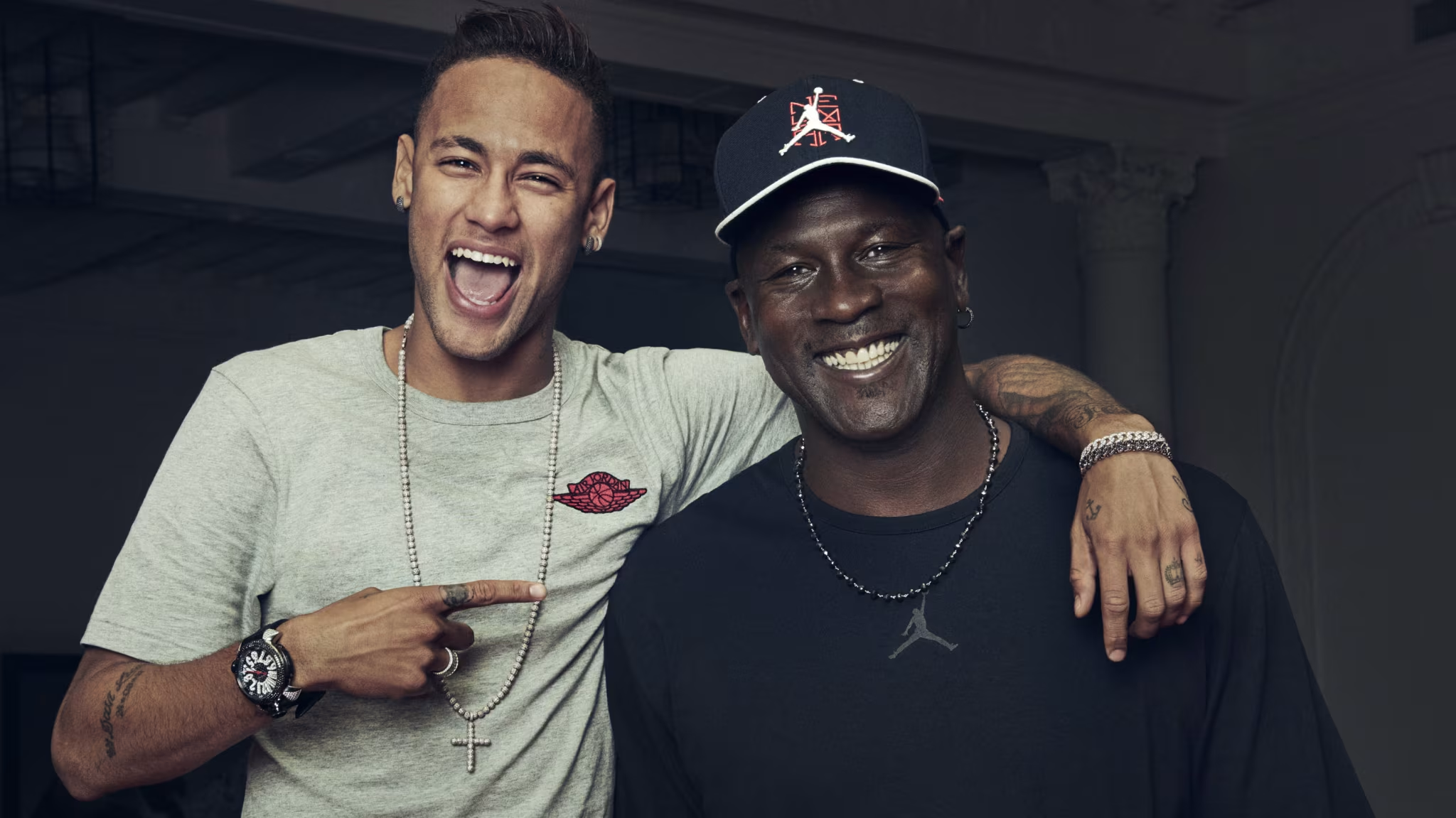
While Carmelo Anthony and Jimmy Butler represent for Team USA basketball in Air Jordans during the 2016 Olympics, the ultra-marketable Neymar Jr. is taking the Jumpman to the football pitch in his home games.
There are football boot fanatics and there’s a snowballing culture of collecting sports footwear, but it’s been a challenge to get the two realms to meet credibly. Both places are heavily connected. Whether its the colossal influence of the terraces and football fans on the UK’s love of trainers and sportswear, pre-millennial photos of a newly-signed Thierry Henry in his Air Max TNs, or a modern player flexing an ostentatious collection of hype on Instagram.
Each of the big brands tried — with particular emphasis during global tournaments — to make it happen time and time again in the past, but bar some well-executed makeups of a shoe based on a national side’s colours, they’ve largely been forgotten.
In recent years, the more overt union of pavement and pitch has been executed with some significant success. Neymar’s Jordan V themed NJR x Jordan Hypervenom II — launched alongside apparel and a special edition Air Jordan V Low — is one of the most ambitious Nike football collaborations to date.
1. A Foundation of Football Boot Hype
Boots have been coveted on their own terms from black kangaroo classics with legendary co-signs to the aesthetic explosion that 1998’s Nike Mercurial ushered in. But wearing a boot on the street would end in trouble and the stud-free training editions have rarely been coveted as fashion statements.
Nike Football’s Senior Football Design Director Nathan VanHook is no stranger to the power of hype, having been the Nike designer behind the internet denting Air Yeezy II back in 2012. Creating performance pieces for the pitch, he acknowledges that the colourful speed-centric boot was a watershed moment, “In 1998, when that first Mercurial came out, it changed the landscape of football boots forever. Even today with the new Mercurial — with releases like the ‘What The’ and the camo projects — it’s taking football boots to a whole other level.”
From conversations with players, Nathan has heard that looks matter to their game, “We pride ourselves on innovation and performance first and foremost, but there’s style too. It’s true that if players look good as well as having product that performs at the highest level they’re able to have this confidence to do extraordinary things. We’ve seen the love that players have for their boots and their understanding of how important they are for them, so it’s great to be able to offer something different.”
2. Nike Bridging the Gap
How do you bridge the sneaker/boot gap? A 2010 Mercurial Vapor for Cristiano Ronaldo used the print from fan favourite designer Tinker Hatfield’s cult 1987 Nike Air Safari lifestyle-orentated runner, partnered with a special edition of the underrated five-a-side/indoor Lunar Gato model.
Nike Sportswear’s 2013 Tiempo 94 tribute to one of their greatest boots was heavily pushed, while the 2014 of Flyknit collars to boots, starting with the Magista Obra, managed to coincide with an ankle-clinging zeitgeist.
A version of the Mercurial with the collectible cartel that is HTM — serial tastemaker Hiroshi Fujiwara, Tinker and Nike, Inc, CEO Mark Parker — was followed by several other successful interpretations of that performance style. A commercially appealing fusion of Mercurial and Air Max was released a few months back, with some strong sales.
Even Jordan Brand has already dabbled in football. Brazil-themed Jordan VI retros and a matching edition of Chris Paul’s CP3 were released to coincide with the 2014 World Cup and tap into that emerging market. Unexpectedly, #23 obsessed Italian hard man Marco Materazzi — recipient of an iconic Zidane headbutt and owner of three Air Jordan 1 tattoos — fronted the release of an Air Jordan 1 themed set of Tiempo ’94 makeups that same year.
3. Jordan's Eye for Greatness
But what about the Air Jordan line? With its namesake representing a certain standard of sporting excellence, we hear “The Michael Jordan of (insert sport/culture/beverage/streaming service)” used as a comparative prefix for greatness, but who is the Michael Jordan of football? That’s a pub debate in itself, but football and basketball are completely different, with different criteria and a lack of clear-cut Hollywood narratives. We don’t necessarily speak the same language, and hat trick sounds a lot better than three-peat. Kickman, passman and tackleman just read like inner-city insults.
Instead of trying to find replacements for the great man, the Jordan Brand looks for specific standards in an athlete that convey that attitude, competitiveness and attitude.
With this outlook in mind, the breadth of athletes sporting Jumpman footwear has long expanded beyond the basketball court (even light heavyweight boxer Roy Jones Jr. was a Team Jordan athlete for several years). Jordan himself played baseball in a modified Air Jordan IX cleat when he switched sports following his first retirement from basketball. By 1999 the likes of baseball’s Derek Jeter and NFL wide receiver Randy Moss, now-legends of American sport, were both wearing cleated remixes of Air Jordans.
If Russell Westbrook represents Jordan Brand on the court in 2016, Brazil and FC Barcelona superstar Neymar Jr. is the first player to represent the Jumpman on the football pitch. While Neymar isn’t signed to the Jordan Brand team and remains a particularly prized Nike athlete, the specially created ’NJR’ edition of the Nike Hypervenom II boot is a first for the Jumpman. As the start of a line that recently expanded into models like the Jordan Trainer 1 Low, it’s well timed for the Olympic Games in Rio where Neymar is competing.
4. An Olympic Heritage
The Air Jordan and the Olympics are culturally connected too. While Jordan’s first Olympics in 1984 were played in Converses, federation rulings regarding professional athletes participating, so it wasn’t until alterations to the rules regarding basketball in 1989 meant that he wouldn’t return to the court until Barcelona in 1992.
That much-feted Dream Team — which even managed to infiltrate British cereal boxes at breakfast time — brought signature shoes to the court at the event with Jordan wearing his Air Jordan VII in a now-recognisable USA makeup and Patrick Ewing wearing his namesake Ewing brand. From Sydney 2000 to present day, the Jordan Brand business has ensured that Jordans are on the court each Olympics even if he’s not inside them.
Football and the Olympics have been the subject of regulation changes too. Neymar can play as a result of some convoluted FIFA regulations that lightened in 1984 to let professionals in, altering in 1992 to limit the number of players over 23 years old. At the ripe old age of 24, he’s an elder statesman in the eyes of those making the rules.
5. Approval from MJ
For the designer, the boot began with a trip to Spain, “This project started in late 2014 when I came to Nike Football, myself and Maxwell, our VP, went out to Barcelona a lot to meet the players there. We talked about doing something special for Neymar for a summer of football and we noticed that he was wearing all these Jordan hats,” Nathan recalls, “the idea was mentioned to Michael Jordan and to Neymar, and they were excited. So that got the project rolling. We showed it to close friends in Jordan’s special projects team and they were on board. The final sign off comes from MJ.”
6. The Air Jordan V: Neymar's Pick
Of all the Air Jordan silhouettes, the Air Jordan V might be one of the most familiar worldwide. It was designed with that ice sole and a reflective tongue for maximum attention and was part of a wider global distribution for the shoe series that seemed to begin with the IV in 1989. For Brits, who weren’t following the game itself, it was a sports shop staple and the design was present on the opening credits of The Fresh Prince of Bel Air at 6:25 on BBC2 every Monday. If you didn’t grab the black pair in 1990, you could grab them again in 2000, 2007, 2011 or this year. As references go, it’s certainly not obscure.
For any shoe designer, the Jordan line represents something prestigious. Nathan is a product of the Air Jordan’s golden age, “It’s amazing to work on this project. As a kid growing up in the 1980s and early 1990s, of course Jordan was the greatest and being such a fan of his performances and Tinker Hatfield’s work — he is the greatest shoe designer of all time.”
Picking from the many Jordans that have continually upped the footwear game since 1985 was pretty much down to Neymar Jr.
“We sat down with Neymar and rolled out a poster of pretty much every Jordan shoe that had come out in the past few decades and asked him what resonated with him. He picked out the V and those fighter jet teeth that Tinker did worked with the Hypervenom, which has teeth too,” says Nate, “When we were in Barcelona at the Hypervenom II we had some off the radar meetings with him and showed him the samples — he had some great input and it was Neymar that suggested having #23 on one boot and #10, which is his national jersey number, on the other. He has a lot of respect for the brand and Jordan’s number.”
It’s sheer speculation, but the idea of a Jordan Brand sponsored footballer in the near future isn’t absurd. As the boot rises above the ankle and young players with the Nike connect keep asking for stacks of retro Jordans, it would make a certain sense. By the time the 2020 Olympics kick off in Tokyo, will we see at least one player wearing a Jumpman boot built from the ground up by the Jordan team? Whether they stick to what they currently know best remains to be seen.
The NJR x Jordan Hypervenom II is available now from nike.com




