Image via Complex Original
Brett Golliff (@BGolliff) is a designer experienced in footwear, automotive and other design.
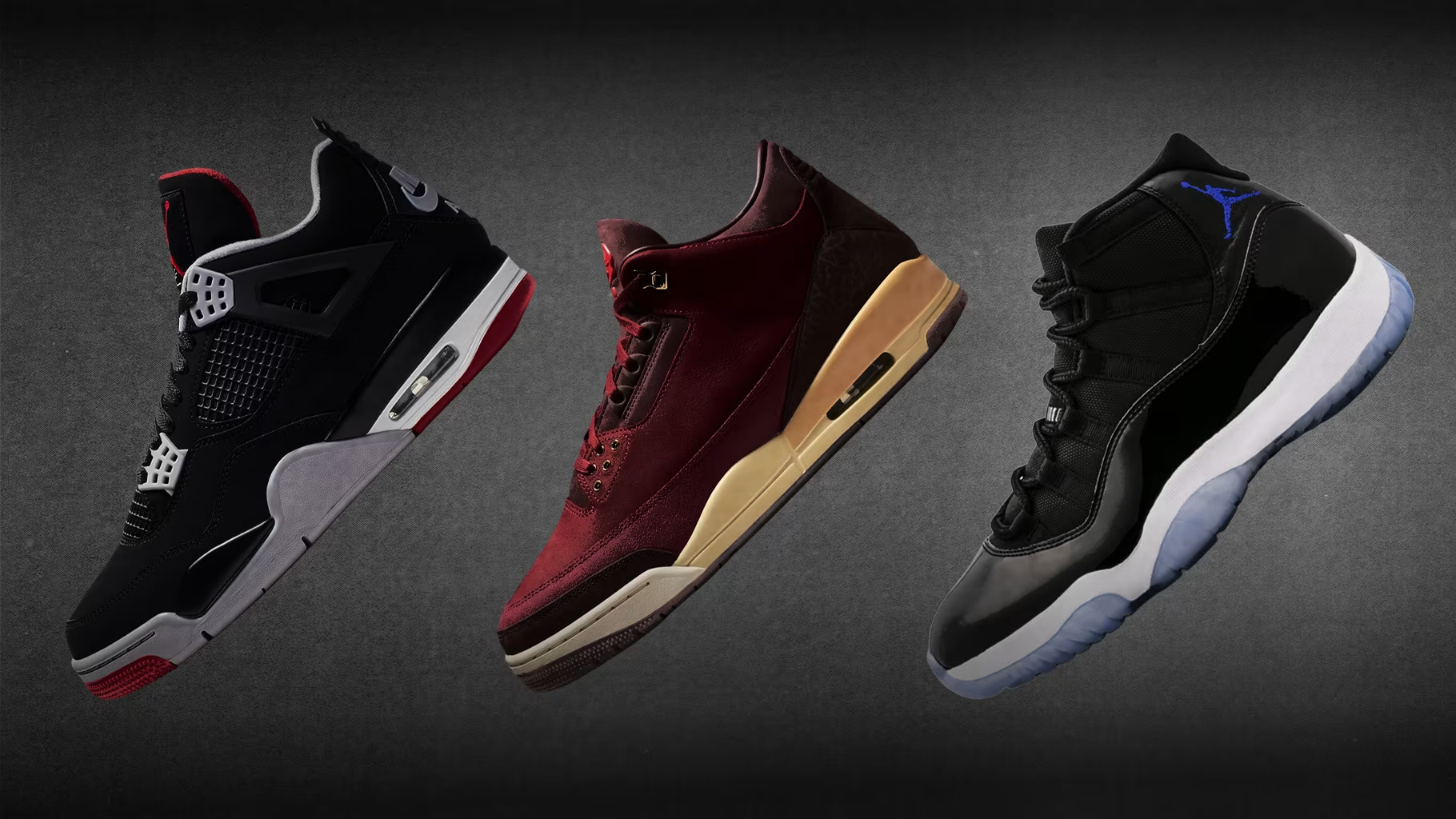
“Quality basketball products inspired by the greatest player ever." This phrase is not just a slogan, it is a mantra. It strikes to the core of every Air Jordan and every Jordan Brand product ever created. Those simple words have helped to inspire some of the greatest innovations footwear has ever seen. I have combined what I consider to be the most pivotal Air Jordan innovations ever and broke down how and why they changed the footwear industry forever. Come back next week as I visually lay out what the future could be for some of these innovations, but in the meantime check out 15 Design Elements the Air Jordan Line Changed Forever.
RELATED: Brett Golliff Renders Elite Versions of Classic Nike Basketball Sneakers
RELATED: The Nike Air Yeezy III Imagined
Air Jordan III
Year Released: 1988
Designed By: Tinker Hatfield
This shoe is significant for many reasons that have been discussed before but what really makes the shoe important from a design language standpoint is that it is the first Air Jordan to have Visible Air and it was the first to debut what could be the most recognizable logo in history, the Jumpman. The use of materials and color would make the III go down as one of the most iconic sneakers ever but its use of branding and technology is what established it as a serious contender as one of the most important sneakers of all time.
Air Jordan IV
Year Released: 1989
Designed By: Tinker Hatfield
By 1989, the idea of having a new Air Jordan was becoming normal, so telling a new product story every year was becoming essential. The IV presented a significant change in basketball shoes at the time as it featured molded "wings" to help hold your foot in place. Plus the shoe was shedding weight by removing layers and "exposing" mesh that was reinforced by injected silicone to allow your foot to breathe and still be supported.
Air Jordan V
Year Released: 1990
Designed By: Tinker Hatfield
I have always been told that every three designs you have to switch things up a bit. The preceding designs should evolve from each other so the consumer has a feeling of consistency, but when its time for the third one to be created you have to hit them with something impactful. The Air Jordan III and IV were a clear evolution from each other so when the V came around it was time to revolutionize. The V would become iconic for many reasons but it was really a great experiment in material execution. The V featured a fully reflective tongue to highlight the Jumpman logo that was becoming so prominent in pop culture. The 3M reflective material used on the tongue would change the industry forever and cause companies to begin looking for effects to take shoes to the next level. The V featured another first-time use on a basketball shoe, clear rubber. Which provided a dramatic look but also function, as it was a stickier compound of rubber providing extra grip.
Air Jordan VI
Year Released: 1991
Designed By: Tinker Hatfield
The VI marked the first Air Jordan to not have a tip. What is a tip, you ask? It is the extra piece of material that is wrapped around the toe for durability. What many don't realize is that as a shoe is manufactured it is pulled tightly around the last to give it supreme fit. When you do this it causes material to fold and bend as it forms around areas, especially rounded areas like the toebox. So to hide those areas of the pattern that didn't wrap properly, overlays are sewn on top of it to "reinforce" the area. So what makes the VI so significant is that it would forever change the manufacturing process of the Air Jordan line and basketball shoes, as having a clean toe would now be the desired look.
Air Jordan VII
Year Released: 1992
Designed By: Tinker Hatfield
An Air Jordan with no Visible Air? The VII marked the first Air Jordan in five years to not feature Visible Air, it still had Air but it was encapsulated inside the shoe. This trend would last for nine years, as the line didn't feature Visible Air again until the XVI. While the aesthetic change was dramatic for the line, the VII provided a larger impact by creating the first-ever internal bootie in an Air Jordan. Taking cues from the Huarache line, the VII would provide Michael with a sock-like fit and forever change the feel of the Air Jordan line as a new focus on fit would become a priority.
Air Jordan IX
Year Released: 1994
Designed By: Tinker Hatfield
The IX became important for the wrong reason, as it would become known as the first Air Jordan that Michael would never wear on court. It's a shame, because it is one of the best-fitting Air Jordan's ever, as it mastered the internal bootie by creating a lacing system that really locks down the foot around it. To achieve the great fit the upper was developed with TPU eyelets that would extend down around your foot, a feature that was truly ahead of its time. Think of it as an early version of Dynamic Fit. Another element that has become a major story in the past few years is the locking down of the forefoot by use of the midsole. Pick any performance shoe on the market today and you will find some sort of outrigger or midsole that wraps and surrounds the forefoot in a highly visual way. 19 years ago the Air Jordan IX did it first by having "fingers" that wrapped up and held the foot in place while cutting.
Air Jordan X
Year Released: 1995
Designed By: Tinker Hatfield
The X is not the most exciting Air Jordan of all time, but its use of elastic bands across the vamp was way ahead of its time. The bands provided a fit that stretched with you but didn't allow the shoe to slip. It was a feature that I think could have been taken further and should be reconsidered for the modern-era basketball shoe.
Air Jordan XI
Year Released: 1996
Designed By: Tinker Hatfield
The most iconic Air Jordan ever is clearly the XI. It is the Eames Lounge or the Porsche 911 of the footwear world. It is pure yet provocative. While its use of patent leather would provide it with its visual impact, it was its exploration of carbon fiber that would change footwear forever. By creating an anatomical shank plate that was formed from a lightweight but high-strength material it allowed Michael to be stable while reacting. Instead of losing energy by rolling over the top of his shoe during directional changes, the carbon fiber locked him into place and kept his inertia going in the proper direction. The XI changed footwear forever for many reasons but carbon fiber is the only piece of that shoe that actively lives throughout in nearly every performance basketball shoe 17 years later.
Air Jordan XII
Year Released: 1997
Designed By: Tinker Hatfield
The Air Jordan line is synonymous with craftsmanship and quality. It has always been touted for its use of full-grain leathers and unparalleled manufacturing capabilities. What I find interesting is that while most consumers use these adjectives to describe the Air Jordan line there are very few Air Jordans that are truly exercises in full-grain leathers, except for the XII. The XII was one of the only Air Jordans to be crafted out of all leather on the full shoe. What should also be noted about the leather use is that it wasn't a wasted feature—it was the main focal point of the shoe by using grains that were luxurious and colors that celebrated their placement.
Air Jordan XIII
Year Released: 1998
Designed By: Tinker Hatfield
The XIII is kind of an oddball in the Air Jordan line. It has color blocking like no other Air Jordan in history, it combines materials in a very unique way and its use of organic shapes is completely out of the ordinary for the Air Jordan line. However, it is that use of organic shapes that makes this Air Jordan one of the most functional models ever. All of the lines flowed around the anatomy of the foot and followed the natural contoured lines of the last. The lines all interacted with each other to bend and break with the podular sole unit that formed to Michael's foot. It also featured hidden lacing for the first time. Which can be seen as a more aesthetic move but it also helps pull the upper of the shoe closer to the foot by pulling the upper from within instead of from the outside like previous models.
Air Jordan XIV
Year Released: 1999
Designed By: Tinker Hatfield
While I am thankful it wasn't the last Air Jordan ever, I do think that the XIV would have been the perfect shoe to end the great line. Just like Michael's final shot against the Jazz, the XIV was the culmination of everything that came before it. It mastered the asymmetrical collar that started on the Jordan V. It had a profound take on forefoot reinforcement that evolved from the IX. It took what was basically a flat molded piece of carbon fiber on the XI and formed it around the entire arch of the shoe to create a heavily contoured shank plate. The crafted leather that was featured on the XII and the unique color blocking on the XIII combined to create some of the best colorways and material packages ever in the Air Jordan line. And it offered a new form of ventilation by having an actual porthole in the shoe to allow air to escape. The Air Jordan XIV truly was the Ferrari of basketball shoes.
Air Jordan XVIII
Year Released: 2003
Designed By: Wilson Smith III
By nature designers are always looking for new answers. Nothing is ever perfect and we can never be satisfied. So it should come to no surprise when we try to remove laces from the shoe and when we realize that that is not the perfect solution we try to find ways to hide them. The XVI and XVII both featured gators and spats that were removable from the upper that concealed the laces to provide a "cleaner" look. But they never fully worked, that is until the Air Jordan XVIII perfected the shrouded look. It managed to be visually clean, simple to use and most importantly functional.
Air Jordan XX
Year Released: 2005
Designed By: Tinker Hatfield, Mark Smith
The XX is a monument to the success of the Air Jordan line providing a visual story to the history of the brand. But what really makes the shoe important was the creation of "Podulon", a revolutionary cushioning set up that featured pillars of Air in key zones under the foot. One thing that I never fully grasped about Air Jordans is that they rarely evolved technologies that were created on the predecessor shoe. It seemed as though the new Air Jordan was always starting over in a sense as it was always the freshest aesthetic take for that year. What was great about the introduction of Podulon is that it lasted and is still in use today in the Jordan Brand line.
Air Jordan XXI
Year Released: 2006
Designed By: D'Wayne Edwards
The XX1 was created in a time when storytelling ruled the industry. In some ways the story became the focal point of the shoe moreso than the shoe itself. The Jordan Brand was selling the memory of Michael Jordan to us by creating shoes that were monuments to Michael that featured lines and forms that represented championships, most points scored, elements of his favorite cars and so on. While I feel that at times those stories got carried away, it is important to note that those stories can lead to innovation that is deeply connected to the product, for instance; modular sole unit cushioning. Long before we had interchangeable midsoles, the XXI offered the athlete the opportunity to switch from Zoom Air to Max Air in their heel to tune their game to their needs. It was a revolutionary feature that had to have been a development nightmare but it paved the way for many current shoes, see the Kobe VII and the forthcoming Lebron XI.
Air Jordan XX8
Year Released: 2013
Designed By: Tinker Hatfield, Josh Heard
While it was not the first Air Jordan to feature the FlightPlate, it was the first Air Jordan to master the FlightPlate. By having it extend through the whole midfoot and forefoot and having the Zoom Air cushioning directly mounted to it, the plate provides a stable platform to launch from. The FlightPlate, like the Podulon that was developed on the XX, is becoming a staple of the Jordan line as it is finding a home in not only basketball product but also training. The FlightPlate is the perfect representation of what the Air Jordan has become, as it is a feature that is created from the DNA of the whole line. It is an exploration on material that is highly visual and highly functional.