Image via Icon
Interviewing Nicolas Winding Refn is a lot like watching one of his films. It’s confusing, intimidating, fascinating, sometimes abrasive, but a lot of fun and always interesting. And most like his films, you also come out not really knowing what just happened.
Straight up, I should say that I am a massive Winding Refn fanboy, and I love all of his movies. I’d interviewed him once before, but that was for a side project, a book of old movie posters he was releasing. But this was different. This was for a proper NWR joint, for his latest movie The Neon Demon. Danish-born Winding Refn is still most famous for directing Drive, the ultra-sleek neon-tinged Ryan Gosling-starring car chase movie from 2011, but as time passes it more and more seems like that was less a breakthrough and more just an anomaly. Since migrating into English language filmmaking, Winding Refn has perfected a style of cinema where images and atmosphere are far more important than plot logic, and there’s usually a lot of neon, violence and pounding synths. Along with Drive, his other recent movies — the Tom Hardy true crime biopic Bronson, Mads Mikkelson Viking movie Valhalla Rising and Ryan Gosling Thai kickboxing flick Only God Forgives — form a very singular cinematic vision.
And the new one, The Neon Demon, might be the most Winding Refn-est of all. It stars Elle Fanning as a young girl heading to LA to become a model. Soon enough she’s the hot new shit of the fashion world, but that only brings the scorn and wrath of the older (early 20s) models who she usurps. And because this is a Winding Refn movie, that wrath takes the form of beautiful, horrific, and occasionally hilarious violence. It kind of feels like a cross between a million dollar Chanel advert and the sort of weird Japanese or Italian horror film your weird stoner friend shows you at 1am. Most people will probably hate it, but it’s incredible.
There’s a specific strand of arthouse directors — David Lynch, Jim Jarmusch — that strike a look and persona in real life that fits their movies. Winding Refn is definitely one of those. In television interviews and on red carpets he is a composed figure, in well cut suits and thick rimmed glasses and controlled thick-accented speech pattern, that reflect his immaculately designed films. When I interview him in a London hotel, clearly tired from a long on-ongoing publicity trail, he was not like this. He was sprawled on the sofa, without glasses, wearing a tracksuit top unzipped a third of the way down. He yawned, and occasionally scratched his chest hair. He looked like an Eastern European henchmen in a Jason Bourne movie.
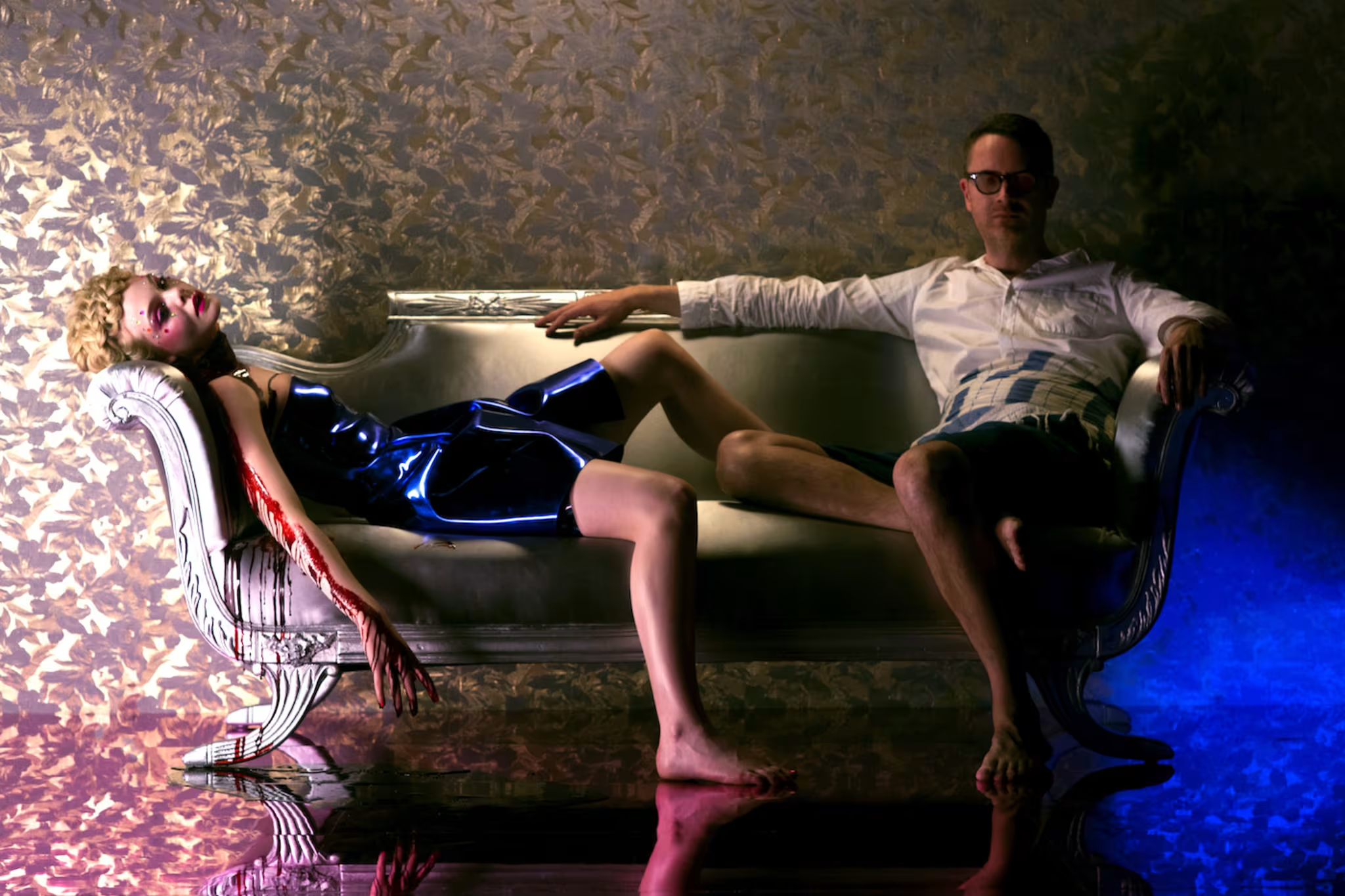
Winding Refn always says that the ideas behind his films start with a single image. So what image did The Neon Demon start with? “Death and beauty. The opening of Elle Fanning lying on the couch [covered in blood]. But looking very pristine. Even before I knew what I wanted to do, I knew I had to make a movie with this image.” Fanning was central to his vision. “There was only one option in my mind, and that was her. There was really no other possibilities. So the mission was get Elle Fanning. So luckily she wanted to work with me, so her mission was to get the part. It was a very easy marriage. I hadn’t seen her in a lot, [but] we saw a fashion shoot she had done, and you just knew she had that thing.” Did she ever get cold feet about some of the really extreme stuff that happens in the film? “She’s a very brave person and she’s game. That’s what’s so unique. I shoot in chronological order, which she really liked, and it really gave us an opportunity to create this character together, and go on her journey.”
The biggest name in the film however, is Keanu Reeves, who has a small but very memorable part as the manager of the motel where Fanning is staying. “I’m a huge admirer of Keanu,” Winding Refn says. “I think he’s absolutely extraordinary. And I just rolled the dice, and offered him a role and he agreed. And it was just like ‘Oh my god, he’s in’. It was an absolutely incredible experience working with him.” He’s very keen to sing his praises. “He’s a complete professional. Courteous to his co-actors, interested in trying things, fearless in choices. He’s the real deal.” I ask if the part was written for Reeves, and I get a very Winding Refn-answer. “It mutated into him, of course. He was able to embrace it in a different way.”
The way Winding Refn makes his films seems to be as unconventional as the finished projects. As he’d already mentioned, he shots as much of the film in order as possible. Why? “It forces me to be instinctual, which for me is very enjoyable. And it forces me to make a movie that is able to adapt to whatever I want it to become in the end.”
The opening titles of the film are particularly remarkable — it looks perfectly like a Dior commercial, with composer Cliff Martinez’s powerful synthesisers playing while glitter tumbles over the credits. Winding Refn himself directed a Gucci commercial with Blake Lively in 2012 — did that experience influence the film? “I would say the fashion world was very entertaining to work in, so it was kind of an interesting backdrop to when you are making a movie about beauty. But I’m not making a documentary. For me it was more about beauty and insanity. Which is quite complex. To some people it’s superficial, but to others it’s really complicated. [If] I had any sort of fashion question I just used [Neon Demon actress and model] Abby Lee — she’s a supermodel.”
So far, the interview is going fine. He’s answering my questions, though letting out the occasional yawn. He has a very deliberate way of speaking, that makes him hard to read. Like his films, it is hard to tell if he’s deeply serious, or completely taking the piss. The Neon Demon feels very much inspired by Dario Argento’s classic Italian supernatural horror Suspiria, as a lot of critics have noted. Was Argento an influence, I ask him? “Not necessarily,” he replies dryly. This is despite the fact that Cliff Martinez told me in another interview the week before that they’d spoke a lot about the music in Argento's films. And Suspiria that film is also part of a collection of influences he’s curated for streaming service Mubi. He’s clearly toying with me. Is The Neon Demon a horror film then? “It’s a film that has a little bit of everything. It’s a horror film, it’s a melodrama. It has glitter, it has vulgarity, it has camp, some humour, a little bit of suspense. And a lot of beautiful girls. So why wouldn’t that make it a horror movie?” Why indeed.
And we’re just moving on the more controversial stuff. So,The Neon Demon is the first of his films to have a female protagonist, and a mostly female cast. Instead of a snarling Tom Hardy or Mads Mikkelson, we have a lithe 16 year old Elle Fanning. “I think that every man has a 16 year old girl inside of him,” Winding Refn explains. “I felt I wanted to celebrate mine, and also celebrate all the qualities of, and the horrific nature of narcissism.” Is that based on a girl he knew when he was 16? “I think everyone knew of girls like this.” He’s being coy again. There must be one, right? “It’s so far back I can’t remember.”
The film is broadly about the fashion industry being vapid and horrible, but due to the sheer level of depravity its characters get up to — expect necrophilia and cannibalism — that it’s definitely going to generate a million thinkpieces about its depiction of women. I mention one negative response I heard to the film, that criticised that all the violence is women against women. Instead of society and the industry corrupting the girls, she felt it was saying that they were naturally like that. I put this to Winding Refn. His response: “That’s interesting. I wonder what her problem is.”
Surely he must have been aware that a film with content like this would get some responses like this? “I’m not a political filmmaker. I don’t have a specific point of view other than this is what it is. This is how I see it, this is my imagine. And that it’s really up to everyone else to take what they what they want, or have opinions of what they want. We live in a time where it’s very much in vogue constant search for pure utopian equality, and which on one level is quite amusingly silly but also on another probably very important.” I mention that the depiction of women in Hollywood is (rightly) particularly scrutinised right now, and reference the madness that erupted over the all-female remake of Ghostbusters. He claims to have no idea that it’s happening. I spend the next few minutes of my limited interview time explaining the Ghostbusters remake to him. I think he’s playing me.
I ask him more standard questions, and I can tell he’s definitely playing me. What good films have you seen recently? “Well, recently my eldest daughter started watching reruns of Friends a lot.” What’s up next for him? “I haven’t really decided yet. You never know.” Which actors would you like to work with? “Clint Eastwood, that’d be cool. James Stewart, but he’s dead.” What would have his rumoured Wonder Woman movie have been like? “I never got to make it, so I don’t know.” He has a wry smile on his face the whole time.
So I ask him if he likes doing interviews. “Sure.” There’s a pause. “It depends on what they ask. When it starts to be “What actor would you work with?” it’s like, what am I going to say? Those things aren’t interesting to me. But how you react to the movie I find interesting. There was once a German journalist that asked me if Only God Forgives takes place in the vagina. I’d never been asked that before, and I said, you know what, I think you’re right. A very interesting interpretation.”
Only God Forgives was one of most divisive movies of recent years. Winding Refn and Ryan Gosling followed up Drive, a movie that everybody loved, with a wilfully oblique and nihilistic Thai revenge movie. It was booed at Cannes, but those who loved it (like me), loved it. Did he deliberately make something so uncommercial to almost troll his new fans? “When you mean uncommercial, its hard for me to understand that, because the movie made a lot of money. It wasn’t very expensive. So uncommercial has a different meaning to me than it does for you. I mean, because of the success of Only God Forgives I got the money for The Neon Demon without a script. It’s interesting that it’s almost three years ago now that Only God Forgives [came out], and people are still asking me about it. So obviously the film must have done something."
He has had the chance to do more mainstream projects — he was even offered a James Bond movie — but he’s turned them all down. “There’s been some great opportunities. But in the end I just feel like so far I’d just rather do my own thing. I don’t feel I need any help. I don’t know what prestige it would give me. And they don’t really pay that well. Well, they may pay well, but then you do a lot of compromising. And it’s easier, and more enjoyable, to do advertisements. I think that if I did something like that you’d probably be really disappointed in the end, wouldn’t you?”
I ask him if he enjoys people hating his film. “I enjoy the fuck you.” Is getting a reaction the most important thing? “It’s the only thing. I mean why else spend your time on it? You might as well just watch television.” Whether you love it or hate it, The Neon Demon will definitely get a reaction out of you.
The Neon Demon is in UK cinemas now.




