None
The TV show that films patients without their knowledge. The 1996 police investigation into the Freemasons. Spies, political assassinations and secret messages hidden in codes—the truth is often stranger than fiction.
The notion that the world around us is full of sinister secrets is one that’s intrigued us for decades. It’s also provided a premise for many a movie, from 1973’s Soylent Green (“it’s people!”) to the virtual reality constructed in The Matrix.
Conspiracy theory thrillers are, much like the slew of clichéd rom-coms we’re bombarded with every Christmas, one genre we just can’t seem to get enough of. But how much truth is behind them? Prepare to be freaked out.
The Truman Show
Truman Burbank (Jim Carrey) is the unwitting star of his own reality show in this classic satire.
While Truman had good reason for his paranoia, there are those who simply find themselves sucked into the virtual world a little too deeply. Psychologists in Germany recently reported a case of ‘Twitter psychosis’ in a woman who obsessively used the site; she began to believe that Tweets from celebrities and friends contained subliminal messages instructing her to do things. Her delusions were put down to an existing psychological disorder, but the notion that social media is watching us isn’t one we should write off as being barmy. Facebook recently came under fire for the invasive settings on its Messenger app, which included access to the user’s camera and contacts, the ability to send unauthorised messages to friends, and storing conversations and personal data.
Some reality shows have, Truman-style, filmed participants without their consent. In Holland, a fly-on-the-wall show set in an A&E department was axed after it emerged that some patients had no idea there were hidden cameras in the room, but the most damaging example comes from Pakistan, where homosexuality is illegal. The show, Khufia, which roughly translates as ‘stealth’, had its presenters chasing people down the street and forcing entry into their homes, shouting accusations of homosexuality. In some of Pakistan’s larger cities, the LGBT community has found areas that will quietly tolerate them, and a petition to have Khufia axed stated that the show would only perpetuate the persecution of homosexuals and compromise their safety.
I Am Legend
A mutant version of measles has wiped out almost all of civilisation bar one man (Will Smith) who has developed immunity. Could an outbreak of disease ever drive humanity to the brink of extinction?
Every few years, a frightening disease comes along and threatens to become a worldwide pandemic. We’ve had SARS, bird flu and swine flu, and now we’ve got Ebola. The outbreak has reached a point where, in an attempt to curb the death toll, an untested cure known as ZMapp has been sent to Liberia. So far, one recipient of the drug has died but two are recovering, so it remains to be seen if it’s working, but the manufacturer has hinted that it won’t be making any more until it’s been tested on humans and approved. The question here is not whether our fate would fall into the hands of one man, but whether the creators of ZMapp are willing to forego testing in an attempt to save lives, or allow more lives to be lost in order to keep to their code of practice.
Disease and vaccines aren’t the only dangerous things to come out of laboratories. In the Fifties, beekeepers bred African bees with Brazilian bees in an attempt to create a bee with a higher output of honey. The result was killer bees; the hybrids weren’t contained and now live in the wild all over North America. ‘Killer’ isn’t an unnecessarily dramatic moniker, either – the bees have been known to attack in swarms and kill humans. Whether a bee or an untested vaccine, these events serve as a reminder that meddling with nature can be dangerous.
Splice
This bizarre Canadian sci-fi tells the tale of two scientists who mix human and animal DNA to create a hybrid creature. Predictably, it doesn’t go as planned, and the creature turns violent. Surely, if human cloning is illegal, the last taboo of mixing of human and animal DNA must be prohibited? Er, not quite.
In 2008, the Human Fertilisation and Embryology Act was introduced, which differed from the 2001 Human Reproduction and Cloning Act in that in legalised experiments for ‘medical reasons’ on human-animal hybrid embryos. However, it is still an offence to implant an embryo which has not been produced by fertilisation – in other words, IVF – into a human womb, meaning that a human-animal hybrid is unlikely to live unless conditions were such that it could grow and survive entirely outside of the womb. There have been no reported cases of anyone attempting to create a mixed-breed creature, but under current UK laws, it is perfectly legal to do so provided it isn’t carried by a human mother. As the UK was the first to regulate cloning, no doubt if it does happen, it’ll happen here first.
Utopia
Channel 4’s dystopian thriller, which recently aired its second series, is built around the premise that a shady organisation has been poisoning the food chain with fertility-altering drugs. The likelihood of such a plot being discovered in a graphic novel, as in the series, is slim, but how safe is our food?
Believers in chemtrails would say ‘not very’. This is the theory that the trails of condensation emitted from aeroplanes as they fly are full of aluminium salts and barium, which fall to earth and settle on our crops. In small quantities, barium is perfectly safe – a tiny dosage may even be given to patients before receiving an x-ray to provide clearer imaging. Larger amounts, however, can cause high blood pressure, an irregular heartbeat and kidney failure, with some theories even suggesting that long-term exposure can trigger degenerative diseases like multiple sclerosis. It’s certainly a less subtle way of killing people off than the methods employed by The Network in Utopia, but advocates of this theory believe the goal is the same – to keep our numbers down.
Food is clearly an effective conduit of poisons, but water is even more so. In 1988, the Cornish village of Camelford had its entire water supply poisoned with 20 tonnes of aluminium sulphate. Worryingly, it was the water board itself behind the contamination, with an employee simply choosing the wrong tank in which to dump the aluminium. Despite being aware of what had happened, local authorities insisted that the water was safe to drink, and allegations of a cover-up ensued. A number of Camelford residents went on to die of rare forms of dementia, which their families claim were caused by aluminium deposits on the brain.
The Constant Gardener
In this adaptation of John le Carré’s political drama, Rachel Weisz’s character is killed after she threatens to reveal illicit drug tests on Kenyans. Could the multi-million pound pharmaceuticals industry really be willing to endanger the lives of third-world inhabitants?
The UK-based organisation, the Institute of Science in Society (ISIS) seems to think so. In a detailed manifesto on their website, they claim that drugs are tested on children in third-world countries by the US Food and Drug Adminstration (FDA) under the guise of providing free treatments. They name and shame Ventria Bioscience for allegedly giving synthetic proteins to Peruvian children, despite knowing that they were unlikely to get clearance to test the proteins in the US. Other reports, however, suggest that the Peruvian Ministry of Health has approved the testing of the proteins, which are designed to provide extra nutrients and hydration to children. The ethical issue seems, in reality, to be centred around the children’s inability to consent, being that all those in the study were below a year old.
The Da Vinci Code
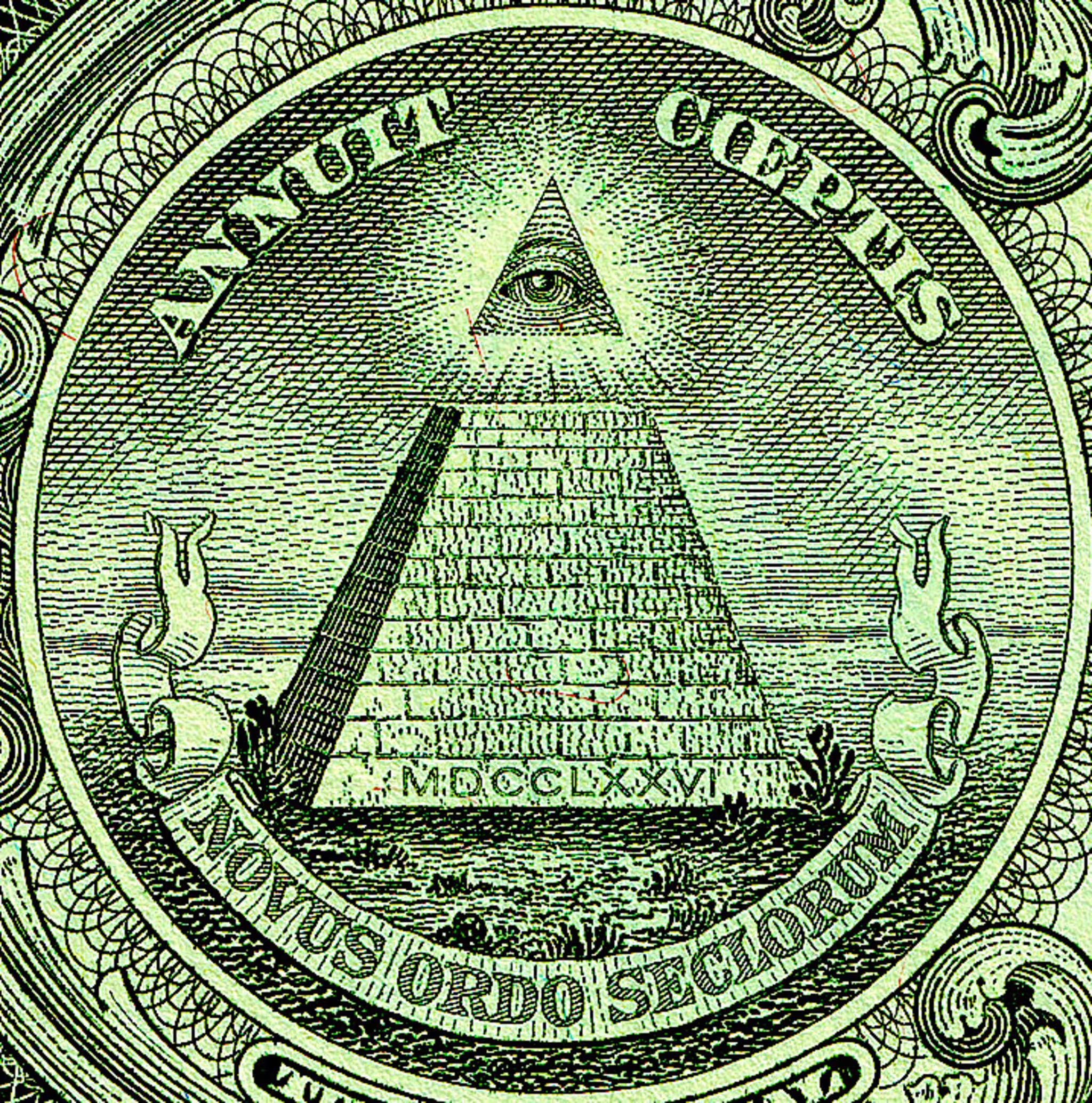
The adaptation of Dan Brown’s bestseller is based on the theory that Jesus and Mary Magdalene were married and had a daughter, and that hidden artefacts in the Louvre could destroy the very foundations of Christianity. This is, of course, the basis of the Illuminati.
While destroying religion as we know it might not be on the Illuminati’s agenda these days, there are those that believe they’re alive and well and trying to take over the world. The most popular theories around what the Illuminati are up to centre around them engineering fatal disasters, such as 9/11 or disappearance of the Malaysian flight MH370. The New World Order, as they’re now widely known, are apparently ruling the world, controlling the output of the media and eliminating anybody who stands in their way – including, apparently, Robin Williams. The unfortunately timed episode of Family Guy that aired before Williams’ death was, according to some, a subliminal message from the New World Order, warning of his impending demise at their hands.
One group that often finds itself accused of affiliation with the Illuminati is the Freemasons, as demonstrated by the strange case of Adrian Nastase, the ex-Prime Minister of Romania and reportedly a prominent Freemason. He was rumoured to be behind a campaign to silence Gregorian Bivolaru, a man who’d written a book exposing the secrets of the New World Order. In 2012, Nastase was arrested on corruption charges and, as the police arrived at his house, he shot himself in the throat. Some suggest that, rather than trying to evade justice, his botched suicide attempt was actually an effort to hide his connections to Freemasonry and the New World Order.
From Hell
This account of the Jack the Ripper murders is another blow to the Freemasons, suggesting that a Masonic plot could have been behind the killings. Are they getting a raw deal when it comes to having conspiracy theories built around them, or can Freemasonry really inspire some to kill?
Some claim that Norwegian serial killer Anders Breivik is proof that it can. Breivik was a member of a Masonic lodge in Norway, and had referenced some Masonic texts in his chilling manifesto prior to the killings. The lodge master, however, evicted Breivik as soon as his crimes were reported. Breivik was also a member of an organisation calling itself the Knights Templar, which was founded in 2002 in London as a ‘reformation’ of the historic group said to know the secrets of Christianity. This modern version, however, wasn’t affiliated with Freemasonry in any way, and described itself as an ‘anti-Jihad’ organisation. Breivik was known to have anti-Islamic views, so it can safely be assumed that he was brainwashed not by Freemasonry, but by far-right ideology masquerading as an ancient sect.
However, in the Dunblane school massacre of 1996, police did investigate the possibility of a Masonic plot. The gunman Thomas Hamilton was reported to be a Freemason, and some argued that this could have made it easier for him to obtain a firearms license and run spurious children’s clubs at the school. Accusations of a cover-up were also levelled at Lord Cullen, the officer in charge of the enquiry, over suggestions that he too was a Freemason. He denied being one, but another police chief, Lord Burton, later reignited claims that he was. It’s incredibly worrying to think that, if Cullen was indeed a Freemason, the protection of his society would come before seeking justice for those who died at Hamilton’s hand.
Prison Break
Like Utopia, there’s a secret organisation at play here, but this time they’re framing an innocent man for the murder of the US Vice-President’s brother. Another how-safe-are-we-from-our-own-government saga, but a look back over some of the events of the last decade would suggest we might have reason to worry.
Probably one of the most famous conspiracies of recent times is the death of David Kelly. During an off-the-record conversation with BBC journalist Andrew Gilligan, Kelly expressed his doubts over the existence of weapons of mass destruction in Iraq, and was aggressively questioned about his claims. Two days later, he was found dead in woods near his home in an apparent suicide. His family, however, claimed that his arthritis would have made it difficult for him to cut his own wrist, and some doctors questioned whether the artery he severed would have led to him losing enough blood for it to be fatal. The Hutton Inquiry, which investigated his death, stated suicide as the cause, but declared all information relating to the case as classified for seventy years.
Another victim of a so-called inside job was the Russian spy Alexander Litvinenko, who accused his employers, the Federal Security Service of the Russian Federation (FSB) of ordering the assassination of a well-known oligarch, Boris Berezovsky. He was arrested on charges of exceeding his position, but these were dropped and he moved to the UK, where he made a career writing about his involvement with the Russian government. In 2006, he was poisoned with polonium and subsequently died, in what many have called out as his silencing by Russian authorities.
Death of A President
This mockumentary details the assassination of George W. Bush, and imagines the aftermath and political ramifications.
Vladimir Putin has been the subject of at least one failed assassination attempt. In 2008, a would-be sniper went to the trouble of renting himself a flat opposite St Basil’s Cathedral in Moscow on the day of the presidential elections, in order to give himself a clear shot. It’s not known whether his estate agents tipped off the police. More recently, a Russian TV host claimed that the shooting down of flight MH17 was actually an attempt on Putin’s life; less than an hour before the passenger flight was targeted, the President had flown back from Brazil along the same flight path.
Barack Obama has also been targeted. Two white supremacists made plans in 2012 to kill 88 Black Americans, including Obama, and behead a further 14. The numbers 88 and 14 hold particular significance to neo-Nazis; the 8 represents H, the eighth letter of the alphabet, and is thought to be code for the Hitler salute, while 14 is a reference to a fourteen-word slogan repeated at supremacist meetings. It was the use of these numbers in their chilling plot that led to it being foiled by police who recognised the significance.
In what can only be described as an epic fail, a deranged man by the name of Karst Tates attempted to kill the Dutch Royal Family as they drove through the streets of Apeldoorn. Tragically, he mowed down several civilians, but completely missed the car in which members of the Royal Family rode. His ride of terror was cut short when he crashed and later died from his injuries. Risk, it would seem, is not a factor that quells the desire of some to kill their leaders, although being of unsound mind is probably a requirement
Jacob's Ladder
This creepy thriller tells the story of a group of Vietnam veterans who begin to experience grotesque flashbacks, and discover that a drug intended to increase their aggression was secretly being tested on them. We already know that secret drug tests may or may not be happening (see point 8), but what happens when legitimate tests go horribly wrong?
While there haven’t been any reports of flashbacks or psychological abnormalities as a result of drug trials, there is a man who paid a tragic physical price when he agreed to be part of a test at Northwick Park in 2006. Ryan Wilson was one of six men who took TGN1412 – a so-called wonder cure for multiple sclerosis and leukaemia – and was left with no fingers or toes as a result. Other participants’ heads swelled to several times their normal size, and all were told that they had a high risk of developing cancer or immune deficiencies as a result of their exposure to the drug.
A similarly frightening trial in 2003 saw some human guinea pigs die and others left with cancer after taking an unnamed asthma drug. More worryingly, a doctor involved with the trial, Dr Edward Erin, was accused of falsifying test results to cover up the disaster. It wasn’t this, however, that sent Erin to prison – by the time his lies over the trial had been discovered, he was already in jail for attempting to poison his pregnant girlfriend. The protagonists in Jacob’s Ladder may not have had a choice over whether to take the drugs given to them, but often, medical trials are seen as nothing more than an easy way to make money. While the majority are indeed safe, the chance of things going disastrously wrong can’t be eliminated, and the dangerous Dr Erin is testament to the fact that, in the worst cases, you can’t even trust your doctor.




