None
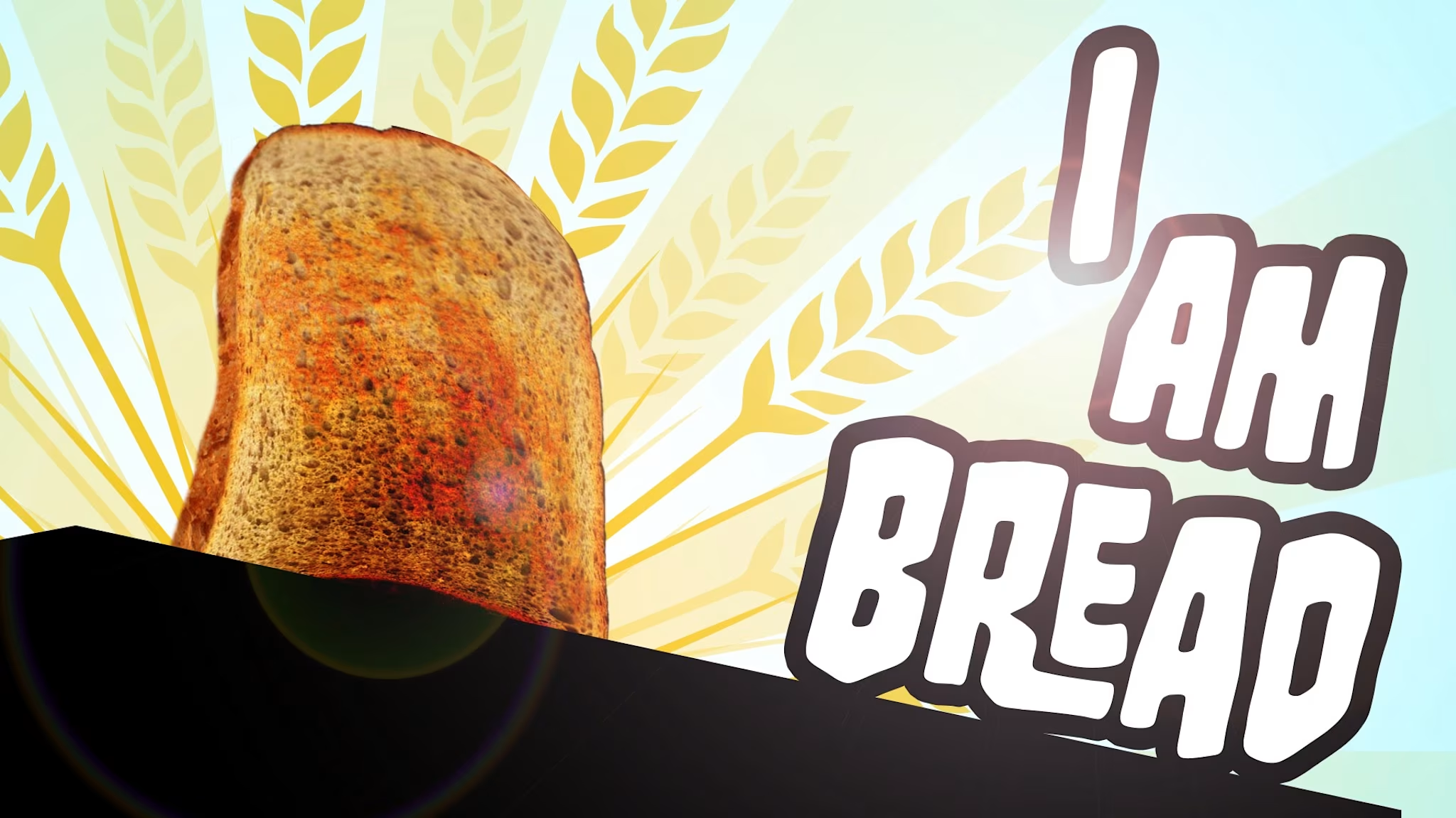
Eating and playing video games. Two age-old pastimes (alright, so the former has been around a little longer than the Xbox) that seemingly share no link. But a quick glance back over the most popular games of the last thirty years points to food being an ever-present theme in the gaming world, and developers Bossa Studios have taken this to the next level with their latest release, I Am Bread.
As the title suggests, you play as the actual piece of bread, embarking on a quest to be toasted. While the idea of role-playing as a piece of food is innovative, the presence of food within gaming has been steadily growing since the release of Pac-Man. While gaming culture is under fire – thanks to movements like Gamergate – for entrenched misogyny, there’s a whole genre that exists outside of the controversy, and has done successfully for years. Here, we take a look at the best servings from the world of food gaming.
I Am Bread (Bossa Studios)
A ‘bread simulator’ might not sound like the most exciting premise for a game, but it’s strangely endearing. The trailer shows the slice of bread—that’s you—flopping and flying its way around a kitchen, smothering itself with power-ups in the form of virtual condiments on its mission to reach the toaster. The house in which the game takes place has the delightfully twee feel of a property straight out of The Sims, but the fact that each corner of the bread is controlled independently suggests that gameplay won’t be as simple as it first appears. I Am Bread looks set to be an instant hit when it’s released—the trailer has already racked up over a million views.
Pac-Man (Namco)
Rewind 34 years, and we find the godfather of food games: Pac-Man. Namco’s arcade hit needs no introduction, and maybe because of its enduring popularity, it’s easy to forget that its basic premise is eating. Its original Japanese name, Paku Paku Taberu, even means ‘the sound one makes when opening and closing their mouth quickly’. It was given the catchier name Pac-Man by its US marketers, Midway, and has pretty much remained a classic ever since. It was heralded upon its release as an entirely new genre—one that appealed to both genders. Addictive simplicity is an important characteristic in food gaming, and as Pac-Man proves, that simple formula works.
Food Fight (Atari)
Hot on the heels of Pac-Man, Atari released Food Fight in 1983. Their foray into food gaming saw Charley, the lead character, making his way across the screen to an ice cream, with the goal of eating it before it melted. Four chefs stood in his way, and much like the ghosts in Pac-Man, could be immobilised by collecting certain foods that appeared throughout the level. It was one of the earliest examples of food being an intrinsic part of the game—while Pac-Man had dots and the occasional magic fruit, Food Fight had ice cream as its end goal, and plenty of other edible fodder (peas, pies and watermelon) along the way.
Pizza Tycoon (Software 2000) Themed
By 1994, food gaming had become a little more sophisticated. Eating or collecting food were no longer the only objectives, and German developers Software 2000 united food and business with Pizza Tycoon. As well as designing pizzas, it was your job to make your restaurant a success, even involving the Mafia if you saw fit. This new cultural element was used to great effect in both Pizza Tycoon and its 2000 sequel, Fast Food Tycoon, both of which borrowed from movie-Mafioso culture and had the player faced with dilemmas such as joining the ‘dark side’ or running their restaurant legitimately. IGN awarded Fast Food Tycoon 7/10 for being a ‘fun economic simulation’, showing that food games could be just as multidimensional as any other genre.
Order Up! (SuperVillain Studios)
An unprecedented hit on the Wii, 2008’s Order Up! took the restaurant sim to a new level of interactivity. But, rather than focusing on business strategy as Pizza Tycoon did, Order Up! introduced more of a puzzle element. Picky customers’ dishes must be completed to perfection in a set amount of time, meaning that the speed and dexterity needed to succeed at the game could almost merit it being filed under the ‘brain training’ category. It might also be the only game to make washing up fun—a plate-washing mini game is one of the many non-culinary challenges. It also tapped into the growing mobile gaming market by releasing Order Up! To go on Android and iOS, through Cut The Rope publisher Chillingo.
Chop Sushi (THQ)
Another food/puzzle hybrid, THQ’s 2010 mobile release sees the central character, Master Chef (who looks suspiciously like a tuna steak in an apron) travelling through a series of islands and battling his opponents in a kind of Connect 4-meets-sushi situation. You won’t find any realism here—the fact that the game is centred around sushi is really just a gimmick, but it’s also the game’s entire identity, and it works. While other food puzzlers like Order Up! and Cooking Mama used simulated cooking as the basis for the game, Chop Sushi uses sushi as nothing more than an aesthetic. It’s a clever device—the likes of Cut The Rope and even Candy Crush show that a mobile game with even a loose food theme has instant appeal.
Fruit Ninja (Halfbrick)
Also released in 2010, Fruit Ninja is another example of food being at the centre of the game, but also being superfluous. It was named as one of Time’s 50 Best iPhone Apps in 2011, and the following year, TechCrunch reported that it surpassed 300 million downloads in the US. But would it have been so popular if you were slicing tennis balls, human heads or any other inedible object? It’s a great example of how the food genre is one of the most appealing themes in gaming today, because it’s aimed at absolutely everyone. By going back to basics and using the tried-and-tested devices of simplicity and addictive gameplay, and adding the cutesy element that virtual food has come to represent, Halfbrick made a hit.
Citizen Burger Disorder (Kritz)
A bizarre blend of Minecraft and restaurant sim, Citizen Burger Disorder appeared quietly this year and soon became a hit with the online multiplayer community. The aim is simple: build burgers. Its purposefully awkward controls (think Octodad) make this decidedly more difficult, but that hasn’t stopped users signing up in their droves, to the point that the servers crashed and the game is currently offline. The resurgence of retro, non-linear games like Minecraft might account for its popularity, but then it could just be the fact that it involves burgers. Watch gaming YouTuber Matt Shea playing to get a feel of what it’s all about.
Don’t Starve (Klei Entertainment)
If you thought the food gaming genre only had room for the cute and cartoonish, 2013’s Don’t Starve is here to change your mind. It turns the genre on its head by using food not as an aesthetic or a puzzle piece, but as the key to the protagonist’s survival. Sitting somewhere between Limbo and Professor Layton on the steampunk scale, Don’t Starve follows Wilson, a ‘gentleman scientist’ according to its makers, as he’s trapped in a demon netherworld. In order for him to survive, the player must find food and sustenance for him. While there’s a lot more to Don’t Starve than scavenging for tidbits, Wilson’s basic need to eat to stay alive adds another dimension to the game.
Food Practice Shooter (Takayuki Kosaka)
It was only a matter of time before someone tried to marry food gaming with eating IRL, and last year, professor Takayuki Kosaka of the Kanagawa Institute of Technology did just that. Food Practice Shooter is part arcade shoot-em-up, part lesson in eating healthily. The player shoots a plastic gun at a screen of marauding vegetables, but in order to replenish their ammo, must eat the corresponding vegetable in real life. By way of a weighted table of veggie treats and a headset that measures chewing, the game knows if you’ve eaten your greens, and won’t let you continue until you do. Whether it actually works as a way to encourage kids to eat healthier isn’t actually clear, but the guinea pigs playing at the 2013 Tokyo Game Show didn’t look too happy.




