If you’ve ever watched a Super Bowl Halftime performance, chances are you’ve seen some of Todd Kaplan’s greatest work. As the former CMO of Pepsi and now Kraft Heinz, Kaplan understands the power of not just looking at the “data” or the “numbers.” He tasks his team—and himself—with creating an emotional connection with the consumer to yield cultural dividends.
Chill and personable, Kaplan took the Zoom call for this interview from his home library, an airy and bright collector’s dream outfitted with trinkets and memorabilia that prove Kaplan is not just a marketing guy, but also a purveyor of pop culture. His bookshelf was stacked with an MTV Moon Man here, a Kobe Bryant bobble head there, and front and center was a signed football from Dr.Dre, Kendrick Lamar, and Eminem after their halftime show. His desk, however, was surprisingly (or unsurprisingly) orderly.
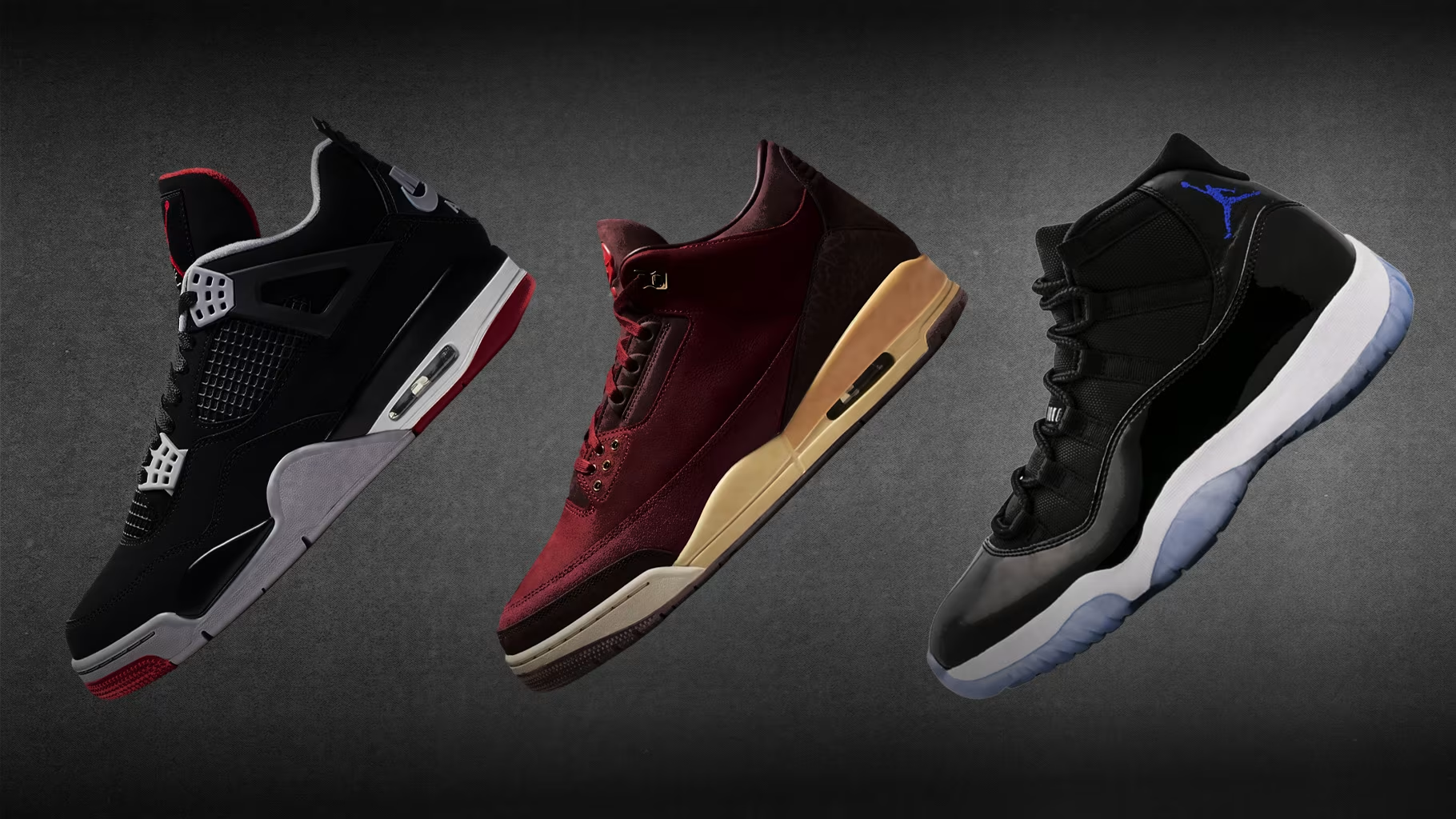
Kaplan didn’t grow up thinking ‘One day I’m going to lead a major CPG brand’; instead, he followed his love for sports and his innate curiosity, and it led him to where he is now. Like many of his generation, Michael Jordan’s impact on the court inspired a culture outside its lines, which was hard to ignore. A certified Nike loyalist, Kaplan eschewed his wingtips for a pair of dunks on his way to the C-suite.
A real one, indeed.
For the second installment in Complex’s CMO series, Todd Kaplan takes center stage to discuss the five qualities a marketer needs in today’s crowded marketplace.
Fun fact: not one of these qualities involves a spreadsheet.
Kids don't grow up and say to themselves, ‘I want to be the chief marketing officer of a major CPG brand.’ So, can you tell me what in your childhood first sparked your interest in marketing?
I've always been a big sports fan, and I may be dating myself, but growing up with Michael Jordan and watching Gatorade and Nike commercials helped. I didn't grow up saying, ‘I want to be a CPG marketer.’ Instead, I interned at Fox Sports Net Chicago and the U.S. Olympic Committee. I was at Michael Jordan's retirement press conference. I started working at Visa on the global sports sponsorships, the NFL, the Rugby World Cup, things like that.
As far as marketing, the psychology part of it has always been interesting to me. What makes people tick, why do they buy things or pay more, etc., but also the creative aspect of it. I've always been creative, inventive, and wanting to create new things. I found my way to PepsiCo and had a great run there for several years before joining Kraft Heinz. Always bringing this idea of sports, music, entertainment, and culture into the brands and into these products because they're real in the lives of consumers.
My introduction to MJ was seeing him play for the Bulls. For a lot of people, they’re introduction to Jordan was Space Jam. What was it about seeing Michael Jordan that sparked your creativity?
I’m in the same camp, but I’m also a Lakers fan, so I have that whole Magic, Shaq, and Kobe thing too. I'd say it was this idea of creating a cultural movement, right? You look at a brand like Gatorade or Nike and how that became a part of the ethos. It wasn't even about whether the Chicago Bulls won or what Jordan was doing, but it was just a lifestyle through sports.
You can get a degree in marketing, look at the numbers, do the research, et cetera, but what innate quality do you think marketers need to have?
There are five things. The first is creativity. Thinking outside of the box and exploring possibilities, so you need to have that muscle. The other is curiosity. Especially nowadays, understanding why someone buys this? Why did they pick that up? The third is storytelling. How you communicate and how you bring your narratives into tight, cohesive stories is an important skill both for internal and external storytelling. Strategic rigor and analytics are the fourth quality you need to understand how you're going to grow your brand, and then the last is empathy.
Empathy? Really?
Yes. I don't think people talk a lot about it in marketing. Really understanding consumers and understanding their behaviors. You can work anywhere, and it doesn't matter if you're a good marketer; you should be able to understand and empathize with your core consumer creatively and strategically connect the dots, and through great storytelling, bring great messages and great products out in the marketplace.
You said think outside the box. Well, what’s the box?
I think the box right now is this idea of being able to find new ways to tell stories that will cut through. You'll learn that humans aren't rational beings at the end of the day. (laughs) We're not an ‘If-then’ Excel formula. What you do learn is through creativity, so if you find the right way to cut through, or the right thing to connect to in how you build that bigger story, there are a lot of emotional layers that you can bring into your brand building. And that's the idea of brand building.
What's different from product marketing is this idea of brand building. Consumers have a deeper emotional connection to brands. The way I talk about the Jordan brand it's almost not rational on a subconscious level. There's a connection point there. That's where I think good brand builders leverage creativity. It's not just the utility of the product or service that you're giving. It's the whole package, and how you can think about it from the packaging all the way up to the communications and everything in between.
You've been quoted as saying, ‘Take no as a request for more information.’ Can you please expound on that?
In a large company or organization, it's expected that you're going to run into your share of no’s and a lot of roadblocks along the way. Whether it's your legal team, your finance team, your supply chain team, whatever it is, there's always a reason not to do something. And a lot of times, a really great idea gets killed early on before it has a chance to evolve. And I like to say, ‘take no as a request for more information,’ because sometimes understanding what's behind the no will help you make the idea better at times, and will also help you understand a different way to bring it through the organization to maybe flip a no into a yes.
So it forces you to bob-and-weave and think about things a little bit differently to get that yes, with your cross-functional partners. And so sometimes you know that this is a great idea, but to get there in the amount of time or with the resource or with the supply chain or with the legal risk or whatever the thing is, you just need to think about it a little bit differently, and sometimes, shimming it through the organization. And so I like to tell my teams to take no as or request for more information.
As the North American Chief Marketing Officer for Kraft, what new marketing tools are you using to get Gen Z's attention?
If you think about the concept of paid media today, you're reaching a target audience, but they're not really engaged. Think of all the messages people receive. I know when a commercial comes on, I pick up my phone. When a pre-roll comes on, I hit skip. When an email comes into my inbox from a brand, it goes to junk mail, so marketers are reaching the target audience, but they're not connecting with them. So, there's this idea of creating opt-in marketing. Making something so interesting that someone seeks you out and wants to forward it to a friend, or talk about it, or read about it in a news article.
That's this idea of marketing that happens where it starts with a cultural truth, a brand or product truth, and a consumer truth. It's creative and interesting enough that people want to talk about it, and you hear about it organically. So, number one, how can you have your brand live outside the walls of paid media with marketing? Number two, the marketing approach, um, has been a bit antiquated. Uh, if you think of the traditional agency client model of you brief, they come back, you wait a few weeks, then you go round one, round two, and you go from there. If you think about moving at the speed of culture, it's been a little bit tricky. And so I've tried to create this new idea, I call it collaboratively, uh, with our agencies.
Lastly, everyone knows Kraft Heinz makes ketchup, but people tend to forget you guys also make Mustard, which lent itself to a pretty dope partnership. Tell me about that.
When Kendrick’s recent album thrust his producer, Mustard, into the spotlight, we saw an opportunity to collaborate. Our goal was to create a cultural moment for Heinz Mustard by further amplifying Kendrick’s iconic callout “Mustaaaaard!” in households everywhere. It was very important to us that we were creating and adding to the cultural conversation, so authenticity in our partnership with Mustard was key.
We created a spot to announce our collab right after Mustard and Kendrick’s win for Song and Record of the Year, instantly teasing a new release that nobody saw coming - a new flavor of “mustaaaard”. We continued the momentum into Super Bowl week as we named Mustard our official Chief Mustard Officer, launched OOH in his hometown of Inglewood, teased exclusive ‘Mustard’ content on our socials, and created 57 custom Mustard hashtags on Super Bowl Sunday that brought Heinz into the social conversation as the world was talking about ‘Mustaaaard’ during his historic halftime performance.
Without an official Super Bowl ad buy, we still became one of the most talked-about brands of the Super Bowl.