Image via FX
If you’re still speechless after watching the Atlanta Season 3 finale, you’re not alone. The incredibly bizarre and thought-provoking third season of the FX hit series came to an end on Thursday, May 19, with the episode titled “Tarrare.” (The episode was named after a French showman named Tarrare who had unusual eating habits and an insatiable appetite, but more on that later.) The episode, written by Stefani Robinson, focuses entirely on Van (Zazie Beetz). Beetz has delivered a subtle yet significant performance this season in the few episodes we’ve seen her in, but she finally gets her explosive solo episode with the finale that tracks where Van is emotionally and mentally. [Ed note: Spoilers for the Season 3 finale of Atlanta below. You’ve been warned.]
Viewers noticed that there was something off about her since the start of the season when she joined Earn (Donald Glover), Darius (LaKeith Stanfield), and Paper Boi (Brian Tyree Henry) on their European tour in Episode 2 “Sinterklaas is Coming to Town.” Van left behind a boyfriend, her career, and Lottie, the daughter she shares with Earn. In Seasons 1 and 2, Van seems to be the one who has it together. She’s the responsible one who is committed to her job and raising her child. In episodes like “Champagne Papi” from Season 2 and “Value” in Season 1, fans got to see her interactions with friends Candice and Jayde whose lives are nothing like Van’s. She has missed out on experiences by being a mother and dating someone like Earn, as opposed to the NBA players or businessmen that her friends date. There are instances where they treated Van as if she was less cultured and less experienced, simply because their lifestyles are different.
Image via Getty
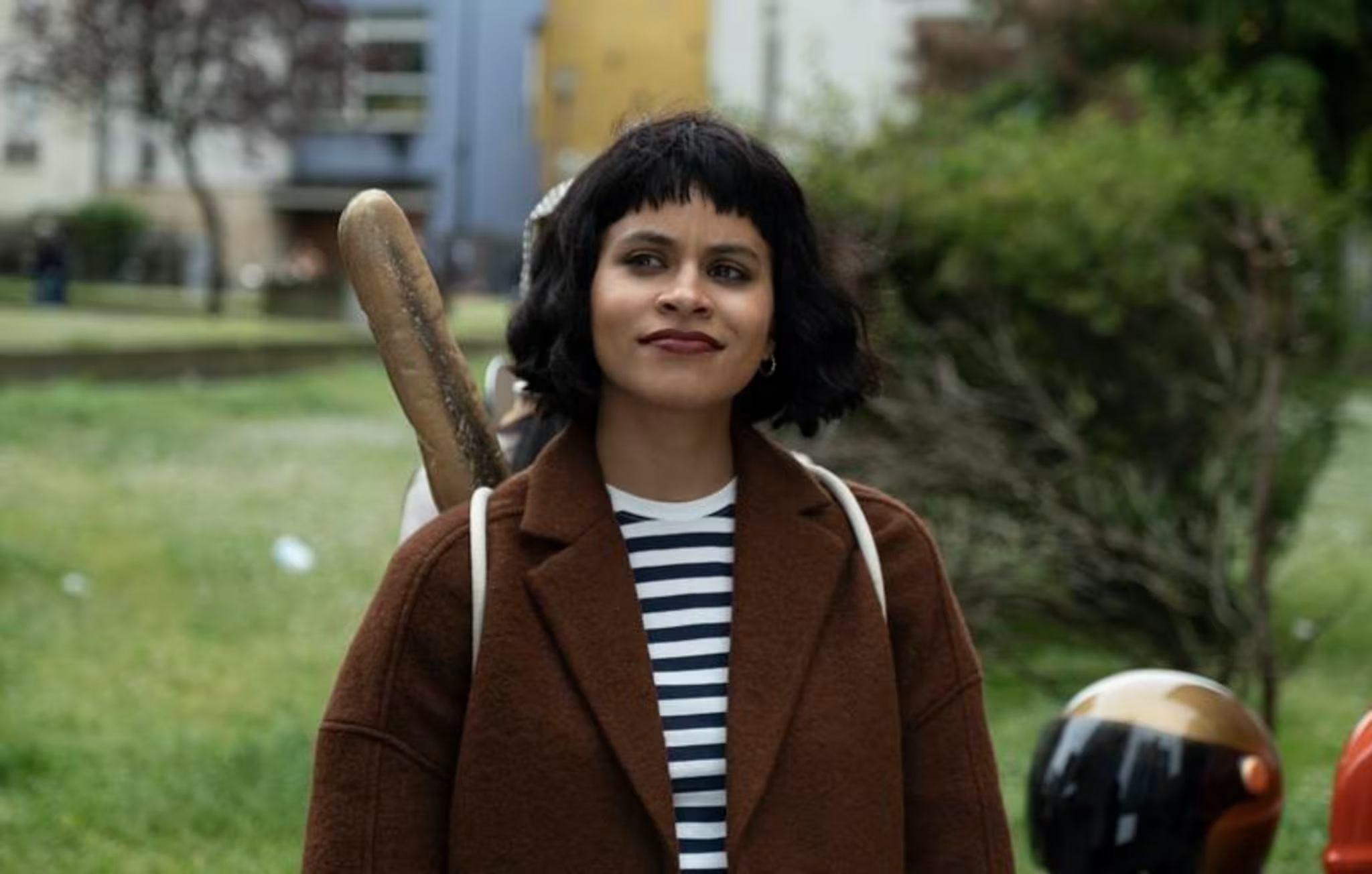
All of that tension that has built up inside her erupts in the Season 3 finale. There are moments earlier in the season where she seems adrift, distracted and absentminded. Earn struggles to get ahold of her eventually, and we don’t see her until “Tarrare.” The finale shows that Van has taken on a whole new personality and has created a strange, new life for herself in Paris, France. She has adopted a French accent, is wearing a wig resembling the titular character’s hair in the 2001 French film Amélie, and has some sort of intimate relationship with Alexander Skarsgård. Van’s new life is nothing like her life in Atlanta, and by chance, she runs into her old friend Candice who eventually reminds her of who she really is. The episode’s writer showcased Van’s identity crisis in an erratic, funny, captivating way, but also managed to display the strangeness, real pain, and confusion that many people in situations similar to Van’s are feeling.
“When you have that identity crisis in that way, it can feel really scary, especially in a world we’re living in where there’s so much emphasis on purpose, right? We’re so inundated with things on social media and presentations of self that feel very manicured. This is what I’m doing, and this is what I did today. This is a cause that means something to me,” Robinson tells Complex. “What happens when you don’t really know what those things are? It’s a very lonely feeling. I feel like having that conversation, just saying it out loud, ‘Yeah, I don’t know who I am. I don’t know what I want to do. I don’t know what I stand for. I don’t know,’ is soul-crushing a little bit, but it’s real. Also, it just felt very natural in terms of her character progression.” Complex caught up with Robinson ahead of the finale, and she delved deeper into her inspiration for this episode, what led to Van’s mental breakdown and how Atlanta’s writers balance telling real stories in unusual and unconventional ways while still delivering a thoughtful and necessary message. Check out our interview with Atlanta writer and executive producer Stefani Robinson below.
How have you been feeling about people’s reactions to the season so far?
Stefani Robinson: I’m not really on social media in that way to really gauge it. But from what I understand, it’s pretty par for the course in terms of Atlanta, which people are like, “I don’t understand this. I don’t like this. I love this. This really speaks to me.” You know what I mean? I feel like from what I’ve heard, it seems pretty consistent to me.
For sure. Obviously, Van has had such an interesting path this season. You captured her emotions from every episode that we saw her. Where do you think this finale finds Van mentally?
SR: I think mentally we sort of see it where we meet up with her in the Amélie wig when we first see her in the episode, you’re sort of witnessing someone in the middle of some kind of mental breakdown and some sort of identity crisis. And obviously, you go through the episode, and it’s funny and you’re on this journey, and you really see that she’s really committed to this alternate identity. Then at the end obviously there’s the reveal that something bigger is going on, something more emotional.
What you’re seeing is sort of like a culmination of all the hints or all the sort of behavior that you’ve seen from her in the previous episodes where you sort of see her in a different light than maybe we’ve seen her before, where she’s been the responsible mom and she’s been trying to keep her job in previous seasons, and now we sort of see that she, I think, is more of an individual, and she’s making individual choices, even though they seem a little unhinged. But that’s sort of the point, that we’re building into this bigger reveal and reveal a better character.
We have seen in two past episodes, one that you wrote, “Value” from Season 1, where we see her relationship with her girl friends and who she is outside of Earn and Lottie. She kind of has a love/hate relationship with her friends, like Candice (who also appeared in Season 2, Episode 7, “Champagne Papi.”) Why was it so important for you to bring Candice back for this episode?
SR: We’re bringing her in as that perspective or that counterpoint, that there is someone who knew who Van was. There’s a really revealing piece of dialogue in the kitchen. Van says something like, “You’re just mad at me because you’re not in charge of me right now.” That perspective isn’t so dissimilar to her feelings towards her friend Jayde in the “Value” episode. And in my mind, Van is someone who has struggled with sort of falling into the shadow of other women and other people, not just women.
You sort of see it with Earn as well, like in the “Helen” episode, and you see sort of bits and pieces of that, that Van is someone who doesn’t know who she is. So much of that comes from maybe not being able to have the opportunity to fully figure out who she is. By having a child early she wouldn’t just be able to pick up and start a music career and go on tour and put herself in a situation where she is figuring it out. She was a little bit stunted in her growth in that way and this is an opportunity where she is alone to figure that out. And obviously, there’s sort of a bigger, darker, subtext of that, that she is having this identity crisis.
She’s someone who just wants to be in control of herself and to know who she is. She’s clearly surrounded herself with a lot of strong people who do know who they are, and that’s sort of what she’s getting at at the end when she says to Candice, “You know who you are. My kid knows who she is, and Earn knows who he is. And I’m just sort of surrounded by people and have been surrounded by people my whole life.” The subtext is that, but know who they are and have had the opportunity to figure it out. She hasn’t, and that was something that was important.
Bringing Candice in to be there to contrast that or to be there to have that dialogue was really important with someone who knew her. And I think it’s more impactful that it was with someone who knew her versus someone who was just seeing her for the first time. It was important that she be confronted with someone who knew who she was before, taking on this persona at least.
What was behind the choice to bring Candice in as opposed to Earn? Because that could have worked also.
SR: I don’t think we wanted it to feel so convenient. Like, “Oh yeah, it’s Earn. He found her, whatever.” The idea that she’s sort of untethered was off on her own and if someone else came upon her was the more interesting thing. That was just sort of a pushing back at what it means to write a TV show in that we just wanted it to feel, more real isn’t the word, but just the idea that these characters aren’t with each other all the time, and there’s something that maybe felt a little bit more organic about this idea that Earn couldn’t even get a hold of her, get through to her, and it took this outside force, someone, something completely random to get her to have the conversations that we wanted to have.
It was us just sort of pushing back on the convenience. Would it be too convenient for her to have a conversation with Earn about all this stuff? Part of me, my own feeling, is that I don’t think she really trusts Earn enough to have these conversations and to be this vulnerable. They obviously love each other in their own way and have a history. But I think that it’s probably really telling that she hasn’t had this conversation with him before. So my own feeling is I don’t think she trusts him enough fully to do this thing or to have that conversation and to speak about the things that she’s talking about at this point. It was important too, to put her in a position where it felt more natural for that character to do that, again sort of pushing back on the convenience. “Oh, of course here’s Earn coming in to, not necessarily save the day, but here he is!” Just felt a little, I don’t know, on the nose. And again, trying to preserve that randomness is sort of the Atlanta approach as well.
In the second episode, we saw Van coming to Amsterdam and meeting up with the guys, and we could instantly tell that something was off. She pushed that guy into the pool and then later she gets accused of stealing. Did she do it? We don’t really know. So maybe this was her slowly becoming the person she is now in the last episode. How were you able to get her from the first time we saw her in Europe to where she is in the finale?
SR: So we always knew that we were breaking, at least the season, with this episode in particular. We knew that this is what, this episode is that perspective or that ending that we wanted to preserve. We wanted to get her to a point where she was having this dialogue with a friend and she had learned about her mental state and how she feels about herself and all that. So we knew that’s something that we wanted, so then we sort of just reverse-engineered from there. So we were just very meticulous about, “OK, now that we know where she ends up, when we see her in all the other episodes we need to keep that in mind.” So it just became something to pay attention to and something that we intentionally placed in there to track to earn that moment at the end.
There is a level of depression that’s going on here, that people don’t really open up about, especially moms, Black women, and women in their 20s and 30s, who are constantly trying to keep up with everybody else. Why did you want to highlight Van’s mental state and that she wasn’t doing well?
SR: What you’re pointing out is incredibly important, and I think that at least for me, I wanted to write that in there just because it was real. It’s just real. And I, speaking as a young person, speaking as a Black woman, I have had issues with mental health. I’ve got so many friends who have had issues with mental health, and it’s just not something that’s easy to talk about in real life, and it’s not so much highlighted in television as well in shows like this.
I wanted to do it in a way that isn’t so, woe is me like it’s all a catastrophe. The other interesting thing is mental health is so, when you’re going through something it doesn’t always look like just sitting in bed crying. It can look like so many different things. It can look like a more manic episode. It can look like trying on different personalities, trying new things with risky behavior. It can look like so many different things. That complexity was something that was important and something that I think is funny about the episode, and not funny to make light of what she’s going through, but just sort of what a mental state like that can push a person to do, but also just having the conversation out loud, it just feels so, I don’t know, authentic to the character.
She’s losing her job. She’s sort of juxtaposed with friends who are living in very intentional ways, and she’s sort of always been kind of floating around trying new things out. Obviously, she’s a mother and a single mother, and she’s sort of taken on the burden of being a mother while Earn is able to go on tours. He’s a manager. He’s got purpose in a different way, and she, I think a lot of her identity, the subtext of it at least, is a lot of her identity has been wrapped up in being a mother and taking care of this other human being. But then now she sort of touched on too, this other human being is starting to form their own identity, but she’s sort of left with, “Well, wait a minute. Well, who the fuck am I then?” My child is going off to school and is becoming a person and has likes and dislikes and has friends that aren’t me.” It’s like, “Well, who are my friends? What do I want to do with my years? And I spent so much time keeping this human being, this little human alive and that isn’t just my, can’t be my identity anymore because even my child is moving on.” It’s scary whether or not you’re a single mother, no matter who you are.
In the scene where she has the breakdown in the kitchen, when she just starts throwing dishes, I felt relief for her. She’s not a very emotionally expressive person, but seeing her blow up, was like, “Finally. You’re human. You’re alive.” Is that what you intended to portray with that scene?
SR: I don’t think there was any intention. It was just sort of what it was, but I love that that’s your interpretation of that, and I can see how that’s really special and is different than maybe how we’ve seen her before. But I think you’re exactly right. That’s a sort of eerie thing about the episode is that she is so committed to being this character with the French accent that it is kind of like, “What are you doing? What is going on?” And that she’s just so committed to not breaking the character that when she is breaking that character and you do see her again, it is just like, “OK, good. You haven’t been sort of brainwashed and you’re tapping into yourself in a way, that you are sort of breaking the facade.”
With Atlanta, there are always these very real conversations that are happening in one layer, but then on the surface, there are a lot of bizarre things that are also happening. Like them eating human hands. Why was that important to add to the story while telling such a deep and thoughtful story about Van and her experience?
SR: I think this is a good question. It’s something that felt cinematic and strange, and it was just so left of field that, which is, I guess you were pointing out this seems to be the MO or the objective of Atlanta’s writers. But some of those things sometimes when you put them in they don’t really have a bigger meaning other than “This is just bizarre.” That was the thing that I wanted to portray was that, and I think we all did, was that she is so clearly deeply entrenched in something that feels scary and strange and really foreign, that it should feel a little scary and strange to someone who knows her, like Candice.
It was just strange and weird and I think was more of a commentary on just foreign culture and eating habits, and again, that sort of thematic thing that we’re sort of picking at too is just like, what does it mean to leave the safety of your home? You are in a new world, and what it means to travel. And we are seeing our characters in new environments. So in that way it just felt like something that doesn’t necessarily happen in Atlanta, people covering their heads and eating hands.
There is an argument that could be made just even about the classism, of what does it mean to have a fancy dinner, and what does that cost? And depending on who you are, if you’re maybe a white, rich, European person, it’s like, “Well, no, this is a delicacy. Yes, they’re human hands. And yes, we did chop the hands off of humans to be eating them. But of course, because we’re having, this is a delicacy.” Who cares about the humanity behind it? What about the experience?
Atlanta’s Season 3 finale is now available to stream on Hulu.




