jlin-black-origami
For all the negatives 2017 has brought, it has been a great year for music, as evidenced by our list of the best albums of the year. There has been some really innovative work from artists on the rise, from SZA to Lil Uzi Vert to Kelela. But we’ve also had some longtime talents come with albums that challenged not only listeners but the artists themselves. Tyler the Creator gave us his most profound and emotional albums yet. Childish Gambino proved that he’s more than clever wordplay, and Lorde followed her debut with an album that is as catchy as it is insightful. It has not been a year of holding back.
Naturally, with all those great records to listen to, there was so much music that many of us couldn’t get around to, even from artists who are by no means new faces. It’s been a powerful year for electronic artists like Fever Ray and Jlin, whose latest records offer music that is at once challenging and irresistible. Perfume Genius, who returned with his fourth album, subverts the notion that music has to be sad to be affecting. There’s also Jonwayne and Kamaiyah, newish voices who have found ways to channel their demons into stinging creations. Below are albums from the past year that should be on your radar.
Perfume Genius, 'No Shape'
It would be a stretch to say that No Shape, the fourth album from Perfume Genius (the moniker of Seattle-based artist Mike Hadreas), was overlooked. But the pop record — as good as pop gets — is certainly an underappreciated work from 2017. The strength of Perfume Genius’s discography lies in its ability to be incredibly raw, excruciatingly real, and, most significantly, foundational for its fans. Hadreas is gay, and his records have always felt confessional, like sacred texts intended to fully document the scope of one’s interiority. His specificity opens doors to relatability, especially for queer listeners. With No Shape, however, Hadreas explores a more ecstatic realm — not necessarily a post-struggle one, but a stable one. On “Valley” he sings, “How much longer must we live right / Before we don’t even have to try.” It’s an ode to routines, an incisive and cutting exploration that also offers up a gentle reminder: There’s still a life to be lived after fulfillment.
Jonwayne, 'Rap Album Two'
On “Human Condition,” a track off of Jonwayne’s affecting fifth record Rap Album Two, he plainly states, “I know my flow’s full of contradiction.” Emblematic of the album at large, the lyric is full of deep meaning. On one level, it speaks to something those who have closely followed Jonwayne’s career could have guessed: He’s cripplingly self-aware. He’s a white guy in a medium that’s not intended for him, but perhaps more telling is that the contradiction Jonwayne is interested in here is one that has plagued artists since the beginning of time. Rap is his life passion, but it’s also eating him alive. It enriches him, but it also drives his worst impulses. He has been open about his struggles with alcoholism, and Rap Album Two is a testament to vice, to a career and purpose that keeps you going while it’s killing you.
Fever Ray, 'Plunge'
Everything is political, and Plunge, the second record from Fever Ray (alias of Swedish musician Karin Dreijer) offers both pure electronic bliss and a fierce declaration of Dreijer’s beliefs about herself, her sexuality, and the messy world in front of us. There’s not an ounce of restraint in Dreijer’s music — it’s deliberately discordant, obtrusive, and cutting — and her lyrics do the same. They’re remarkably open. “Tell me something sexy and I'll log off my whatever / Gag me, awake my fighting spirit / Take your time and stay off the channels / We’re not attracted to this country’s standards,” she sings. Plunge doesn’t exactly contain any sort of traditional hit on it, but it becomes an easy record to savor in a time of such discordance. Dreijer sings of BDSM, abortions, and her desires, making for a record that’s contagious with its maniacal energy. Contagious and, perhaps, cathartic.
Mount Eerie, 'A Crow Looked At Me'
A Crow Looked at Me is, from the outset, a difficult record, but one that Phil Elverum had to make. The album was released the year after his wife, cartoonist Genevieve Castrée, passed away. Much of it sees Elverum not so much trying to work past his grief, but holding onto the tenderest moments of his relationship, stating understandable insecurities and fears about raising their young daughter — and, in its most poignant moments — he evokes the power of memory, of memory poems. On “Seaweed” he narrates, to his dead partner, and wonders if she were into Canadian geese.” It’s where A Crow Looked at Me starts to feel like a gorgeous transcription, a last chance to document a chapter of Elverum’s life that tragically came to a close. It’s very sparse musically, but it also feels completely organic, like a work that could not exist in any other form. The melodies are uncomplicated, the verses appear more like disjointed diary entries than of anything traditional, but it suits Elverum’s undertaking. There are few things that capture pain as well, as undiluted, as A Crow Looked at Me does.
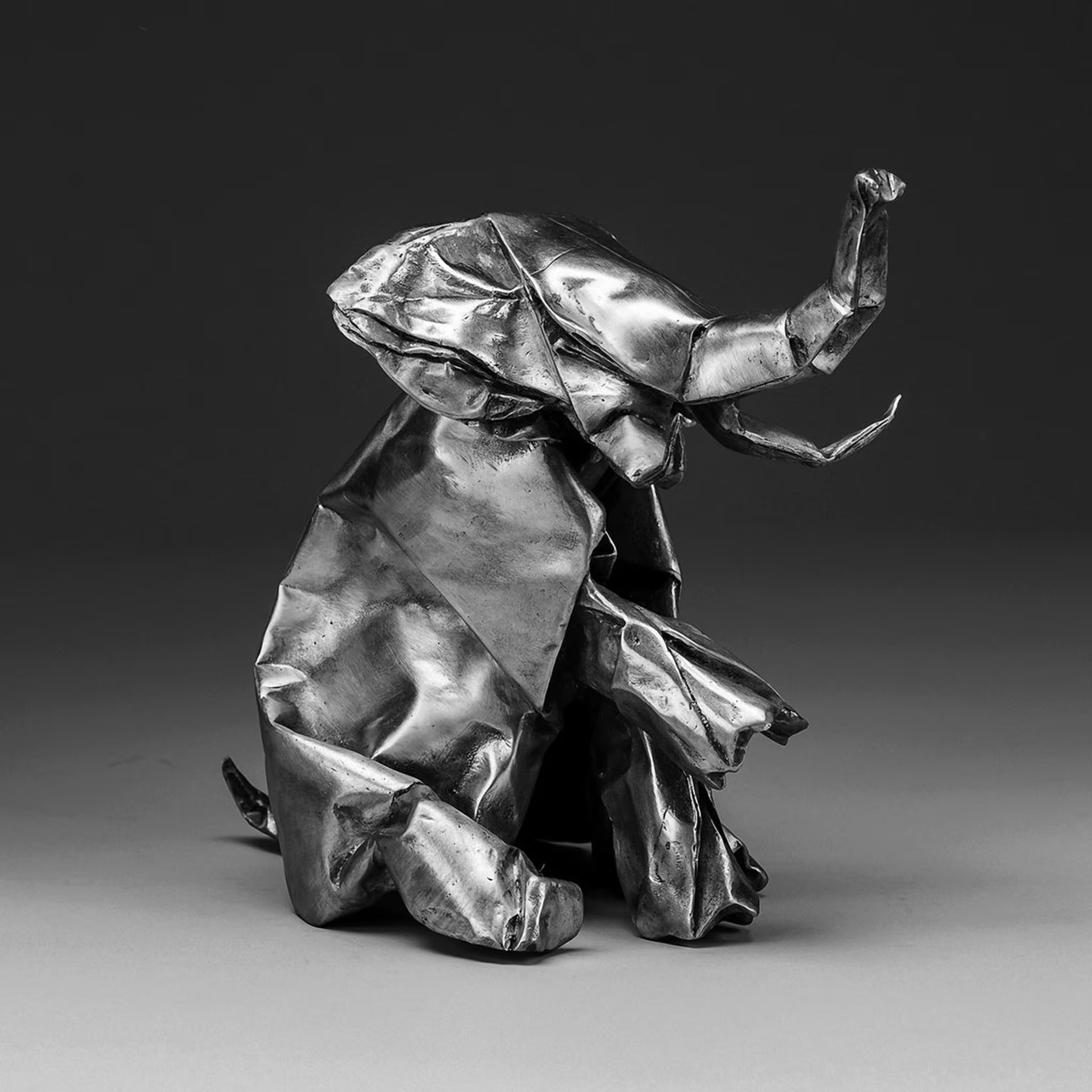
Jlin, 'Black Origami'
The appeal of Jlin’s Black Origami isn’t simple to articulate. It isn’t intellectual either. The Gary, Indiana-born electronic artist garnered attention for her 2015 debut, Dark Energy, an intensely gorgeous dance album that operates as an homage to footwork, the dance and music style born in Chicago in the ’90s, but also offers an eruptive sound that’s entirely unique to Jlin. On Black Origami, the footwork influences are still apparent: techno, bass, and a clear appreciation for rap aesthetics. She takes things a step further, however, and creates an album that is immediately disruptive — it’s practically arrhythmic — but also seductive and hypnotic. You get lost in her strange beats, her synth work, and the faint and incomprehensible voices that appear throughout the record. Black Origami is transcendental, a listening experience that can’t be reduced to clear, mathematical objectives. It’s too wild for that, too alien. Yet, you listen. Again and again.
Kamaiyah, 'Before I Wake'
Kamaiyah’s second mixtape, Before I Wake, contradicts everything we’ve come to be weary of in a sophomore effort. It’s not a repetitive work — the themes from her first mixtape A Good in the Ghetto don’t appear here (or at least not in the same way). Instead, it’s more sonically and lyrically mature, indicative of a rap talent who has a lot to pull from. Take “Therapy,” the closing track off the mixtape. It opens with a contagious synth, but then meshes the upbeat, dance-y track with something a little less artificial. “No parenting / Going crazy, think I need therapy / Who gon' really love me and be there for me? / When it comes to money, they don't care for me / Apparently,” she raps. Before I Wake is super-concerned with the mental health of its star, but impressively manages to be vulnerable without sacrificing boldness. Even when she’s expressing her anxieties and the way she feels about herself in the world, Before I Wake is confident. As she says in the opening track, “Dope Bitch,” “I know you hate to see me living this great / But you ain't got the tools to make the moves I make.”
King Krule, 'The Ooz'
Archy Marshall does a lot. At 23, he’s released more music than many artists do over a lifetime, and has done so using several aliases. King Krule, perhaps his most famous, is also his greatest project. His raw talent — immediately evident with his first record, 6 Feet Beneath the Moon — made him a figure to watch. With his rich baritone, immediately distinguishable, Marshall’s music has been praised for the way it fuses jazz, hip hop, and punk sounds. On The Ooz he pushes his influences even further, to the point that it’s surprising any of it fits together. It’s a must-listen record, if only to hear the way he seamlessly blends genres together, creating something that feels distinctly King Krule. A track like “Logos” feels contained, with sultry jazz and quiet vocals. But he can also move on to something louder, more violent, like the angsty “Emergency Blimp.” Sometimes he yells, other times he coos. Sometimes he broods like Morrissey, other times he rages like Pete Doherty. But with all of this, The Ooz is an entirely cohesive effort, an audacious work from a talent who knows what he likes, even though it may seem unfathomable to the rest of us.
Arca, 'Arca'
It’s not a coincidence that Arca, the Venezuelan electronic artist who got his start as a producer, enhancing some of the best songs off of albums like Kanye’s Yeezus and Bjork’s Vulnicura, named his third record after himself. He first proved he was more than a great collaborator with his prior two electronic records, Xen and Mutant. Much of the pleasure one experiences when listening to these works comes from the fact that they’re bizarrely loose and amorphous, absorbing in how confounding and unstable they feel. They’re even more spectacular when put alongside his visuals, which he creates alongside the artist Jesse Kanda. Arca’s music videos feature all sorts of animated creatures, and these shapeless, genderless bodies enhance what Arca does best as an artist: make us question all we’ve deemed normal and traditional. This continues on Arca, a record as unhinged as his previous ones, but also one that’s immediately more intimate. Arca sings on it, and his vocals, operatic and haunting over music that is at once melancholic and divine, make for one of this year’s most spectacular projects.




