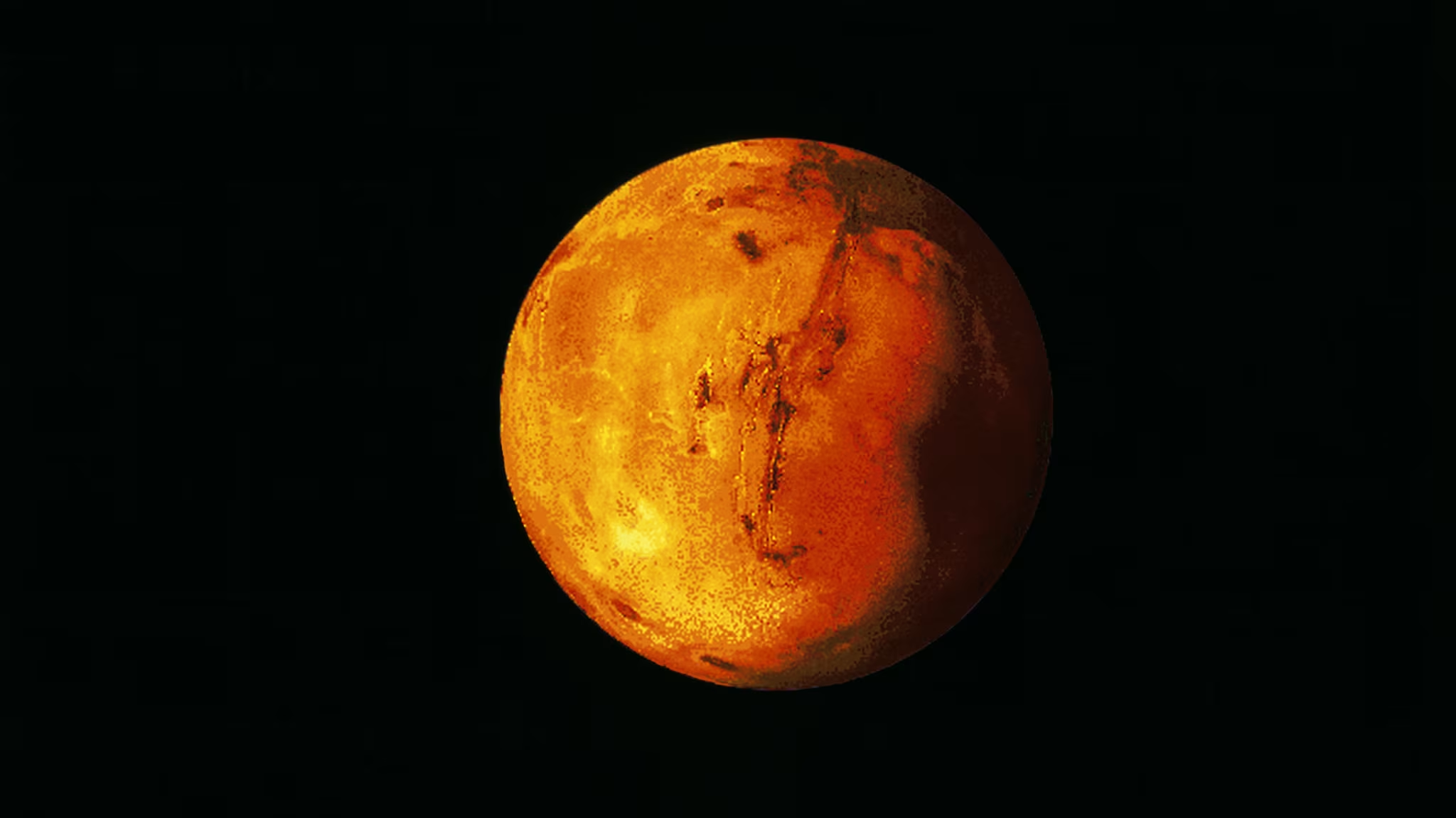
NASA is investigating a string of “Marsquakes” that have been detected on the Red Planet, in the hopes that they could provide info about potential surface landslides or underground volcanos.
The tremors were detected by the space agency’s InSight lander, which touched down on our planetary neighbor back in November 2018. Insight’s purpose is to learn more about Mars’ interior in order to give scientists a better idea of how the planet was shaped. If scientists are able to acquire knowledge on that subject then they’ll better understand why rocky planets form, and subsequently may be able to learn which of those planets have a greater chance of supporting life.
This past Thursday, NASA revealed that Insight’s seismometer detected “two sizable quakes.” Those happened on March 7th and 18th, in an area called Cerberus Fossae, which is where two previous quakes had occurred. The most recent two recorded magnitudes of 3.3 and 3.1, which are weaker than the two that had happened before (those were 3.6 and 3.5), but they’ve actually been more useful in giving scientists a better idea of the planet’s interior.
“Over the course of the mission, we’ve seen two different types of marsquakes: one that is more ‘Moon-like’ and the other, more ‘Earth-like,’” said Taichi Kawamura of France’s Institut de Physique du Globe de Paris. “Interestingly, all four of these larger quakes, which come from Cerberus Fossae, are ‘Earth-like.’”
Something that all four quakes also share in common is that they occurred during the Martian northern summer. Note that a Martian year is equal to slightly less than two years on Earth. We inform you of this not to pad out the article, but because winds during that time of year are calmer, which provides a more conducive environment for scientists to hear seismic activity.
“It’s wonderful to once again observe marsquakes after a long period of recording wind noise,” seismologist John Clinton said.
It’s believed that Mars, unlike Earth, lacks tectonic plates. Instead it looks like its volcanically-active regions are responsible for the events. NASA adds that the InSight has detected more than 500 quakes to date.
Related Stories

Plans Unveiled for First Sustainable City on Mars by 2100
The architecture studio ABIBOO has revealed its plans for Nüwa, the first sustainable city on Mars that can be be populated by up to 250,000 people.

Elon Musk Thinks SpaceX Will Get Humans to Mars Within the Next Six Years
After a successful round of SpaceX flights, Elon Musk thinks he'll send a manned craft to Mars by 2026. The CEO has long eyed the Red Planet as a goal.

SpaceX's Starship Prototype Achieves Successful Test Flight: 'Mars Is Looking Real'
Mars feels closer than ever to being a full-blown reality after a recent (short) test flight from Elon Musk's SpaceX company, who's having a solid 2020.




