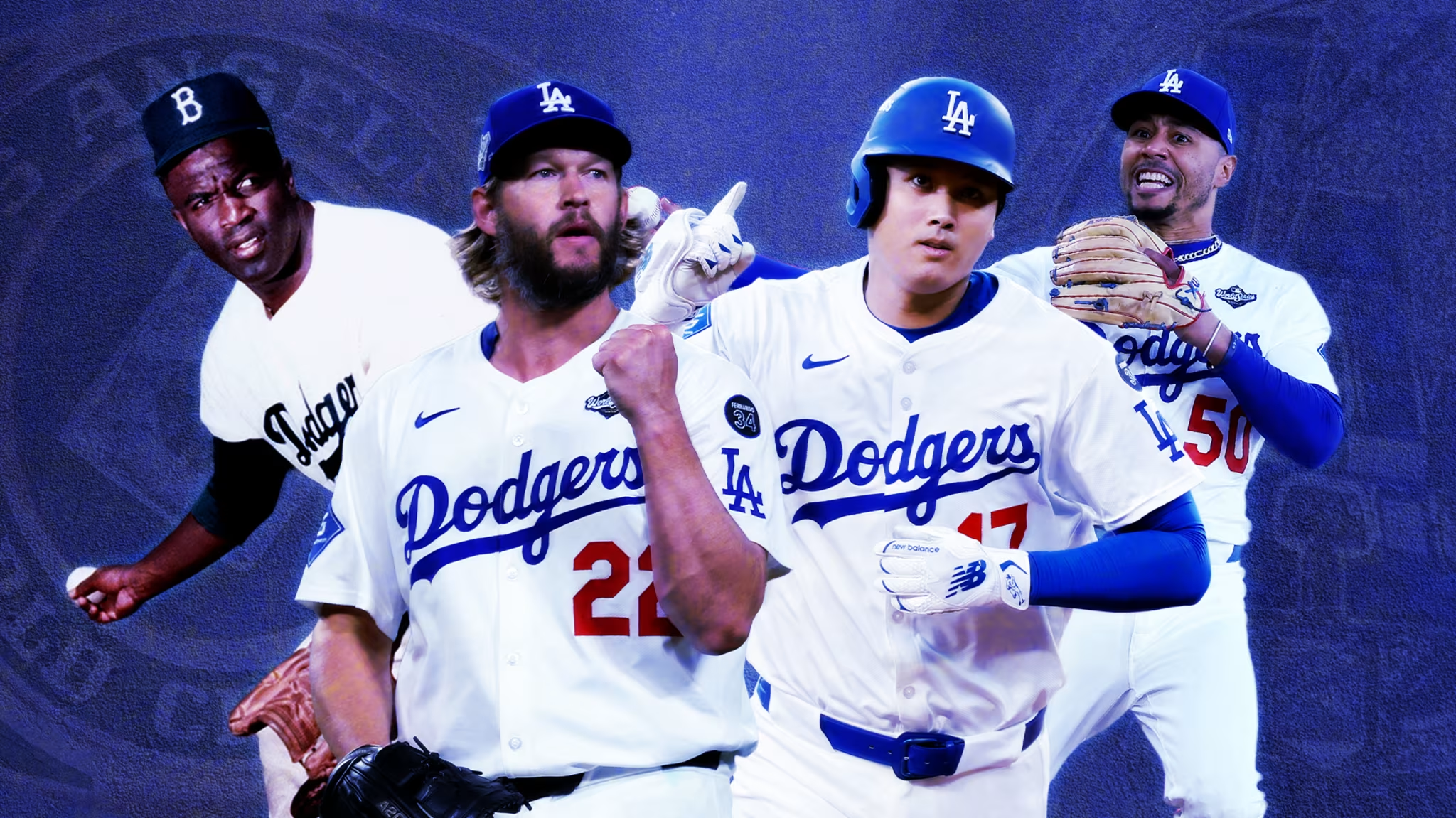
The Los Angeles Dodgers are one of the biggest brands in professional sports.
They play in an iconic stadium. They have their own color (Dodger blue) and hot dog (the Dodger dog), an iconic logo, and multiple nicknames. They are the Boys of Summer, Dem Bums, and Los Doyers. But more importantly, they are winners despite spending their early years in Brooklyn as the sport’s preeminent lovable losers.
The Dodgers have made 25 World Series appearances, good for second all time behind the New York Yankees’ 41, and have won nine World Series titles, tied for third most in MLB history, behind the Yankees (27) and the St. Louis Cardinals (11). They’re also favored to add to those totals as the Dodgers are the heavy favorites (+200) to win the 2026 World Series according to Fanatics Sportsbook; the Dodgers are aiming to become the first MLB team to three-peat since the 2000 New York Yankees.
How do they do it? Stars. From Duke Snider in the 1950s to Sandy Koufax in the 1960s to the current roster that features a trio of future Hall of Famers (Shohei Ohtani, Mookie Betts, and Freddie Freeman) and an embarrassment of riches in the starting rotation, the Dodgers have always been a star-driven franchise in a star-driven town.
But who is the best player to ever wear the uniform? These are the 30 Best Dodgers of All Time, Ranked.
Kirk Gibson
Seasons: 1988–1990
World Series Appearances: 1 (1988)
World Series Championships: 1 (1988)
Accolades: NL MVP (1988)
Kirk Gibson played just 310 regular season games in Dodger blue. But in that time he won an MVP award and hit the most dramatic home run in World Series history. Let’s set the scene: Dodger Stadium. Game 1 of the 1988 World Series. Bottom of the ninth. Two outs. Runner on. Gibson, who didn’t start due to injuriers to both legs, emerged from the dugout to pinch hit against Oakland A’s fireman Dennis Eckersley, the top closer in the game. He worked the count full, then yanked a 3-2 backdoor slider into the right field stands to give the Dodgers a 5-4 win; the Dodgers would go on to win the series in a gentleman’s sweep. Gibson didn’t have another at-bat in the series but he had already etched his name in Dodgers’ lore. —Thomas Golianopoulos
Matt Kemp
Seasons: 2006-2014, 2018
World Series appearances: 1 (2018)
World Series championships: 0
Accolades: 3-time All-Star (2011-2012, 2018), NL home run leader (2011), NL RBI leader (2011)
Kemp was the face of the franchise in the late 2000s and early 2010s. The five-tool outfielder peaked in 2011 when he hit .324, blasted 39 home runs, and drove in 126 runs. Kemp finished runner-up to Ryan Braun in National League MVP voting that year, although it was later revealed that Braun had used performance-enhancing drugs that season. Kemp was traded to the Padres in 2014, and briefly played for the Braves, before finding his way back to the Dodgers in 2018. No one was more excited about the move than Kemp. “You walk out and it’s just a different smell in LA,” Kemp told ESPN The Magazine that year. “Like the air is … you just feel good. The sun’s always shining. It barely rains. It’s just this city, man. The stadium, the atmosphere, the lights. There’s nothing like it.” —Matt Burke
Kenley Jansen
Seasons: 2010-2021
World Series appearances: 3 (2017, 2018, 2020)
World Series championships: 1 (2020)
Accolades: 3-time All-Star (2016-2018)
Jansen is still active in MLB and he currently ranks third on baseball’s all-time save list with 486, trailing only Mariano Rivera and Trevor Hoffman, all-time. It was the Dodgers front office that converted Jansen to a pitcher, as the franchise initially signed him as a catcher in 2004. The Curacaoan hurler excelled as the Dodgers’ closer from 2012 to 2021. He was at the peak of his powers in 2017 as he set a then-Major League record of 51 consecutive strikeouts without a walk. He led the National League in saves while with the Dodgers in 2017. Jansen was a part of the Dodgers’ World Series-winning club in 2020.—MB
Davey Lopes
Seasons: 1972-1981
World Series appearances: 4 (1974, 1977, 1978, 1981)
World Series championships: 1 (1981)
Accolades: 4-time All-Star (1978-1981)
Lopes was a mainstay for the Dodgers in the 1970s and early 80’s as he typically served as the team’s leadoff hitter. He was a menace on the basepaths leading MLB in steals in 1975 with 77 thefts. That season, he stole 38 consecutive bases without being caught. It was an MLB record that stood for 13 years. Lopes played 1,139 games at second base for the Dodgers. In 833 of those games, he was joined in the Dodgers infield by shortstop Bill Russell, third baseman Ron Cey, and first baseman Steve Garvey. The foursome owns the record for most games played together by an infield, according to the Elias Sports Bureau. Lopes came up huge in the 1977 postseason for the Dodgers. In the NLCS against the Phillies, he belted two homers and had a sparkling 1.278 OPS. In the World Series against the Yankees, he smashed three homers and posted a 1.011 OPS. —MB
Mike Piazza
Seasons: 1992–1998
World Series Appearances: 0
World Series Championships: 0
Accolades: 5x All-Star (1993–1997), N.L. ROY (1993)
The Los Angeles Dodgers famously selected Mike Piazza in the 62nd round of the 1988 MLB Draft as a favor to his father Vince Piazza, a childhood friend of longtime Dodgers manager Tommy Lasorda. Little did they know that he’d go on to become the best hitting catcher of all time. Piazza was an immediate sensation in Dodger blue, slugging 35 home runs, driving in 112 runs and slashing .318/.370/.561 en route to winning Rookie of Year. He’d average 33 HR and 105 RBI and bat. 337 in his five full seasons with the Dodgers. But the team traded the impending free agent in the spring of 1998 when it became apparent that the two sides were far apart in contract negotiations.—TG
Pedro Guerrero
Seasons: 1978-1988
World Series appearances: 3 (1978, 1981, 1988)
World Series championships: 2 (1981, 1988)
Accolades: 4-time All-Star (1981, 1983, 1985, 1987)
Guerrero is revered by Dodgers Nation, thanks in large part to his unforgettable performance in the 1981 World Series against the hated Yankees. The Dodgers were trailing New York, 1-0, through seven innings in Game 5 of that year’s Fall Classic. LA just couldn’t figure out Yankees left-hander Ron Guidry, but with one out in the eighth Guerrero broke through with a solo homer. The Dodgers’ Steve Yeager then added another solo shot as LA squeaked by with a 2-1 win. In a series-clinching Game 6, Guerrero was even better as he posted a home run, a triple, and a bases-loaded single in a 9-2 LA victory. Guerrero was named co-MVP (with Ron Cey and Yeager) of the ’81 World Series.—MB
Carl Furillo
Seasons: 1946–1960
World Series Appearances: 7 (1947, 1949, 1952, 1953, 1955, 1956, 1959)
World Series Championships: 2 (1955, 1959)
Accolades: 2-time All-Star (1952–1953) N.L. Batting Title (1953)
Though not as renowned as some of his teammates, Furillio was an essential member of the Boys of Summer, the late 1940s and 1950s Dodgers teams that captured the borough’s heart before breaking it with their move to the West Coast before the 1958 season. Nicknamed “The Reading Rocket” after his hometown (Reading, PA) and for his big arm, Furillo was also a stalwart in the Dodgers lineup, finishing his career among the franchise leaders in hits, runs, doubles, home runs, and runs batted in. —TG
Claude Osteen
Seasons: 1965–1973
World Series Appearances: 2 (1965, 1966)
World Series Championships: 1 (1965)
Accolades: 3-time All-Star (1967, 1970, 1973)
With a fastball topping out at 88 miles per hour, Claude Osteen likely wouldn’t make an MLB roster today. In fact, he probably wouldn’t be drafted. But that merely exposes the flaws in how pitchers are evaluated in 2026 (or it could explain how the game has simply evolved). Osteen relied on pinpoint control, smarts, and guile, and finished his Dodgers’ career in the top 10 for wins (147), games started, innings pitched, and shutouts. Legendary LA Times columnist Jim Murray once wrote that Osteen was “as dependable as sunset.” But he was more than just an innings eater. Overshadowed by Sandy Koufax and Don Drysdale, Osteen rescued the Dodgers after their dual aces dropped the first two games of the 1965 World Series to the Minnesota Twins. With their season on the line, Osteen threw a complete game shutout in the Dodgers’ 4-0 win to prove he was more than just a third wheel.—TG
Johnny Podres
Seasons: 1953–1955; 1957–1966
World Series Appearances: 5 (1953, 1955, 1959, 1963, 1965)
World Series Championships: 4 (1955, 1959, 1963, 1965)
Accolades: 3-time All-Star (1958, 1960, 1962), NL E.R.A. Leader (1957)
Less than a week after turning 24, Johnny Podres, a crafty southpaw from upstate New York, took the mound for the biggest game in franchise history. The Brooklyn Dodgers—Dem Bums, the lovable losers, perennial bridesmaids, World Series runner-up in 1947, 1949, 1952, and 1953—were facing the New York Yankees in Game 7 of the 1955 World Series. In Game 3, Podres went nine in the Dodgers’ 8-3 win. But Game 7 was a different animal. Podres, however, would not be overwhelmed by the moment. With the entire borough of Brooklyn watching, he threw a complete game shutout to clinch the Dodgers’ first World Series championship. Podres finished top 10 in franchise history in wins, games started, shutouts, and strikeouts, but will always be remembered for his clutch gem on the game’s biggest stage.—TG
Willie Davis
Seasons: 1960-1973
World Series appearances: 3 (1963, 1965, 1966)
World Series championships: 2 (1963, 1965)
Accolades: 2-time All-Star (1971, 1973)
Davis was an LA-guy through and through as he was a three-sport star at Theodore Roosevelt High School in the Boyle Heights area of Los Angeles. The speedy Davis was part of a changing of the guard in the Dodgers outfield in the early 1960s as he replaced Duke Snider in center field. Davis would roam center field at Chavez Ravine for 13 years. One of the fastest players of his generation, Davis recorded 20 or more stolen bases in 11 straight seasons. His career-high for a season came in 1964 when he swiped 42 bags. According to CooperstownExpert.com, Davis has the highest career WAR (60.7) of any player that has never appeared on the ballot for the Baseball Hall of Fame. —MB
Preacher Roe
Seasons: 1948-1954
World Series appearances: 3 ( 1949, 1952, 1953)
World Series championships: 0
Accolades: 4-time All-Star (1949-1952)
Famed Dodgers general manager Branch Rickey swung a trade for Roe in December of 1947. The move immediately paid dividends as Roe finished the 1948 season with a 12-8 record and an ERA of 2.63. Roe’s top season in Dodger blue came in 1951 as he went 22-3 on the season. The lanky lefty from Arkansas admitted after he retired that his “money pitch” was the outlawed “spitball.” Ever the character, Roe would throw a “fake spitball” whenever he thought the umpires or batters might be catching on. Roe came up huge for the Dodgers in the 1949 World Series against the Yankees as he threw a six-hit complete-game shutout in Game 2. It was Brooklyn’s only win in the five-game series. —MB
Don Newcombe
Seasons: 1949-51, 1954-58
World Series appearances: 3 (1949, 1955, 1956)
World Series championships: 1 (1955)
Accolades: 4-time All-Star (1949-1951, 1955), NL MVP (1956), NL Cy Young (1956), NL ROY (1949), MLB strikeout leader (1951)
Newcombe is one of the more under-appreciated players in baseball history. He was just the third African-American pitcher in the majors, following only Dan Bankhead and Satchel Paige. In his first season in Dodger blue in 1949, he led the league in shutouts and pitched 32 consecutive scoreless innings. This production earned him National League Rookie of the Year honors. “Newk’s” masterpiece season came in 1956 when he went 27-7 with a 3.06 ERA. He recorded 139 strikeouts and threw 18 complete games that season. It earned him the NL MVP award, and he was awarded the first-ever Cy Young award. Newcombe was the only player to win MVP, Cy Young, and Rookie of the Year until Justin Verlander completed the hat trick in 2011.—MB
Freddie Freeman
Seasons: 2022-present
World Series appearances: 2 (2024, 2025)
World Series championships: 2 (2024, 2025)
Accolades: 5-time All-Star (2022-26)
After winning the World Series with Atlanta in 2021, Freddie Freeman seemed well on his way to eventually reaching the Hall of Fame wearing a Braves hat. That offseason, Freeman and Atlanta couldn’t reach a deal on a new contract, and after the Braves traded for first baseman Matt Olson to replace him, Freeman signed with the Dodgers. Since joining the Dodgers, Freeman’s posted two of his three best seasons, won two World Series and a World Series MVP, and hit the only walk-off grand slam in World Series history. He’s 36 and has another year on his Dodgers contract, and it’s entirely possible he’ll go to Cooperstown wearing Dodger blue.—Jack Erwin
Don Sutton
Seasons: 1966-1980, 1988
World Series appearances: 4 (1966, 1974, 1977, 1978)
World Series championships: 0
Accolades: 4-time All-Star (1972, 1973, 1975, 1977), MLB ERA-leader (1980)
They often say that availability is the best ability, and the ever-durable Sutton was always there for the Dodgers. The righty never missed a turn in the rotation, making 756 starts. That is the third-most all-time behind only Cy Young and Nolan Ryan. Sutton won at least 11 games and struck out at least 125 batters in every season he pitched for the Dodgers during his first stint, from 1966 to 1980. He racked up 324 wins in his career, which ranks 14th in MLB history. Sutton became something of a celebrity in Los Angeles as he made appearances on the popular game show “Match Game.” After spending much of the 1980s pitching for other teams, Sutton returned to the Dodgers for one more season, in 1988. He made 16 starts for the ’88 team that won the World Series, but he was released in August of that season to make room for a rookie pitcher.—MB
Ron Cey
Seasons: 1971–1982
World Series Appearances: 4 (1974, 1977-1978, 1981)
World Series Championships: 1 (1981)
Accolades: 6-time All-Star (1974–1979), 1981 World Series MVP
Cey manned the Dodgers’ hot corner for over a decade as the linchpin of their All-Star infield, alongside Bill Russell, Davey Lopes, and Steve Garvey. Cey was the power hitter of the group as his 228 home runs are good for fifth all time in Dodgers’ history. He was also a proven postseason performer, winning the 1981 World Series co-MVP. With the Dodgers down 2 games to none, Cey helped swing the series with his performance in Game 3, slugging a three-run home run in the first inning and later triggering a double play with a diving catch of a Bobby Murcer bunt. —TG
Maury Wills
Seasons: 1959–1966; 1970–1972
World Series Appearances: 4 (1959, 1963, 1965, 1966)
World Series Championships: 3 (1959, 1963, 1965)
Accolades: 5-time All-Star (1961–1963, 1965–1966), 1962 N.L MVP
The Dodgers’ all-time leader in stolen bases was not some one-dimensional specialist. In addition to leading the league in swipes six times, Willis also provided Gold Glove caliber defense at shortstop (where he replaced Dodgers legend Pee Wee Reese) and averaged over 180 hits per season at the plate during his first stint on the team. He also came up big in the biggest moments. Case in point: Game 5 of the 1965 World Series. With the series tied, Willis scattered four hits, knocked in a run, and stole a base in the Dodgers’ 7-0 win. The Dodgers would later secure their fourth World Series title and the third of Willis’ career.—TG
Orel Hershiser
Seasons: 1983-1994, 2000
World Series appearances: 1 (1988)
World Series championships: 1 (1988)
Accolades: NL Cy Young Award winner (1988); NL wins leader (1988); 3-time All-Star (1987-1989)
Hershiser had an excellent six-year start to his career with the Dodgers, beginning with his rookie season in 1984 where he tied for the league lead in shutouts despite not becoming a full-time starter until July. But he’d probably make this list for his 1988 season alone, one of the greatest pitching seasons in baseball history. That year Hershiser went 23-8 with 15 complete games and eight shutouts, capped off by a 59-inning scoreless streak near the end of the season. The role of starting pitchers has changed dramatically since ‘88, but here’s yet another stat to prove it: In September of that year, Hershiser pitched five consecutive complete game shutouts; so far this season there have been a combined six thrown by every pitcher in MLB. Hershiser won the Cy Young, Gold Glove, NLCS MVP, and World Series MVP in 1988, and finished his Dodgers career 135-107 with a 3.12 ERA and 1,456 strikeouts.—JE
Steve Garvey
Seasons: 1969–1982
World Series Appearances: 4 (1974, 1977-1978, 1981)
World Series Championships: 1 (1981)
Accolades: 8-time All-Star (1974–1981) N.L. MVP (1974)
Garvey was a top third base prospect until the Dodgers realized that he had trouble making the long throws across the diamond. In 1973, they moved him to first base where he’d be a model of consistency and sustained excellence. Over the next nine seasons, he notched 200 hits six times, made eight All-Star teams, won four Gold Gloves, and set the NL record for consecutive games played. Garvey also excelled under pressure, batting .346 with 10 home runs 22 runs batted in and a .942 OPS in nine postseason series with the Dodgers. Though a fan favorite, Garvey departed for the San Diego Padres after the Dodgers refused to meet his contract demands. —TG
Zack Wheat
Seasons: 1909-1926
World Series appearances: 2 (1916, 1920)
World Series championships: 0
Accolades: NL batting champion (1918)
Wheat was one of the top hitters of his era as he hit over .300 in 13 of the 18 seasons he played with Brooklyn. The left fielder from Missouri drove in over 100 runs in 1922 and 1925, and he had a career-high hitting streak of 29 games in 1916. He was instrumental in getting the then-Brooklyn Robins to the World Series in 1916 and 1920. Wheat and the Robins fell to Babe Ruth’s Red Sox in 1916, 4-1, and then lost to the Cleveland Indians, 5-2, in a best-of-nine series. Wheat is the Dodgers’ franchise leader in hits, doubles, and triples. —MB
Mookie Betts
Seasons: 2020-present
World Series appearances: 3 (2020, 2024, 2025)
World Series championships: 3 (2020, 2024, 2025)
Accolades: 4-time All-Star (2021-2024)
In February 2020, the Red Sox inexplicably traded Betts—who’d won an MVP and World Series in Boston—to the Dodgers for prospects and luxury tax relief. Since coming to LA, all Betts has done is win three World Series, finish in the top 5 of MVP voting three times, win two Gold Gloves in the outfield, then switch positions in his age-30 season and become a finalist for the Gold Glove in the most demanding position on the diamond. By all accounts he’s a swell guy off the field as well, winning the Roberto Clemente Award in ‘25. Betts is going to the Hall of Fame, in all likelihood as a Dodger; the Red Sox have two wild cards, three last-place finishes, and a part-time catcher to show for their end of the trade. —JE
Gil Hodges
Seasons: 1943, 1947-1961
World Series appearances: 7 (1947, 1949, 1952, 1953, 1955, 1956, 1959)
World Series championships: 2 (1955, 1959)
Accolades: 8-time All-Star (1949-55, 1957)
A hero in New York for his role on two different teams, Hodges first came to prominence as the linchpin of the Brooklyn Dodgers’ iconic late ‘40s/early ‘50s “Boys of Summer” teams. Originally a catcher, Hodges became a Gold Glove first baseman, and hit 310 home runs in the 1950s, second only to teammate Duke Snider. Hodges won World Series with the Dodgers in both Brooklyn and LA, and began a managerial career immediately after retiring as a player. A beloved manager (he literally talked one of his players off a bridge), Hodges won another World Series leading the 1969 Miracle Mets, before dying of a heart attack at age 47 in 1972. There are two Dodgers with pieces of major New York City infrastructure named after them: Jackie Robinson (the Jackie Robinson Parkway between Brooklyn and Queens) and Hodges (the Gil Hodges Memorial Bridge, also connecting Brooklyn and Queens). —JE
Pee Wee Reese
Seasons: 1940-1942, 1946-1958
World Series appearances: 7 (1941, 1947, 1949, 1952, 1953, 1955, 1956)
World Series championships: 1 (1955)
Accolades: 10-time All-Star (1942, 1946–1954)
Reese was the heart-and-soul of the Dodgers during their glory days. The shortstop fielded the final ball hit by a Yankee in Game 7 of the 1955 World Series as he threw the ball to first baseman Gil Hodges to end that year’s Fall Classic. Reese’s Dodgers won, 2-0, to claim the first World Series title in franchise history. Reese was also at the center of one of the most impactful moments in baseball history. Legend has it that when Jackie Robinson was being heckled in Cincinnati, Reese left his shortstop position to go put his arm around Robinson in front of the jeering crowd. The act is commemorated by a statue that still stands at Maimonides Park in Brooklyn.—MB
Fernando Valenzuela
Seasons: 1980-1990
World Series appearances: 1 (1981)
World Series championships: 1 (1981)
Accolades: NL Cy Young (1981); NL Rookie of the Year (1981); 6-time All-Star (1981-1986); NL wins leader (1981); MLB strikeout leader (1986)
The perfect combination of athlete, city, and moment. Los Angeles was founded in 1781 when a group of people we’d today call Mexicans established El Pueblo de Nuestra Senora la Reina de Los Angeles on a plot of land about two miles from present day Dodger Stadium (built on land dispossessed from Mexican-Americans, fwiw). Two hundred years later, a pitcher from Sonora owned the city in the way very few athletes have ever owned a city. Just 20 years old, Valenzuela won both the Rookie of the Year and Cy Young awards in 1981 (the only player in MLB history who can claim that) and set off “Fernandomania” in LA, with each of his starts becoming pop culture events. The Dodgers won the World Series in ‘81, and Valenzuela would be an excellent pitcher for the next five seasons, finishing in the top 5 of Cy Young voting three more times. One of the most beloved Dodgers of all time, he was a color commentator for the team’s Spanish-language radio and TV for 20 years prior to his death at age 63 in 2024. —JE
Don Drysdale
Seasons: 1956-1969
World Series appearances: 5 (1956, 1959, 1963, 1965, 1966)
World Series championships: 3 (1959, 1963, 1965)
Accolades: 9-time All-Star, Cy Young award (1962), MLB wins leader (1962), MLB strikeout leader (1959, 1960, 1962)
Drysdale dominated the competition with his signature sidearm fastball. Standing at 6-feet-6 inches, “Big D” intimidated opponents, as he was never afraid to pitch inside. The Los Angeles native started the All-Star Game a record-tying five times. The most remarkable number that Drysdale posted came in 1968 when he pitched 58.2 straight scoreless innings. That record would stand for 20 years. During that scoreless stretch, Drysdale tallied six straight shutouts. The 1-2 punch of Drysdale and Sandy Koufax is considered one of the top pitching duos in baseball history. —MB
Roy Campanella
Seasons: 1948-57
World Series appearances: 5 (1949, 1952, 1953, 1955, 1956)
World Series championships: 1 (1955)
Accolades: 3-time NL MVP (1951, 1953, 1955); 8-time All-Star (1949-56); NL RBI leader (1953)
Trivia question: Who was the first Black player to play on a racially integrated team in America in the 20th Century? Hint: It’s a former Dodger (two actually), just not the one you think. Roy Campanella had started playing in the Negro Leagues when he was 15 and joined the Dodgers organization in 1946 when he was 24. That year Jackie Robinson was sent to the Dodgers top minor league club in Montreal, while Campanella and fellow Dodgers great Don Newcombe were sent to the Dodgers Class B team in Nashua, New Hampshire, making the Nashua Dodgers the first racially integrated team in America in the 20th Century.
But Campanella was more than just the answer to a trick trivia question. Campanella debuted with the Brooklyn Dodgers in 1948 and won the NL MVP Award in 1951, 1953, and 1955, hitting better than .300 with more than 30 home runs and 100 RBI in each of those seasons. Also a phenomenal defensive catcher, Campanella’s 57% caught stealing rate is still tops all time. Sadly, his career was cut short when he was just 37 after he was paralyzed from the neck down in a car accident before the 1958 season.—JE
Duke Snider
Seasons: 1947-62
World Series appearances: 7 (1947, 1949, 1952, 1953, 1955, 1956, 1959)
World Series championships: 2 (1955, 1959)
Accolades: 7-time All-Star (1950-56); NL RBI leader (1955); NL home run leader (1956)
Snider’s career spanned the Dodgers’ move from Brooklyn to LA, and he’s one of a handful of players (a lot of whom are on this list) to win chips on both coasts (‘55 in Brooklyn and ‘59 in LA). When he was in Brooklyn he was known as the “Duke of Flatbush,” and while his fellow New York centerfielders of the ‘50s—Willie Mays and Mickey Mantle—are justifiably more famous, Snider had a run of three seasons (‘53-’55) where he went toe-to-toe with the other two for the KONY title. Snider is still the franchise’s all-time leader in home runs and RBI. —JE
Shohei Ohtani
Seasons: 2024-present
World Series appearances: 2 (2024, 2025)
World Series championships: 2 (2024, 2025)
Accolades: 2 NL MVPs (2024, 2025); 3-time All-Star (2024-26); NL home run leader (2024); NL RBI leader (2024)
It’s a little absurd to think that a player with just two-and-a-half seasons with the team could be one of the best in the franchise’s 141-year history, but Shohei Ohtani is an absurd player. In those two-and-a-half years with the Dodgers, he’s accomplished the following:
- Became the first player in MLB history to hit 50+ home runs and steal 50+ bases in a season (2024)
- Had the best offensive season in Dodgers history (2024)
- Won back-to-back league MVPs
In his first (mostly) full season as a starting pitcher with the Dodgers, Ohtani would rank second in MLB for ERA (he’s fewer than 10 inning shy of qualifying); as a hitter he’s fourth in OPS. Combined, he’s on track to shatter the Dodgers record for Wins Above Replacement this season.
But here’s the stat that matters most to Dodgers fans: 2-2. In each of his two full seasons with the team, Shohei has lifted the World Series trophy after the final game. —JE
Clayton Kershaw
Seasons: 2008–2025
World Series Appearances: 5 (2017-2018, 2020, 2024-2025)
World Series Championships: 3 (2020, 2024–2025)
Accolades: 11x All-Star (2011–2017, 2019, 2022-2023, 2025), NL MVP (2014), NL CY Young (2011, 2013–2014), MLB S.O. Leader (2011), N.L. S.O. leader (2011, 2013), NL wins leader (2011), MLB wins leader (2014, 2017), MLB E.R.A. leader (2011-2014), NL E.R.A. leader (2017)
The best pitcher of his generation is also one of the greatest Dodgers of all time. A 6-foot 4-inch southpaw with a funky delivery, Kershaw dominated for 18 seasons, utilizing a four-seam fastball (that topped out at 96 MPH in his prime), a nasty slider, and his trademark Cooperstown Curve, a 12-to-6 breaking ball that kept hitters off balance. Back injuries and age took their toll but Kershaw still pitched at an elite level in the back nine of his career even as his fastball sat in the high 80s. He’s the Dodgers all-time leader in WHIP, strikeouts, and, it must be stated, postseason flameouts. Though he sported a career 2.53 regular season ERA, that number ballooned to 4.62 in the postseason. —TG
Sandy Koufax
Seasons: 1955-66
World Series appearances: 6 (1955, 1956, 1959, 1963, 1965, 1966)
World Series championships: 4 (1955, 1959, 1963, 1965)
Accolades: NL MVP (1963); 3-time Cy Young Award winner (1963, 1965, 1966); 3-time Triple Crown winner (1963, 1965, 1966); 3-time MLB wins leader (1963, 1965, 1966); 5-time NL ERA leader (1962-1966); 4-time MLB strikeout leader (1961, 1963, 1965, 1966); 6-time All-Star (1961-1966)
Sandy Koufax is one of the most famous names in baseball history, a shorthand for legendary pitching, but the fact that he’s so well known despite retiring at age 30 and not being very good for the first half of his career is a testament to just how good his six-season prime actually was.
Koufax broke into the majors with the Dodgers in 1955 when he was just 19 years old, but after the 1960 season he had a won-loss record of just 36-40 with an ERA close to 4.00. From 1961 until his retirement after the 1966 season, he went 129-47 with an ERA below 2.00. In that six-season span, he won three Cy Young Awards and an MVP, won the NL pitching Triple Crown (leading the league in wins, strikeouts, and ERA) three times, and pitched four no-hitters, including a perfect game. A deeply religious man, he famously refused to play in Game 1 of the 1965 because it fell on Yom Kippur; he pitched in Games 2, 5, and 7, throwing shutouts in 5 and 7 (the latter on two days rest) to win World Series MVP.—JE
Jackie Robinson
Seasons: 1947–1956
World Series Appearances: 6 (1947, 1949, 1952, 1953, 1955, 1956)
World Series Championships: 1 (1955)
Accolades: 6-time All-Star (1949-1954), N.L. Batting Title (1949), N.L. ROY (1947), N.L. MVP (1949)
The best Dodger of all time earned that title for what he accomplished both on and off the field. More than just a ballplayer, Jackie Robinson was a leader in the Civil Rights Movement and one of the most important Americans who ever lived. By now, the story is familiar: Before the 1947 season, Brooklyn Dodgers owner Branch Rickey selected Robinson, a multi-sport star at UCLA, to break baseball’s color barrier. He was incredibly talented but also sported traits like integrity and character. He encountered racism from fans, opponents, and even some of his opponents, yet would not be deterred or rattled. Over time, Robinson’s historical importance overshadowed the fact that he was a heckuva ballplayer. A lifetime .313 hitter with a .410 On Base Percentage, Robinson was an analytics darling before the term existed and he led the league in Wins Above Replacement three times during his ten-season career. His familiar no. 42 is the only jersey number permanently retired across MLB. —TG






